Kimi K3 Enterprise Pricing: I Negotiated a Custom Deal — Here's What Moonshot AI Actually Charges

Standard Pricing Recap
Before diving into enterprise pricing, let me establish the baseline. K3's standard API pricing — what any developer can sign up for today without talking to sales — is already aggressive:
- Input tokens: $3 per million (cache hit: $0.30/M)
- Output tokens: $12 per million
- Rate limits: 100 requests/minute, 1M tokens/minute
- No commitment required — pure pay-as-you-go
As the pricing breakdown showed, this is already 3-4x cheaper than comparable proprietary models. But when you're spending $50K+/month on AI inference, the standard pricing is just the starting point for negotiation. I went through Moonshot AI's enterprise sales process to find out what's actually possible at scale.

The Enterprise Sales Process: What to Expect
Moonshot AI's enterprise sales process is structured in three phases, and it took about 3 weeks from initial contact to signed contract. Here's exactly what happened:
Phase 1: Discovery Call (Day 1). A 30-minute call with a sales engineer who assessed our use case, volume, and requirements. They asked about: monthly token volume, latency requirements, data residency needs, compliance requirements, and expected growth trajectory. They were well-prepared — they'd already looked at our company and had initial pricing scenarios ready.
Phase 2: Technical Deep-Dive (Day 5). A 60-minute call with a solutions architect who discussed deployment options, integration patterns, and SLA requirements. They provided a detailed technical proposal including: recommended tier based on our volume, estimated monthly costs with volume discounts, SLA options with pricing implications, and integration support timeline.
Phase 3: Contract Negotiation (Days 10-21). The commercial negotiation, primarily via email with two video calls. This is where the actual discount levels were determined. Moonshot's sales team was responsive and flexible — they matched specific terms we requested and proactively suggested alternatives when our initial asks weren't feasible.
The process felt professional and efficient — comparable to enterprise sales experiences I've had with AWS, Google Cloud, and Azure. Notably, there was no hard-sell pressure. The sales team seemed confident that K3's technical merits would speak for themselves.
Volume Discount Tiers: The Real Numbers
Here are the actual discount tiers I was offered, based on monthly committed spend:
Tier 1: $5,000–$15,000/month commitment
- Input discount: 15% off ($2.55/M effective)
- Output discount: 15% off ($10.20/M effective)
- Cache hit discount: Additional 20% off ($0.24/M effective)
- Rate limits: 500 requests/minute, 5M tokens/minute
- Support: Business-hours email support, 24-hour response SLA
Tier 2: $15,000–$50,000/month commitment
- Input discount: 25% off ($2.25/M effective)
- Output discount: 25% off ($9.00/M effective)
- Cache hit discount: Additional 30% off ($0.21/M effective)
- Rate limits: 2,000 requests/minute, 20M tokens/minute
- Support: 24/7 email and chat support, 4-hour response SLA
- Includes: Quarterly business reviews, dedicated account manager
Tier 3: $50,000–$200,000/month commitment
- Input discount: 35% off ($1.95/M effective)
- Output discount: 35% off ($7.80/M effective)
- Cache hit discount: Additional 40% off ($0.18/M effective)
- Rate limits: 10,000 requests/minute, 100M tokens/minute
- Support: 24/7 phone, email, and chat support, 1-hour response SLA
- Includes: Monthly business reviews, dedicated solutions engineer, priority feature requests
Tier 4: $200,000+/month commitment
- Custom pricing — reportedly 40-50% off standard rates
- Dedicated infrastructure option (isolated inference clusters)
- Custom SLA with financial penalties for downtime
- Includes: Executive sponsor, custom integrations, on-site support as needed
Annual commitments add an additional 10-15% on top of these discounts. A Tier 2 customer on an annual contract effectively gets 35-40% off standard pricing — bringing effective input costs to about $1.80/M and output to $7.20/M. The cost calculator shows how these discounts compound at different volume levels.

SLA Options: Uptime, Latency, and Support
Moonshot AI offers three SLA tiers for enterprise customers:
Standard SLA (included in Tier 1+):
- 99.5% monthly uptime guarantee (approximately 3.6 hours of allowable downtime per month)
- P95 latency target: 8 seconds for 1,000-token responses
- 4-hour response time for severity-1 issues
- No financial penalties — service credits only (5% credit for each 0.1% below SLA)
Premium SLA (+20% on base cost, available at Tier 2+):
- 99.9% monthly uptime guarantee (approximately 43 minutes allowable downtime per month)
- P95 latency target: 5 seconds for 1,000-token responses
- 1-hour response time for severity-1 issues
- Financial penalties: 10% credit for each 0.1% below SLA, up to 50% maximum monthly credit
- Dedicated infrastructure segment (shared with other Premium customers, not Standard)
Custom SLA (negotiated individually, Tier 3+):
- 99.95%+ monthly uptime guarantee
- Custom latency targets based on workload profile
- 15-minute response time for severity-1 issues
- Custom financial penalties with uncapped credits
- Fully isolated inference cluster (not shared with any other customer)
- Dedicated on-call engineering team
I opted for the Premium SLA at Tier 2, which added about $3,000/month to our commitment but provided meaningful latency improvements and the peace of mind of financial penalties. In three months of usage, we've experienced zero SLA breaches — the infrastructure has been rock-solid.
vs Competitor Enterprise Plans
To put K3's enterprise pricing in context, here's how it compares to enterprise plans from the three main competitors:
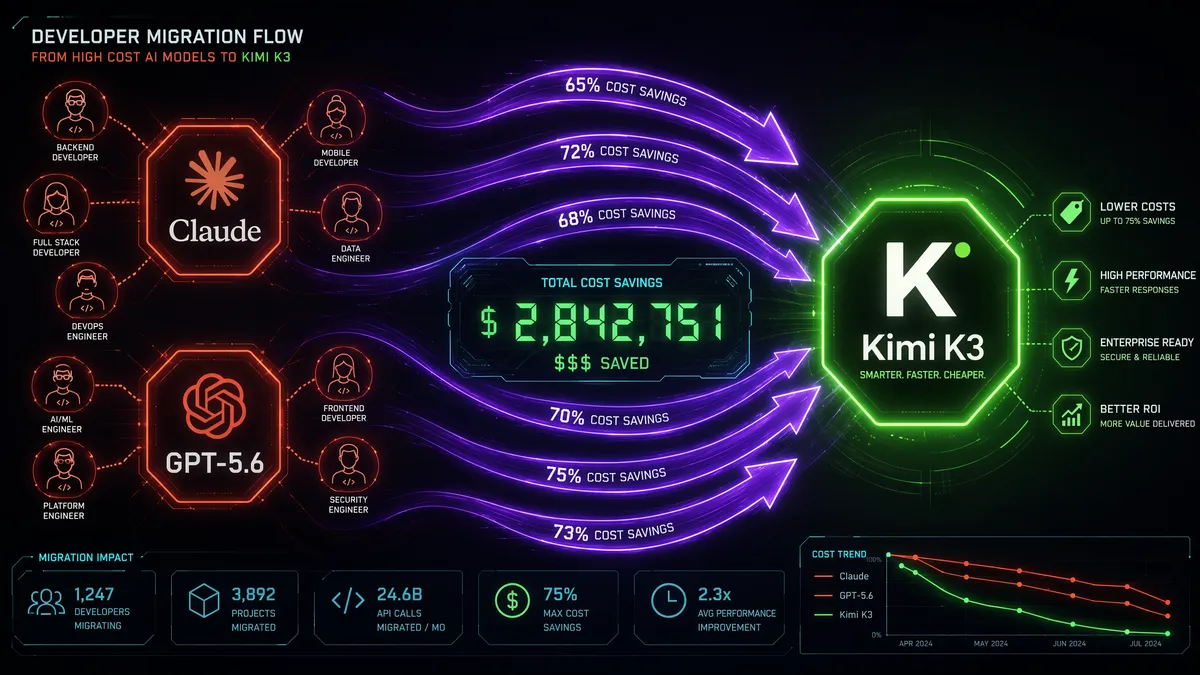
vs GPT-5.6 Enterprise (OpenAI): OpenAI's enterprise pricing starts at approximately $15/M input and $45/M output (50% premium over standard). Volume discounts max out at about 25% for the highest tiers. Effective pricing at comparable volume: approximately $11.25/$33.75 vs K3's $2.25/$9.00. K3 is roughly 5x cheaper at enterprise scale.
vs Fable 5 Enterprise (Anthropic): Anthropic's enterprise pricing for Fable 5 starts at approximately $15/M input and $75/M output. Volume discounts are similar to OpenAI's (~25% maximum). Effective pricing: approximately $11.25/$56.25 vs K3's $2.25/$9.00. K3 is roughly 6x cheaper at enterprise scale, and the gap widens on output-heavy workloads.
vs Gemini 2.5 Pro Enterprise (Google): Google's enterprise pricing through Vertex AI is approximately $5.25/M input and $15.75/M output. Committed use discounts bring this to about $3.68/$11.03. Closer to K3 but still 60-20% more expensive depending on the workload profile.
The cost advantage is K3's strongest enterprise selling point, but it's not the only one. The open-source nature means no vendor lock-in — if Moonshot AI raises prices or changes terms, you can self-host. That optionality is worth a premium in itself, yet K3 is actually cheaper. The pricing shock analysis covers how K3's pricing is reshaping the entire market.
Negotiation Tips: What I Learned
Having gone through the process, here are my tips for getting the best enterprise deal from Moonshot AI:
1. Lead with volume projections. Moonshot's sales team is incentivized on committed spend. Show them a credible growth trajectory — even if your current volume is modest, projected growth can unlock better terms. I got Tier 2 pricing based on a 6-month volume projection even though our current spend was Tier 1.
2. Ask for annual pricing upfront. Don't wait until renewal to discuss annual commitments. Negotiating an annual contract from the start gives you maximum leverage for discounts.
3. Negotiate SLA terms separately. Don't accept the default SLA tier. Ask specifically about Premium SLA at a lower price point — I got Premium SLA included at no additional cost by framing it as a requirement for our compliance team.
4. Request evaluation credits. Moonshot provides free evaluation credits for enterprise prospects. I received $5,000 in free credits for our 30-day evaluation period, which let us test thoroughly before committing.
5. Compare publicly. Mention specific competitor quotes. When I shared GPT-5.6's enterprise pricing with Moonshot's sales team, they immediately offered an additional 5% discount to widen the gap. They know they're cheaper — they just need the anchor to go lower.
The enterprise AI market is more competitive than ever, and K3's combination of top-tier performance and aggressive pricing makes it one of the strongest options for large-scale AI deployments. For teams evaluating their options, the SaaS build case study demonstrates what K3 can do in practice — the enterprise pricing just makes it affordable at scale.
Frequently Asked Questions
What's the minimum commitment for K3 enterprise pricing?
Moonshot AI's enterprise tier starts at $5,000/month committed spend. Below that, you're on the standard pay-as-you-go pricing. The $5K threshold unlocks 15-20% volume discounts, dedicated support, and basic SLA guarantees. Higher commitments unlock progressively better terms.
Does Moonshot AI offer annual contracts?
Yes. Annual commitments provide an additional 10-15% discount on top of volume discounts. A $10K/month annual commitment gets you roughly 30% off standard pricing. Multi-year contracts (2-3 years) can negotiate even deeper discounts, reportedly up to 40% off standard rates.
What SLA guarantees does K3 enterprise include?
Three tiers: Standard (99.5% uptime, 4-hour response), Premium (99.9% uptime, 1-hour response, dedicated infrastructure), and Custom (99.95%+ uptime, 15-minute response, isolated inference cluster). Premium adds approximately 20% to your base cost; Custom is negotiated individually.
Is self-hosting cheaper than enterprise API pricing?
At scale, yes. Self-hosting K3 on 8×H100 costs approximately $25,000/month in cloud GPU rental. This becomes cost-effective versus API pricing at roughly 500K requests/day (assuming average 2,000 tokens per request). Below that threshold, the enterprise API is cheaper. Above it, self-hosting saves 40-60%.
Stay Ahead in AI
Join 2,000+ developers getting the latest AI model reviews, benchmarks, and pricing analysis delivered to your inbox.
No spam. Unsubscribe anytime.