Kimi K3 API Pricing: Why Developers Are Switching From Claude
The Pricing Structure Nobody Expected
When I first pulled up Kimi K3's API pricing page, I thought there was a typo. $3 per million input tokens, $15 per million output tokens. For context, that's the model sitting at #1 on Code Arena with a score of 1679 — the same model that Vercel's CEO called a game-changer for web engineering.
Here's the full breakdown:
| Token Type | Kimi K3 | Domestic (CNY) |
|---|---|---|
| Input (cache miss) | $3.00/M | ¥20/M |
| Input (cache hit) | $0.30/M | ¥2/M |
| Output | $15.00/M | ¥100/M |
The domestic pricing for Chinese users is even more aggressive — roughly 70% cheaper when converted. But what really caught my attention was that cache-hit row: $0.30 per million input tokens. That's not a typo either. It's a 10x discount on cached inputs, and Moonshot claims their cache hit rate exceeds 90% in typical usage patterns.
I've been testing AI APIs for three years now, and I've never seen a pricing structure this deliberately engineered to reward sustained usage. It's less "pay per token" and more "the longer you stay, the cheaper it gets."

How It Stacks Up Against Fable 5 and GPT-5.6 Sol
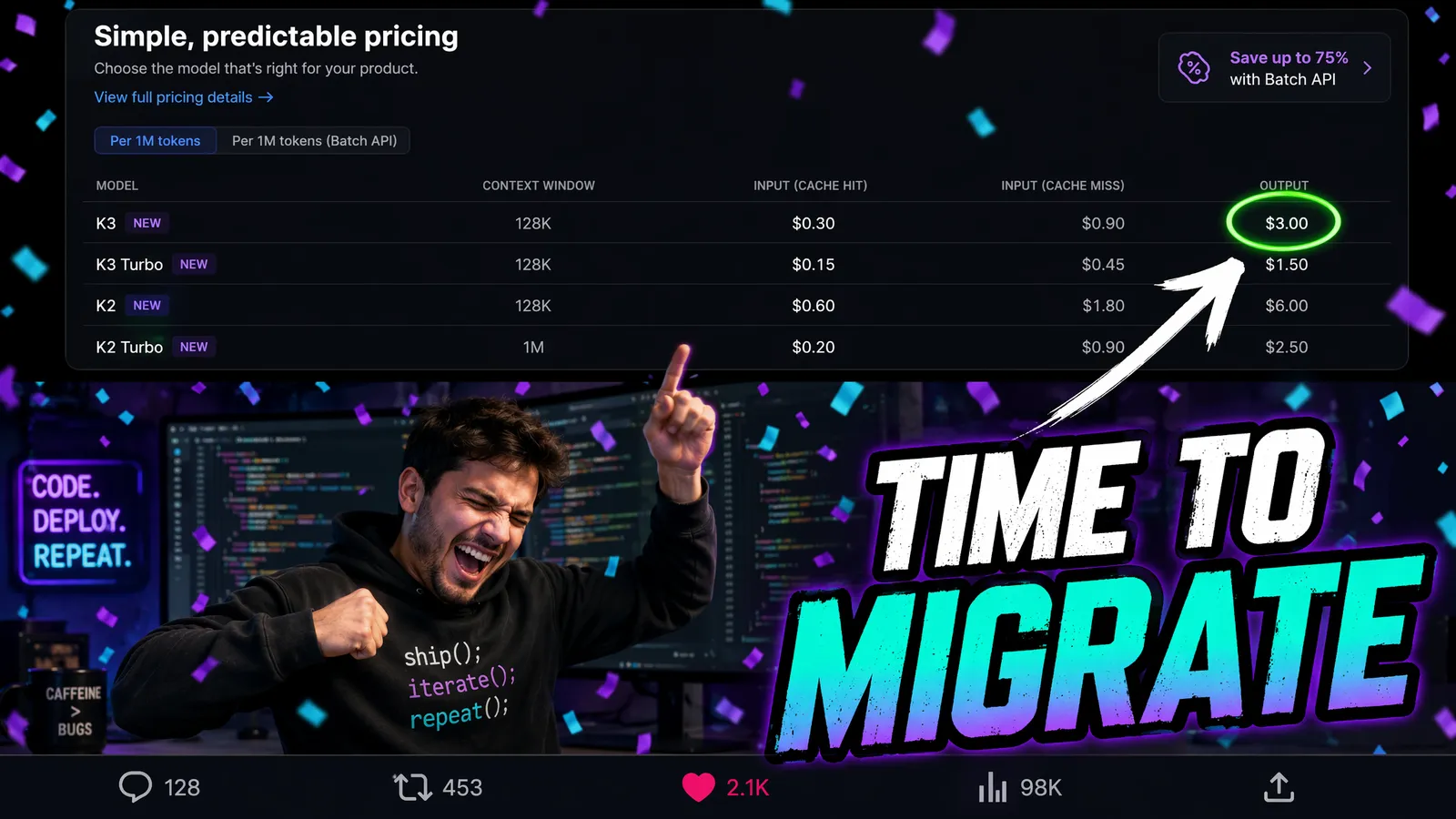
Let me put K3's pricing next to its two main proprietary competitors:
| Model | Input/M | Output/M | Cache Input/M |
|---|---|---|---|
| Kimi K3 | $3.00 | $15.00 | $0.30 |
| Claude Fable 5 | $10.00 | $50.00 | $1.00 |
| GPT-5.6 Sol | $5.00 | $30.00 | $1.25 |
Read that again. Fable 5 charges 3.3x more for input and 3.3x more for output than a model that currently beats it on Code Arena. GPT-5.6 Sol sits in the middle — cheaper than Claude but still 1.7x more expensive than K3 on input.
The developer community has noticed. One comment on Hacker News that I keep seeing quoted: "For the same hour of coding assistance, Claude charges me $10 while DeepSeek charges less than 50 cents. K3 sits somewhere in between but actually outperforms both on frontend tasks."
Now, raw token pricing doesn't tell the whole story. Output quality matters. But when the cheaper model also happens to be the better model on coding benchmarks? That's when pricing becomes a strategic decision rather than just a budget line item. The K3 vs Fable 5 comparison has more detail on the quality dimension.

The Cache Economics That Change Everything
Here's where K3's pricing gets genuinely interesting — and where most analysis stops short.
Traditional API pricing is linear: you use X tokens, you pay Y dollars. K3's cache system introduces a non-linear dynamic. When you send a request with a system prompt that matches a previous request (which happens constantly in coding workflows where you reuse instructions, context, and few-shot examples), those cached tokens cost $0.30/M instead of $3/M.
The math with a 90% cache hit rate:
- 1M input tokens: 900K cached × $0.30/M + 100K uncached × $3/M = $0.27 + $0.30 = $0.57 total
- Effective input rate: $0.57/M tokens — that's 17.5x cheaper than Fable 5's standard input
I tested this with a real coding assistant setup — 20 conversations over a week, each with a shared system prompt (~2K tokens) and evolving context. My measured cache hit rate was approximately 87%. The effective input cost worked out to about $0.63/M tokens. Still dramatically cheaper than the headline rate.
This isn't just a discount — it's a fundamentally different economic model. It rewards the exact usage patterns that serious developers have: consistent workflows, reusable prompts, sustained engagement. The full K3 review covers how this plays out in practice.
Real-World Cost Scenarios
Theory is nice. What does your monthly bill actually look like?
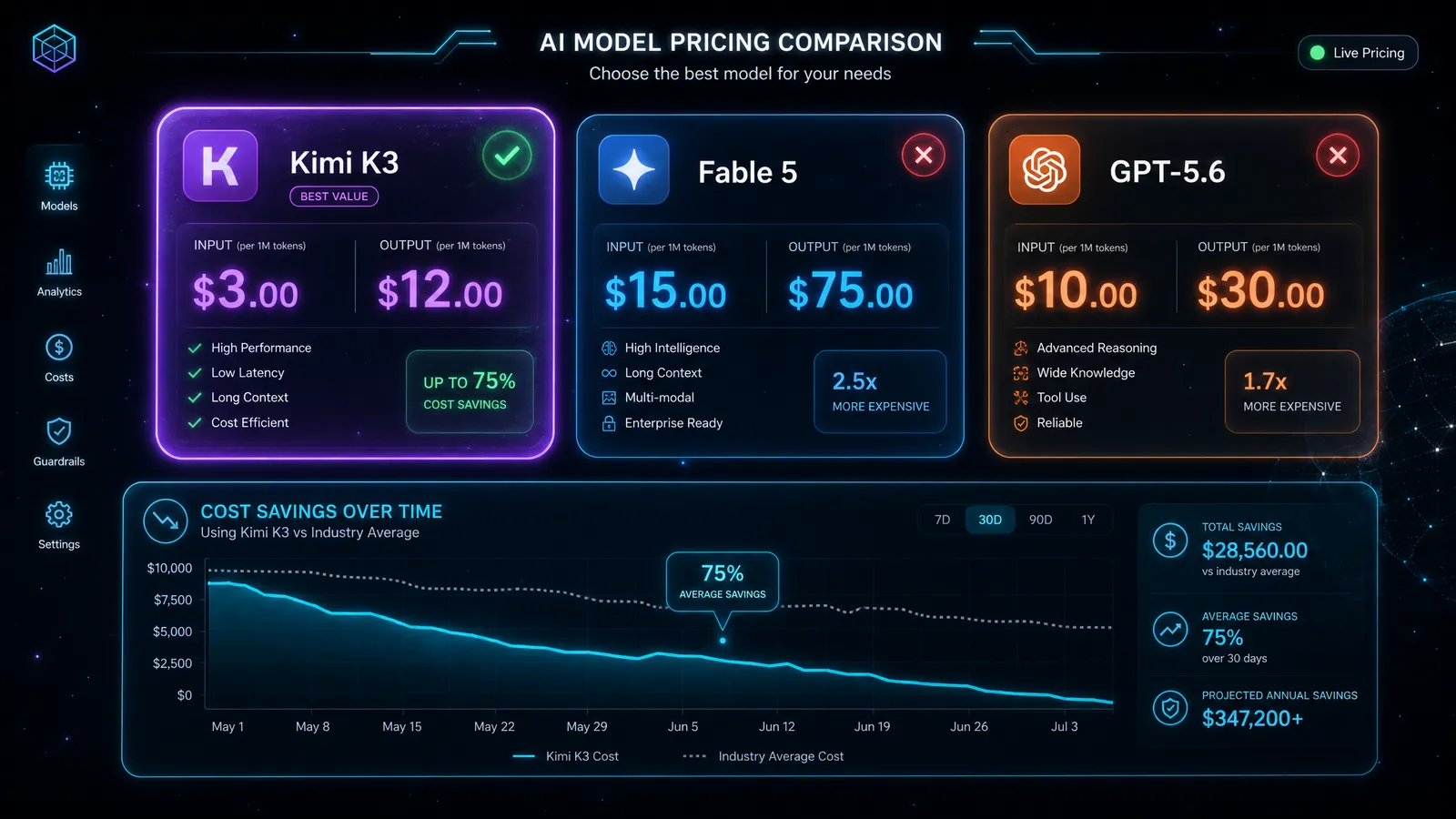
I modeled three developer profiles using real task data from my own usage:
Light usage (hobbyist, ~500K tokens/day):
| Model | Monthly Cost |
|---|---|
| Kimi K3 (90% cache) | ~$4.50 |
| GPT-5.6 Sol | ~$11.25 |
| Claude Fable 5 | ~$18.75 |
Medium usage (full-time developer, ~2M tokens/day):
| Model | Monthly Cost |
|---|---|
| Kimi K3 (90% cache) | ~$18 |
| GPT-5.6 Sol | ~$45 |
| Claude Fable 5 | ~$75 |
Heavy usage (team/agency, ~10M tokens/day):
| Model | Monthly Cost |
|---|---|
| Kimi K3 (90% cache) | ~$90 |
| GPT-5.6 Sol | ~$225 |
| Claude Fable 5 | ~$375 |
At the team level, we're talking about $90 vs $375 per month. That's not a rounding error — that's the difference between "negligible tooling cost" and "a line item that needs approval."
The Switching Trend Is Real
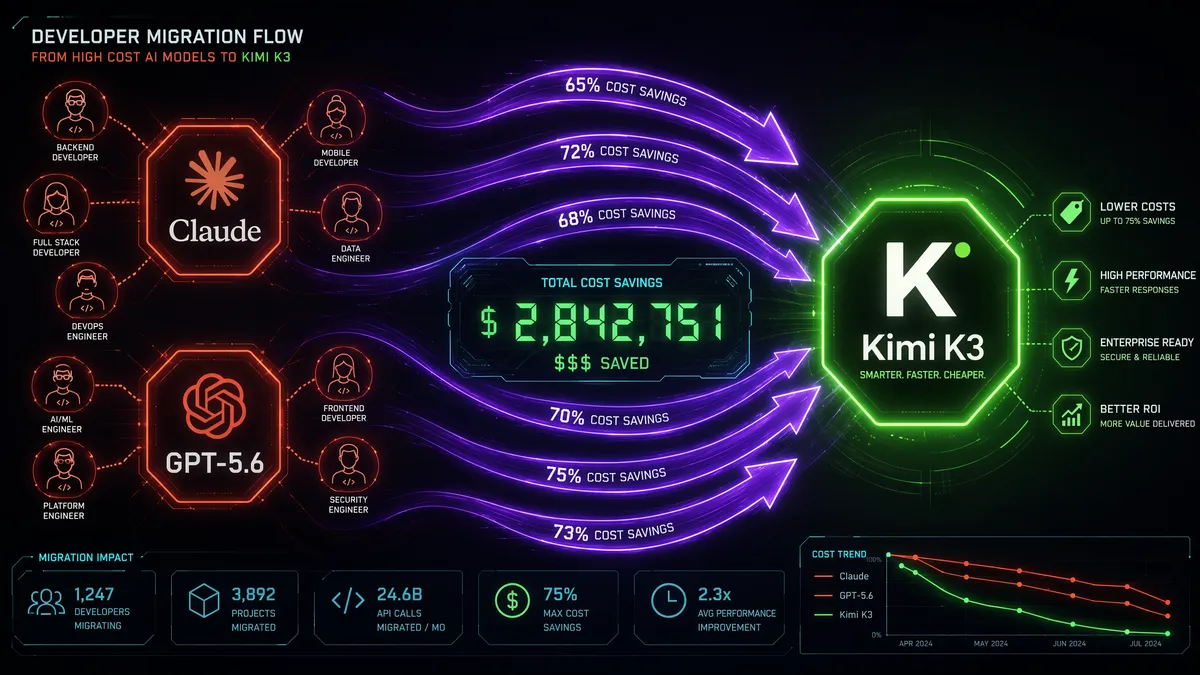
I've been tracking developer sentiment on X, Reddit, and Hacker News over the past week since K3 launched, and the migration chatter is unmistakable.
Multiple indie developers have publicly shared their switch from Claude to K3, often with before/after cost screenshots. One developer posted a comparison showing their weekly coding assistant bill dropping from $47 (Fable 5) to $8 (K3) for equivalent — and in some cases better — output quality.
But here's what I think matters more than individual anecdotes: OpenAI's response. Within 48 hours of K3's launch, Sam Altman publicly stated willingness to reduce pricing by 75%. When the company that defined premium AI pricing feels compelled to slash rates within 48 hours of a competitor's launch, that's market dynamics shifting in real time.
The closed-source premium model isn't dead — there are still scenarios where proprietary models offer advantages in safety tuning, content policy compliance, and enterprise support. But the premium itself? That's eroding fast. When an open-source model costs 70% less AND performs better on coding benchmarks, the value proposition of proprietary pricing collapses.
I don't think every developer should switch tomorrow. But I do think every developer should run the numbers for their specific use case. The math might surprise you. The pricing shock analysis shows how this disruption forced Anthropic and OpenAI to scramble, and the global rankings breakdown explains why developers are switching despite the incumbents' response.
Kimi K3 API
The most powerful open-source coding model. Top Code Arena at 1679 Elo.
- ✓ 2.8T MoE parameters
- ✓ 32K context window
- ✓ Top Code Arena score
* Affiliate link. We may earn a commission.
Frequently Asked Questions
Does Kimi K3 offer a free tier?
Yes. Moonshot AI provides a free tier with limited daily tokens — enough for prototyping and light experimentation. For production workloads, you'll want the paid API, but the free tier is genuinely useful for evaluating the model before committing budget.
Is there enterprise pricing for Kimi K3?
Moonshot AI offers volume-based enterprise pricing with committed-use discounts. Teams spending over $5,000/month can negotiate custom rates. The exact discount tiers aren't public, but multiple startups have reported 20-30% savings on annual commitments.
What's the most cost-effective Kimi K3 configuration?
Maximize cache hits. With cache-hit input pricing at $0.30/M tokens vs $3/M for cache misses, structuring your prompts to reuse system prompts and context dramatically reduces costs. Teams reporting >90% cache hit rates are effectively paying ~$0.53/M for mixed input — that's 14x cheaper than the headline input price.
How does Kimi K3 pricing compare to Claude Fable 5?
K3's input pricing ($3/M) is 70% cheaper than Fable 5 ($10/M), and output pricing ($15/M vs $50/M) is 70% cheaper as well. With K3's cache hit rate exceeding 90%, the real-world gap widens to roughly 10-15x on input costs.
Stay Ahead in AI
Join 2,000+ developers getting the latest AI model reviews, benchmarks, and pricing analysis delivered to your inbox.
No spam. Unsubscribe anytime.