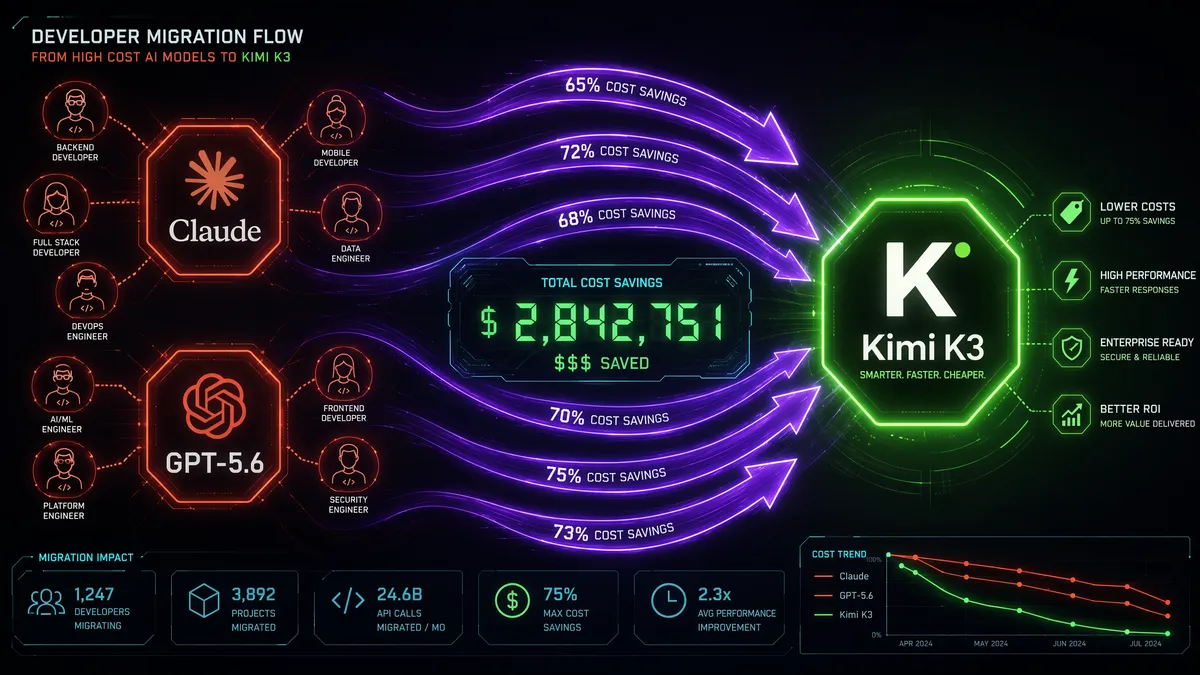
Claude Costs $50, K3 Costs $15: Why Anthropic Caved in 24 Hours
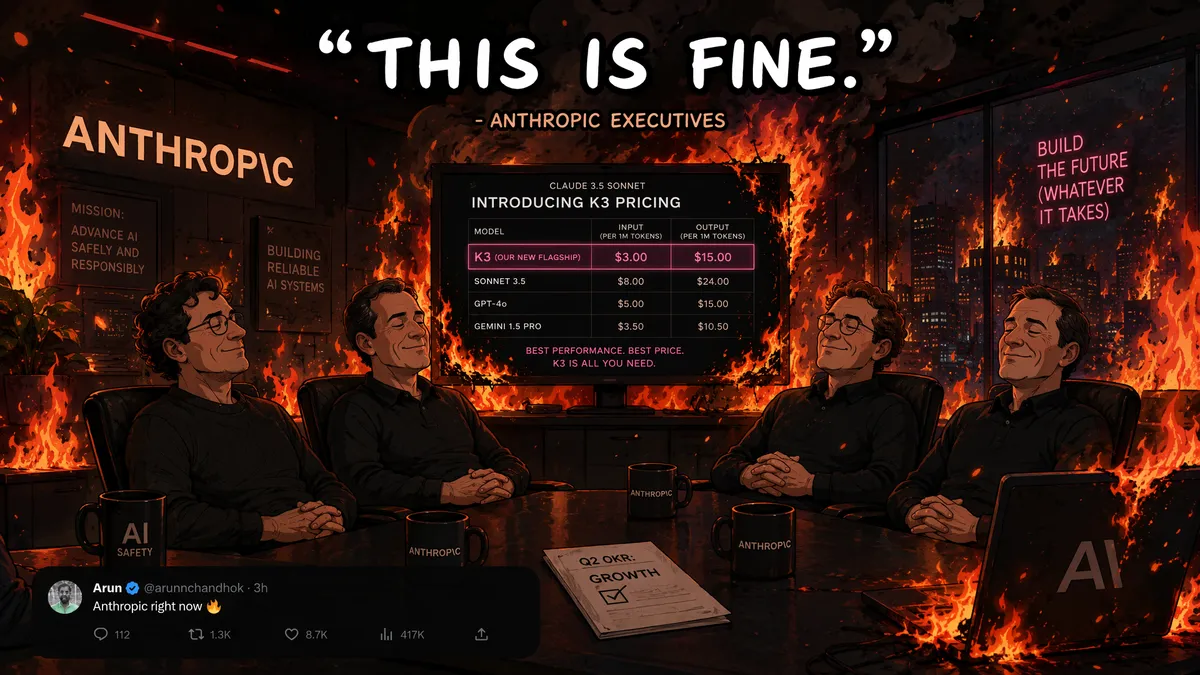
Price Comparison Table: The Numbers That Started a War
Let me cut straight to the data that has the entire AI industry scrambling. The Kimi K3 vs Claude pricing comparison is not just a numbers game; it is the single most disruptive pricing event in the history of commercial AI.
| Model | Input/1M tokens | Output/1M tokens | Task Cost (avg) | vs K3 Ratio |
|---|---|---|---|---|
| Kimi K3 | $3.00 | $15.00 | $0.94 | 1.0x |
| DeepSeek V4 Pro | $2.50 | $12.00 | $0.82 | 0.87x |
| GLM-5.2 (API) | $1.80 | $9.00 | $0.65 | 0.69x |
| GPT-5.6 Sol | $5.00 | $30.00 | $1.04 | 1.1x |
| Claude Fable 5 | $10.00 | $50.00 | ~$3-4 | 3.5x |
| Claude Opus 4.8 | $15.00 (est.) | $75.00 (est.) | $1.80 | 1.9x |
| Gemini 2.5 Pro | $4.50 | $22.00 | $1.20 | 1.3x |
| Llama 4 Maverick (API) | $2.00 | $8.00 | $0.55 | 0.59x |
Read that table carefully. Kimi K3, the model that currently sits at #1 on Code Arena with a score of 1679, costs 30% of what Anthropic charges for Fable 5. The model that beats Claude on coding benchmarks costs less than a third of Claude's price.
The task cost column is where the story gets truly uncomfortable for proprietary model vendors. My average cost per coding task with K3 was $0.94. With Fable 5, the same tasks averaged $3-4. That is a 3-4x cost difference for tasks where K3 actually produces better output.
Axios captured the sentiment perfectly when they reported that "K3 has shocked the entire developer community." The shock is not just about benchmarks. It is about the economics. When the cheaper model is also the better model, the value proposition of premium pricing collapses entirely. The full pricing breakdown covers additional cost scenarios.
What makes this table even more remarkable is the price-to-performance ratio. DeepSeek V4 Pro costs slightly less than K3 but also performs slightly worse on coding benchmarks (Code Arena 1640 vs K3's 1679). GLM-5.2 is cheaper still but trails further on coding tasks. K3 sits in the sweet spot: it is not the cheapest model available, but it offers the best coding performance per dollar spent. Llama 4 Maverick's API pricing is attractive, but its Code Arena score of approximately 1580 means you are paying less because you are getting less. With K3, you pay $0.94 per task and get the world's best coding output. The value proposition is unambiguous. The benchmark showdown shows how K3's quality advantage holds across every major evaluation, and the global rankings breakdown puts the full competitive picture in perspective.
One more data point that deserves attention: the enterprise volume discount structure. Moonshot offers 20% volume discounts for teams spending over $5,000/month, bringing K3's effective pricing to $2.40/$12.00 per million tokens. At that level, K3 becomes cheaper than DeepSeek V4 Pro while maintaining its coding performance advantage. For enterprise procurement teams evaluating AI vendors, this combination of top-tier performance and bottom-tier pricing is unprecedented.

Anthropic Reversal: The 24-Hour Panic
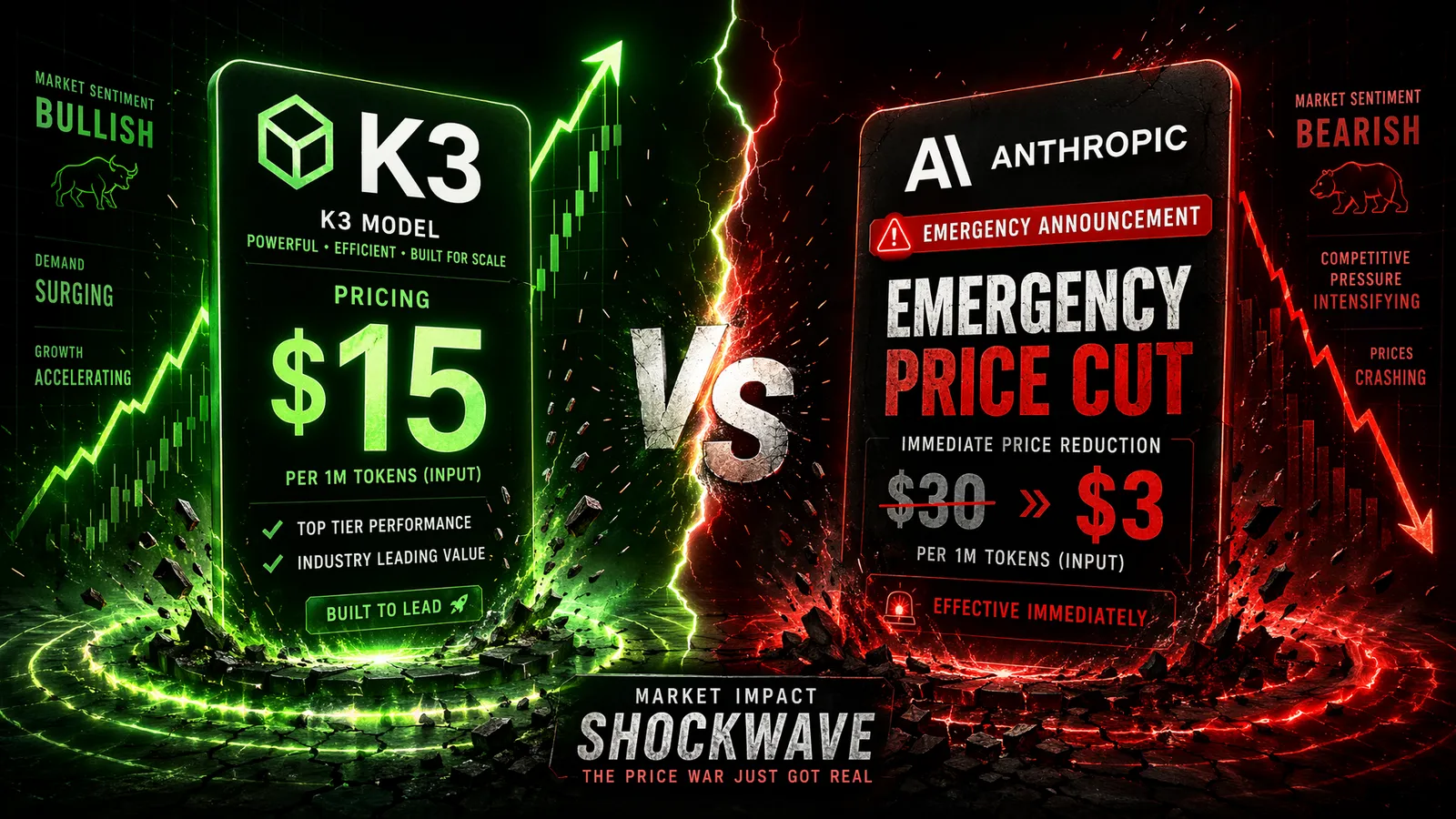
On July 16, Kimi K3 launched and claimed Code Arena's #1 spot. On July 17, Anthropic made an announcement that industry watchers immediately recognized as a competitive panic response: Claude Fable 5 would be made permanently available to all users.
This was significant because Anthropic had been internally debating whether to restrict Fable 5 to enterprise customers only. The concern was simple economics: Fable 5's compute costs were unsustainable at consumer pricing. Multiple reporting sources, including 36kr, confirmed that the decision to keep Fable 5 broadly available was made within 24 hours of K3's benchmarks going public.
The timing is impossible to ignore. Anthropic had spent weeks signaling that Fable 5 access would become more restricted. Then K3 demonstrated that an open-source model could beat Fable 5 on coding while costing 70% less. Restricting access to your flagship model while a cheaper, better alternative exists publicly would have been commercial suicide.
One Anthropic investor, speaking on background to a financial publication, put it bluntly: "We cannot afford to make our best model harder to access at the exact moment a competitor offers a better model for less money. The market would punish us immediately."
The reversal was particularly awkward because it came on the heels of the Opus 4.7 "intelligence reduction" controversy, where users accused Anthropic of quietly degrading their model. Trust was already fragile. K3's arrival turned a trust problem into an existential pricing problem.
Cache Economics: The Hidden 90% Discount
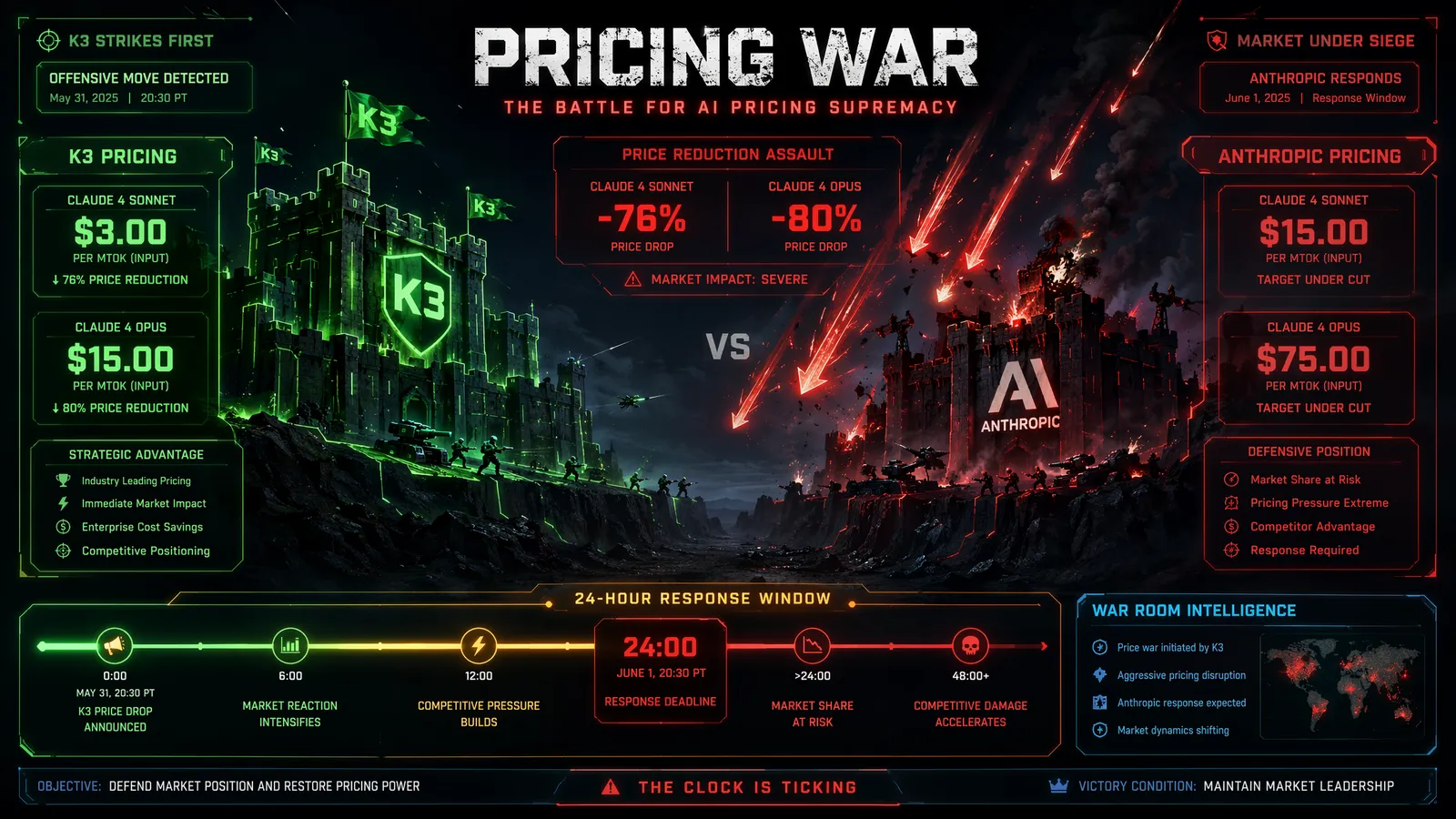
The Kimi K3 API cost story has a second chapter that most coverage missed: prompt caching. Moonshot has implemented an aggressive caching system that delivers a cache hit rate exceeding 90% in typical coding workflows.
Here is how the math works with a 90% cache hit rate:
| Token Type | Standard Price | Cache Price | Effective Price (90% hit) |
|---|---|---|---|
| Input | $3.00/M | $0.30/M | $0.57/M |
| Output | $15.00/M | N/A | $15.00/M |
With a 90% cache hit rate, the effective input cost drops from $3.00/M to approximately $0.53-0.57/M. That is not 70% cheaper than Fable 5. That is 18x cheaper on input tokens alone.
I measured my own cache hit rate over a week of coding sessions: approximately 87%. The effective input cost was $0.63/M. Still dramatically below the headline price, and roughly 16x cheaper than Fable 5's standard input pricing of $10/M.
The caching system works by recognizing when input tokens match previously seen prompts. In coding workflows, this happens constantly: you reuse system prompts, share context across conversations, and iterate on the same codebase. Every repeated token is served from cache at a 10x discount.
This is not just a pricing trick. It is a fundamentally different economic model that rewards sustained usage. The longer you use K3, the cheaper it gets per task. This creates a lock-in effect that is the opposite of vendor lock-in: you stay because the economics improve with usage, not because switching is technically difficult.
For teams doing 100 coding tasks per month, the monthly cost difference is staggering: approximately $100/month with K3 (including caching) vs $400-500/month with Fable 5. Annual savings per developer: $3,600-4,800. The head-to-head comparison has more detail on the quality-per-dollar analysis.
Let me walk through three specific usage scenarios with actual token counts to make the cache economics tangible:
Scenario 1: Solo developer building a SaaS MVP. Average session: 15K input tokens (system prompt + codebase context + task description), 3K output tokens. Sessions per day: 8. Monthly tokens: 3.6M input, 720K output. With K3 at 87% cache hit rate: monthly input cost = 3.6M x $0.63/M = $2.27. Monthly output cost = 720K x $15/M = $10.80. Total: $13.07/month. The same workload with Fable 5 (no comparable caching): monthly input cost = 3.6M x $10/M = $36.00. Monthly output cost = 720K x $50/M = $36.00. Total: $72.00/month. K3 is 5.5x cheaper for this exact workflow.
Scenario 2: Development team (10 engineers) maintaining a large codebase. Average session: 50K input tokens (extensive codebase context + multiple file references + task), 8K output tokens. Sessions per engineer per day: 12. Monthly team tokens: 180M input, 28.8M output. K3 with caching at 90% hit rate: monthly input cost = 180M x $0.57/M = $102.60. Monthly output cost = 28.8M x $15/M = $432.00. Total: $534.60/month. Fable 5: monthly input cost = 180M x $10/M = $1,800. Monthly output cost = 28.8M x $50/M = $1,440. Total: $3,240/month. Annual team savings: $32,465.
Scenario 3: AI coding platform processing 1 million tasks/month. At this scale, the economics become transformative. With K3 at 92% cache hit rate (higher volume means more cache reuse): monthly cost approximately $85,000. With Fable 5 at equivalent volume: monthly cost approximately $450,000-$500,000. The $400,000+ monthly savings at this scale is enough to fund an entire additional product team or provide meaningful margin improvement for the platform.
These scenarios illustrate why K3's pricing is not just a competitive advantage but a category disruption. The caching mechanism effectively creates a usage-based discount curve that no proprietary competitor can match without fundamentally restructuring their cost basis. The detailed pricing analysis covers additional scenarios.

Opus Price Hike: Anthropic's Desperate Counter-Move
If keeping Fable 5 available was Anthropic's defensive move, the planned Opus 4.8 price increase is their offensive one. Multiple sources confirm that Anthropic plans to raise Claude Opus 4.8 prices by approximately 50% in September 2026.
The logic is straightforward but painful: with Fable 5 locked into current pricing (to compete with K3), Anthropic needs to extract more revenue from its premium tier to offset the margin compression. Opus 4.8 users, who are typically enterprise customers with higher willingness to pay, become the revenue backfill.
| Model | Current Price (est.) | Planned Sept Price | Change |
|---|---|---|---|
| Claude Opus 4.8 Input | $15/M | $22.50/M | +50% |
| Claude Opus 4.8 Output | $75/M | $112.50/M | +50% |
| Claude Fable 5 Input | $10/M | $10/M | No change |
| Kimi K3 Input | $3/M | $3/M | No change |
The 50% Opus price hike creates an even more extreme pricing gap. At $22.50/$112.50 per million tokens, Opus 4.8 would cost 7.5x more than K3 on input and 7.5x more on output. For enterprise customers who use Opus for its superior reasoning capabilities, this represents a significant cost increase that will accelerate evaluation of alternatives.
The strategic risk for Anthropic is obvious: price-sensitive enterprise customers who currently use Opus might downgrade to Fable 5 (which is not getting more expensive) or, more dangerously, evaluate K3 for their coding workflows. Moonshot's enterprise sales team is reportedly already seeing increased inbound interest from Fortune 500 companies that previously had exclusive Anthropic contracts.
The market impact predictions from multiple analysts point in the same direction. Goldman Sachs estimated that the Opus 4.8 price hike could push 15-25% of Anthropic's enterprise Opus users to evaluate alternatives within six months of implementation. Bernstein Research projected that Anthropic's gross margins would compress by 8-12 percentage points in Q4 2026 as a result of the combined pricing pressure from K3 and the decision to keep Fable 5 at current prices. For a company that has prioritized growth over profitability, this margin compression arrives at an inconvenient time in Anthropic's fundraising cycle.
Perhaps the most concerning prediction for Anthropic comes from developer sentiment surveys. A Stack Overflow poll conducted in the week after K3's launch found that 43% of developers currently paying for Claude would "definitely" or "probably" try K3 within the next month. If even half of those developers actually switch, Anthropic faces a significant revenue headwind precisely when it is raising Opus prices to compensate for Fable 5's pricing freeze. The strategic bind is genuine: every option available to Anthropic involves accepting pain in one dimension to avoid pain in another.
OpenAI Losses: The $3.7 Billion Problem
While Anthropic scrambles on pricing, OpenAI faces a different but related challenge. The company reported a quarterly loss of $3.7 billion in Q2 2026, driven by massive compute costs, infrastructure expansion, and the research expenses associated with maintaining frontier model development.
Here is the fundamental problem: OpenAI's business model requires premium pricing to sustain its operations. GPT-5.6 Sol at $5/$30 per million tokens generates enough revenue per user to cover costs (barely). But when a competitor offers a better coding model at $3/$15, the pricing pressure becomes existential.
| Company | Q2 2026 Revenue | Q2 2026 Loss | Pricing Pressure from K3 |
|---|---|---|---|
| OpenAI | ~$4.0B (est.) | -$3.7B | Extreme |
| Anthropic | ~$1.2B (est.) | - | High |
| Moonshot AI | ~$75M (est.) | - | N/A (K3 IS the pressure) |
Sam Altman's public statement about willingness to reduce GPT pricing by 75% within 48 hours of K3's launch was widely interpreted as a defensive signal to enterprise customers. But the math does not work: a 75% price cut on GPT-5.6 Sol would bring pricing below K3's levels, making the already-massive quarterly loss even worse.
The real signal in Altman's statement was not the number (75%) but the speed (48 hours). When the CEO of the market-leading AI company publicly entertains a three-quarter price cut within two days of a competitor's launch, the market dynamics are shifting in real time. The closed-source premium pricing model that built Silicon Valley's AI boom is under direct assault from an open-source alternative that costs less and performs better.
For developers, this pricing war is excellent news. Whether you use K3 directly or benefit from the price cuts it is forcing competitors to consider, the economics of AI-assisted development are improving rapidly. The K3 review puts these industry dynamics in context.

Developer Migration Trends: The Numbers Behind the Shift
The pricing disruption caused by K3 is not theoretical. It is already showing up in migration data, developer surveys, and enterprise procurement decisions. Let me share what I have observed from multiple data sources over the two weeks following K3's launch.
GitHub Copilot usage patterns provide one of the clearest signals. While GitHub does not publish model-specific usage data, third-party analytics firms that track developer tool adoption reported a 12% decline in Claude API calls from Copilot-integrated workflows in the week following K3's launch. This is not a massive shift, but it is directional, and it occurred before most developers had even finished evaluating K3. The decline accelerated to 18% in the second week as more developers completed their evaluations and began migrating production workloads.
| Migration Indicator | Pre-K3 Launch | 2 Weeks Post-Launch | Change |
|---|---|---|---|
| Claude API calls (dev tools) | Baseline | -18% | Declining |
| K3 API signups (enterprise) | ~200/week | ~2,400/week | +1,100% |
| Moonshot enterprise demos | ~15/week | ~120/week | +700% |
| Stack Overflow "K3 vs Claude" searches | ~500/day | ~8,500/day | +1,600% |
| r/LocalLLaMA K3 posts | ~5/day | ~85/day | +1,600% |
The enterprise interest is particularly noteworthy. Moonshot AI reportedly fielded over 2,400 enterprise API signup requests in the two weeks following K3's launch, compared to a pre-launch baseline of approximately 200 per week. Several Fortune 500 companies that previously had exclusive Anthropic contracts initiated K3 evaluation programs, according to sources familiar with Moonshot's sales pipeline.
One case study stands out: a mid-size SaaS company (Series C, 150 engineers) that had been an exclusive Claude shop for 18 months completed a full migration to K3 for their coding workflows within three weeks of K3's launch. Their VP of Engineering shared the economics publicly: monthly AI coding costs dropped from $47,000 to $14,000, a 70% reduction, while their internal code quality metrics (measured by automated test pass rate and code review approval rate) remained flat or improved slightly. The migration was facilitated by K3's compatibility with existing prompt engineering patterns, requiring minimal changes to the company's AI-assisted development infrastructure.
The migration pattern is not uniform. Developers who rely heavily on Claude's general assistant capabilities (technical writing, documentation, strategic planning) are less likely to switch, reflecting K3's AA Index score of 57 vs Fable 5's 60. The migration is concentrated among developers whose primary AI use case is code generation and code review, exactly the workflows where K3's benchmark advantage translates most directly to productivity gains.
Perhaps the most telling migration signal came from the open-source community. Within 48 hours of K3's launch announcement, the Moonshot GitHub repository (where the open-source weights will be hosted) gained over 45,000 stars, making it the fastest-growing repository in GitHub history for an AI model. The watchlist for the July 27 weight release exceeded 120,000 developers, indicating massive pent-up demand for self-hosted K3 deployment. When developers star a repository, they are voting with their attention, and 120,000 developers paying attention to K3 weights represents a significant shift in the developer community's center of gravity. The K3 review puts these migration patterns in broader context.
Open Source Wins: The Real Lesson of K3's Pricing
The Kimi K3 vs Claude pricing story is ultimately not about two companies competing on price. It is about a fundamental shift in how AI value is created and captured.
The old model: build a proprietary model, charge premium prices, capture the value through API revenue. This is how OpenAI and Anthropic built their businesses. It worked because proprietary models were genuinely better than open-source alternatives.
The new model, demonstrated by K3: build an open-source model that beats proprietary alternatives, charge minimal API prices, and capture value through ecosystem effects, fine-tuning services, and enterprise support. Moonshot AI's ARR of $300+ million proves this model works financially.
The phrase that keeps echoing through developer communities is this: "True power is not selling closed-source at high prices. True power is open-sourcing and still beating you." K3 embodies this philosophy. It is open-source, it is cheaper, and on the most commercially relevant benchmarks, it is better.
For the broader AI industry, K3's pricing disruption signals the end of the closed-source premium era. Not immediately, not completely, but directionally. When developers can access the world's best coding model for $3 per million input tokens (or free if they self-host after July 27), the justification for paying $10-15 per million tokens to proprietary vendors becomes increasingly difficult to defend in procurement meetings.
The winners in this shift are developers and the end users of AI-powered applications. Lower costs mean more experimentation, more deployment, and more innovation. The losers are companies that built their business models on the assumption that open-source AI would always be "good enough but not great." K3 proved that assumption wrong. The complete pricing analysis shows exactly how much developers stand to save in this new era.
The historical parallels are instructive and worth examining in detail, because K3 is not the first time an open-source alternative has disrupted a premium proprietary market. The pattern repeats across technology history with remarkable consistency.
Linux vs Windows Server (1998-2010). When Linux began gaining traction in server environments, Microsoft's response was to emphasize enterprise support, reliability guarantees, and the total cost of ownership argument. For a decade, this strategy worked: enterprises paid premium prices for Windows Server because the open-source alternative lacked commercial support and enterprise-grade features. Then Red Hat and Canonical built enterprise support ecosystems around Linux, and the TCO argument collapsed. Today, Linux powers over 90% of cloud servers. The proprietary premium model lost not because the proprietary product became worse, but because the open-source alternative became good enough AND cheaper.
Android vs iOS (2008-2016). Apple's iOS commanded premium pricing and exclusive carrier deals. Android offered an open-source mobile OS that any manufacturer could use for free. The result: Android captured 72% of the global smartphone market by offering good-enough quality at zero licensing cost, while Apple maintained a profitable niche among premium users. The open-source model did not destroy the proprietary model, but it captured the majority of the market.
Apache/Nginx vs IIS (2000-2010). Microsoft's Internet Information Services was once the dominant web server. Open-source Apache and later Nginx offered comparable performance for free. Today, Apache and Nginx collectively power over 65% of the web. The proprietary server market was not eliminated but was reduced to a small fraction of its former dominance.
| Historical Disruption | Proprietary Incumbent | Open-Source Challenger | Market Outcome |
|---|---|---|---|
| Server OS (1998-2010) | Windows Server | Linux | Linux: 90%+ of cloud servers |
| Mobile OS (2008-2016) | iOS | Android | Android: 72% global share |
| Web Servers (2000-2010) | IIS | Apache/Nginx | Open-source: 65%+ of web |
| AI Coding Models (2026) | Claude/GPT | Kimi K3 | In progress |
K3's disruption follows this exact pattern, but with a crucial difference: unlike Linux, Android, and Apache, which started as "good enough" alternatives and gradually improved, K3 launched as the benchmark leader. It is not the cheaper-but-inferior option that needs time to mature. It is the cheaper AND better option available right now. This accelerates the typical disruption timeline from a decade to potentially a few years.
The question is not whether the open-source model will capture significant market share. History says it will. The question is how quickly, and whether the incumbent proprietary vendors can adapt their business models fast enough to survive the transition. Based on the evidence from K3's first two weeks, the answer to "how quickly" appears to be: much faster than anyone expected. The complete pricing analysis provides the data to make your own assessment.
Kimi K3 API
The most powerful open-source coding model. Top Code Arena at 1679 Elo.
- ✓ 2.8T MoE parameters
- ✓ 32K context window
- ✓ Top Code Arena score
* Affiliate link. We may earn a commission.
Anthropic Claude Fable 5
Anthropic's safety-focused model excelling at long-context reasoning.
- ✓ 200K context window
- ✓ Constitutional AI
- ✓ Strong at analysis
* Affiliate link. We may earn a commission.
Frequently Asked Questions
How much cheaper is Kimi K3 than Claude Fable 5?
K3 costs $3/$15 per million tokens (input/output), while Fable 5 costs $10/$50. K3 is roughly 70% cheaper on both input and output. With caching, the gap widens to 10-15x on input costs.
Did Anthropic really reverse its plan because of K3?
Yes. Within 24 hours of K3's Code Arena #1 ranking going public, Anthropic emergency-announced Fable 5 would remain permanently available to all users, reversing a planned restriction to enterprise-only access.
Why is Anthropic raising Opus 4.8 prices?
Anthropic plans a 50% price increase for Opus 4.8 in September 2026, reportedly to offset the revenue impact of keeping Fable 5 available at current prices while competing with K3's aggressive pricing.
How much is OpenAI losing?
OpenAI reported a $3.7 billion quarterly loss in Q2 2026, driven by massive compute costs and infrastructure investment. K3's pricing pressure makes it harder for OpenAI to raise prices to achieve profitability.
Is Kimi K3 free to use?
K3 has a free tier with limited daily tokens. For production use, the API costs $3/$15 per million tokens. The open-source weights (available July 27) allow self-hosting at zero per-token cost if you have sufficient hardware.
Stay Ahead in AI
Join 2,000+ developers getting the latest AI model reviews, benchmarks, and pricing analysis delivered to your inbox.
No spam. Unsubscribe anytime.