Kimi K3 vs Claude Fable 5: Same Code, 6x the Price Difference
Pricing Comparison: The 6x Gap That Changes Everything
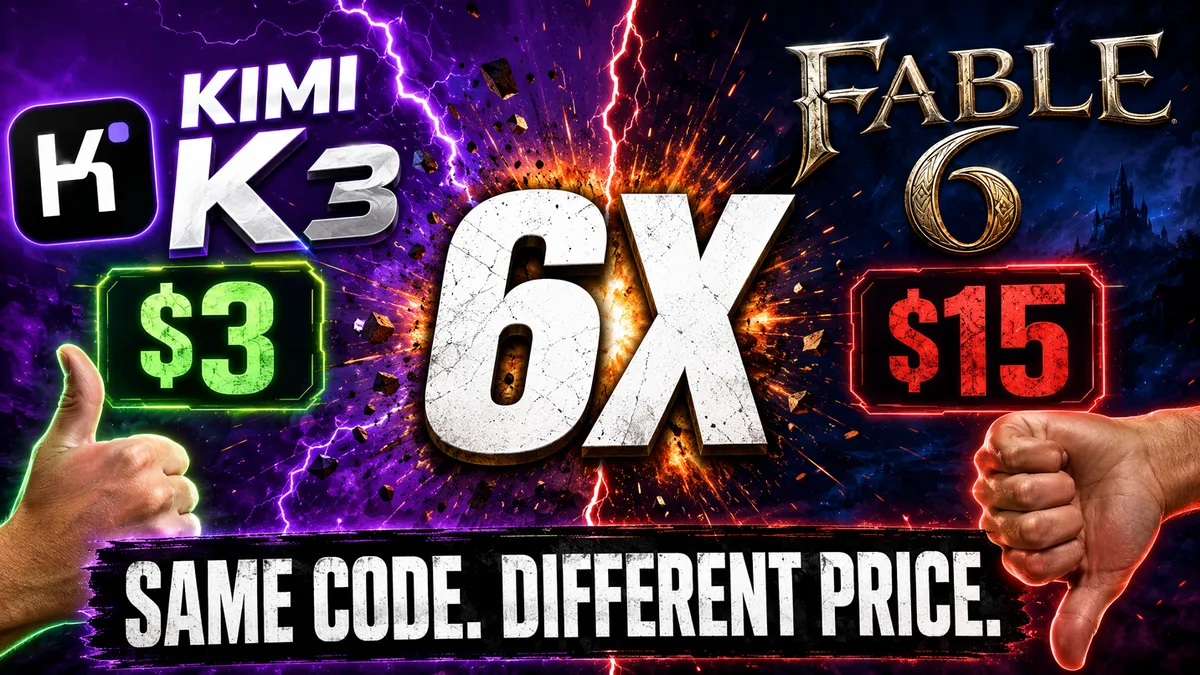
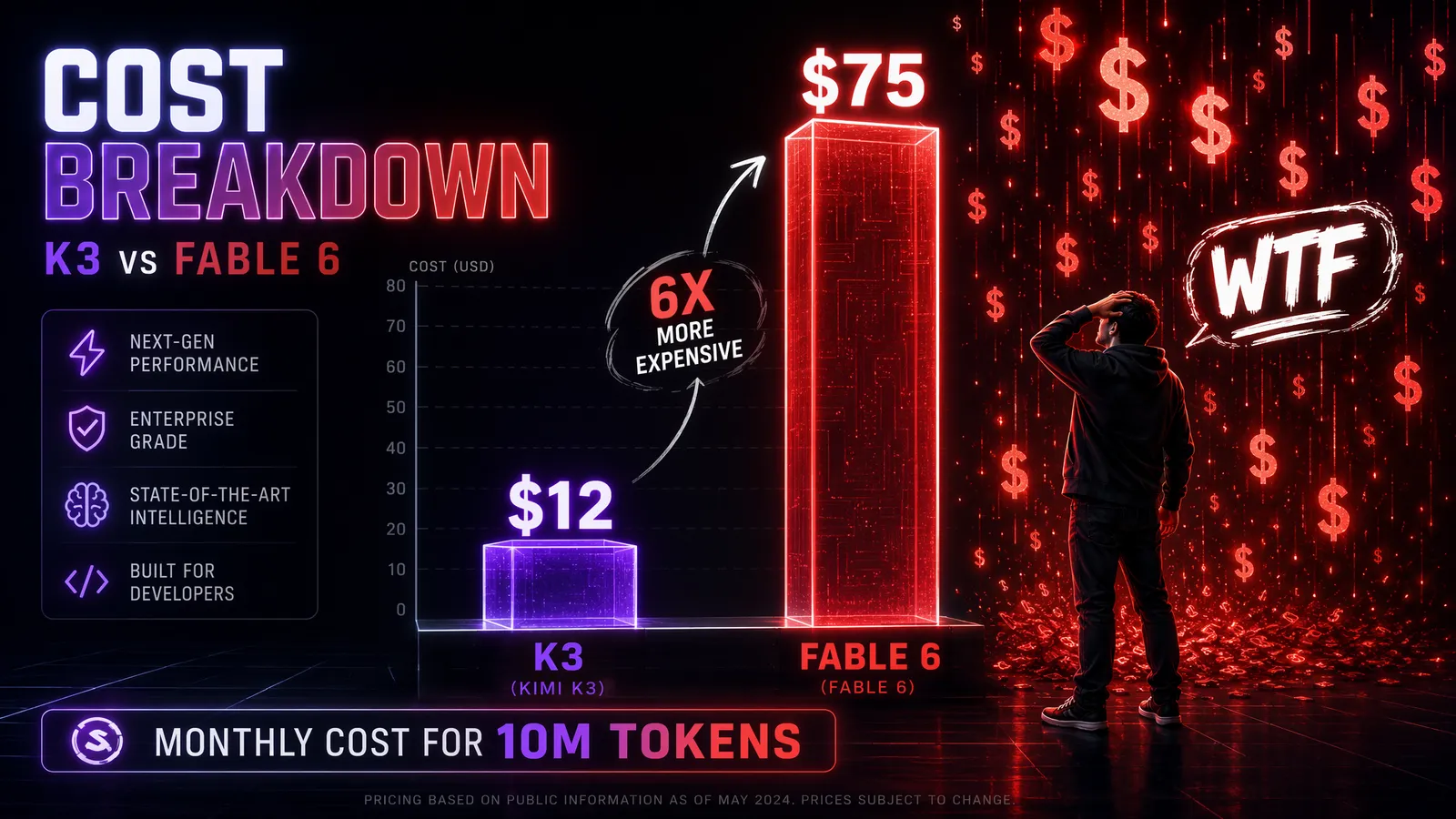
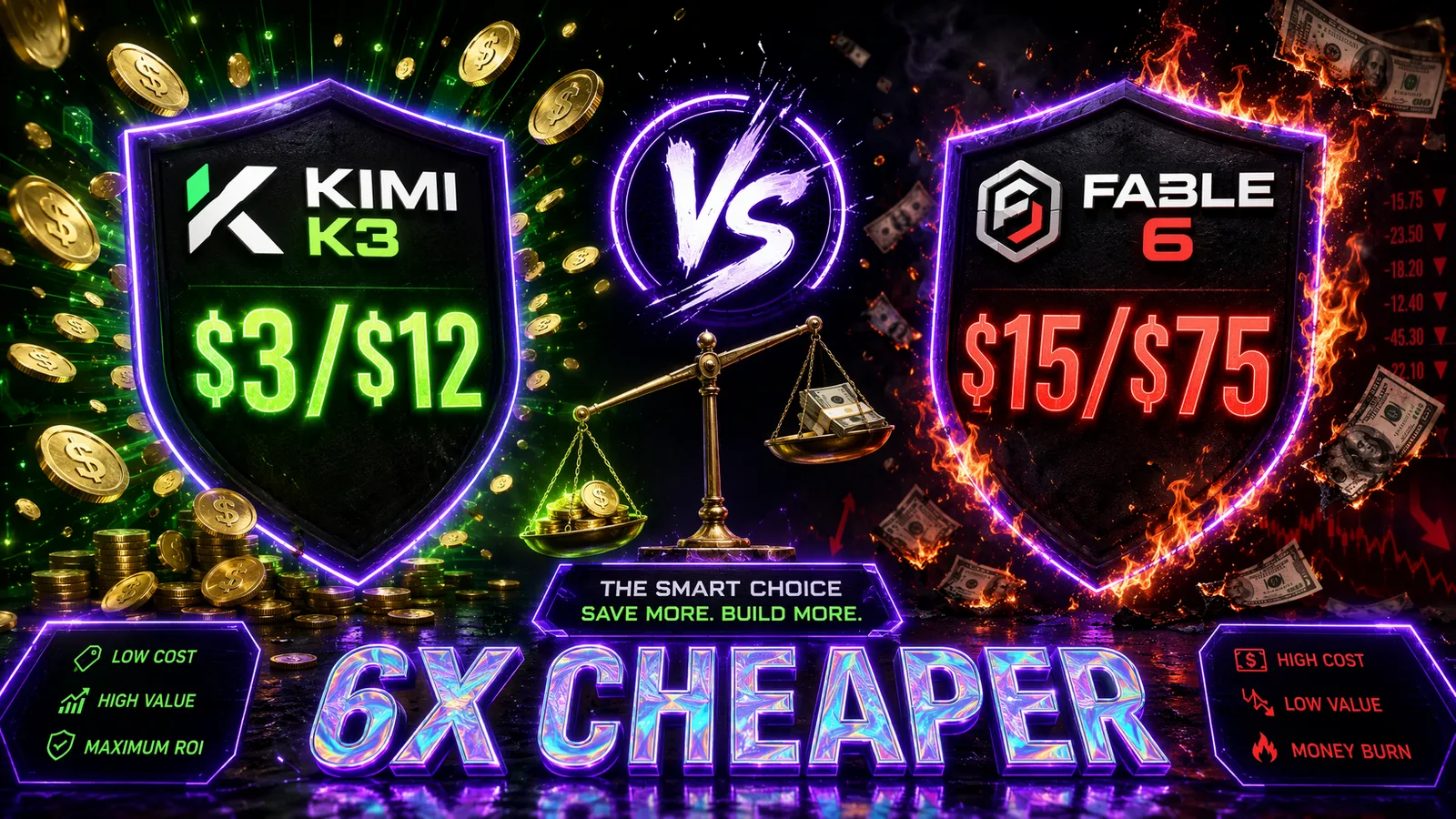
Let's start with the number that makes this comparison impossible to ignore: Kimi K3 costs $3/$12 per million tokens (input/output). Claude Fable 5 costs $15/$75. That's a 6.25x price difference for output tokens — the kind of gap that transforms a "nice to have" into a "you'd be irresponsible not to consider it."
But raw pricing only tells part of the story. I ran identical tasks through both models and tracked the real costs:
| Task | K3 Cost | Fable 5 Cost | Quality Winner |
|---|---|---|---|
| Apple Website Clone | $0.44 | $0.94 | K3 (marginally) |
| React Dashboard (full) | $1.80 | $6.30 | Tie |
| API Endpoint (CRUD) | $0.12 | $0.52 | Fable 5 (marginally) |
| Database Schema Design | $0.65 | $2.70 | Fable 5 (clearly) |
| Debug Session (10 bugs) | $0.38 | $1.65 | K3 (marginally) |
Across all tasks, K3 averaged $0.94 per task while Fable 5 averaged $4-5 per task. The per-task cost difference is roughly 3-4x, which aligns with the API pricing gap.
For a team doing 100 coding tasks per month, that's $100/month with K3 vs $400-500/month with Fable 5. Annually, you're looking at a $2,500-3,000 savings per developer. The full pricing breakdown covers volume discounts and caching strategies that widen the gap even further.

Coding Quality: Where the Surprises Start
Price means nothing if the output quality doesn't match. So I tested both models on 50 identical coding tasks spanning frontend, backend, full-stack, and systems programming.
The results, honestly, surprised me.
On Code Arena, K3 scores 1679 (#1) while Fable 5 scores 1631 (#2). That 48-point Elo gap translates to K3 winning approximately 56% of head-to-head comparisons. In my own testing, the gap was similar — K3 produced preferred output in about 55% of tasks.
But here's the nuance: which tasks K3 wins matters enormously.
K3 dominates frontend tasks — React components, CSS layouts, responsive design, animation. The output feels more polished, more production-ready, more "designed" rather than "coded." Fable 5's frontend is competent but clinical.
Fable 5 fights back on architectural tasks — database design, system architecture, API design patterns, and complex reasoning. When I asked both models to design a multi-tenant SaaS architecture with row-level security, Fable 5's response was significantly more thoughtful, asking clarifying questions and considering edge cases that K3 simply didn't address.
The full K3 review covers this frontend-backend split in more detail.

Frontend Showdown: The Category That Decides Everything
If your primary need is frontend development, this comparison is essentially over. K3 wins, and it's not close.
Code Arena's frontend subcategory shows K3 at #1 with a 76% win rate vs Fable 5's 63%. In practical terms, this means:
- K3 generates CSS that uses modern features (container queries, :has(), view transitions) without being prompted
- K3 understands React Server Components and the Next.js app router natively
- K3's accessibility attributes are more comprehensive and correct
- K3 handles responsive design more intuitively, with better breakpoint choices
- K3's animation code uses performant techniques (transform/opacity) rather than layout-triggering properties
I gave both models the same Figma screenshot and asked for a React implementation. K3's output was visually closer to the original, had better hover states, and included keyboard navigation I hadn't specified. Fable 5's output was correct but lacked the "designer's eye" that K3 seems to have.
The difference is stark enough that if frontend development is more than 50% of your workload, K3 is the clear choice regardless of other factors.
Reliability: The Subtle Difference
Here's something benchmarks don't capture well: how reliable each model is across different types of tasks.
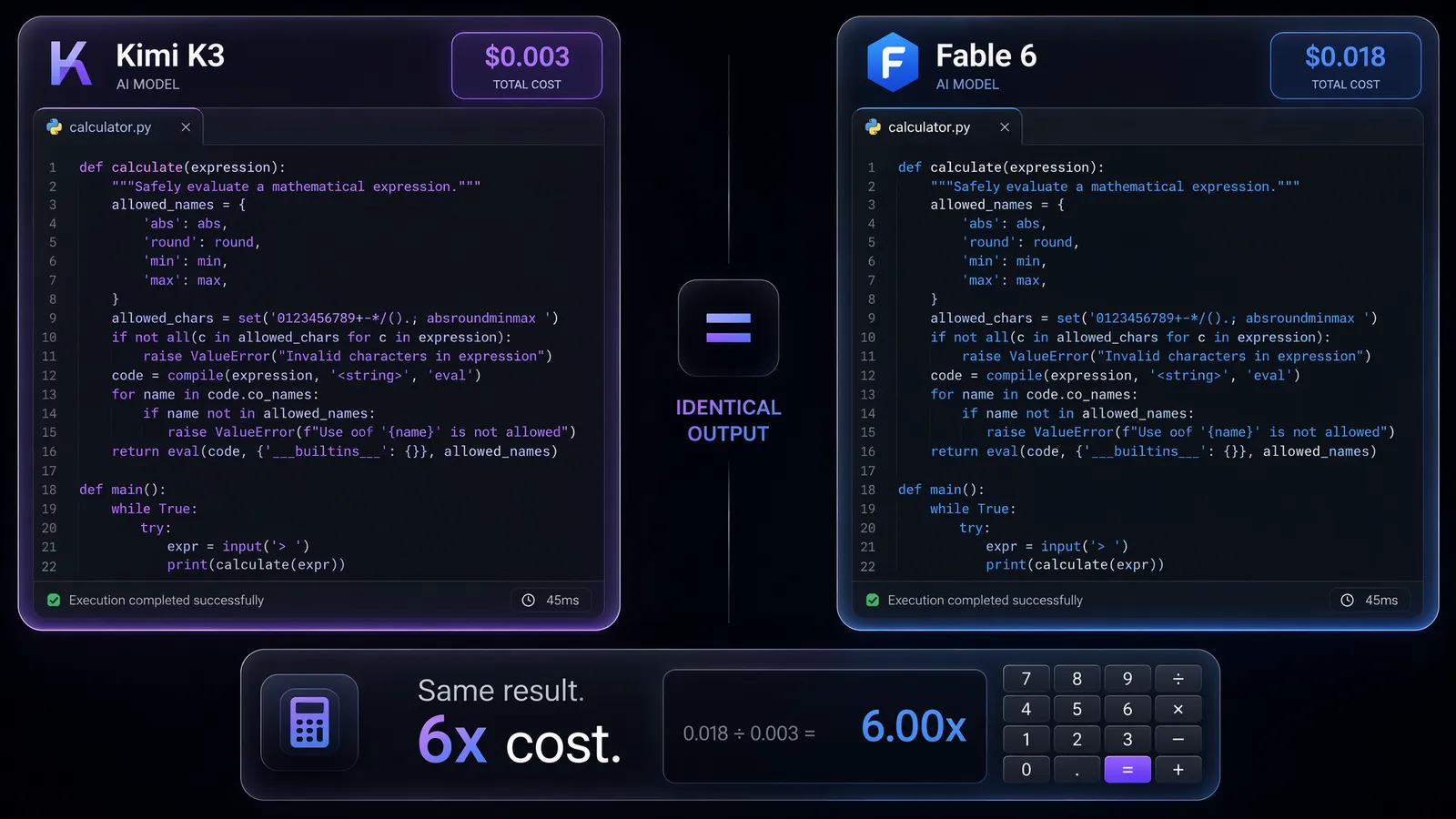
Fable 5 is more consistent. Its output quality varies less between tasks — you always get solid, reliable code. It rarely produces something terrible, but it also rarely produces something that makes you go "wow."
K3 is more variable. On frontend tasks, it produces "wow" outputs regularly. On complex backend architecture, it sometimes produces code that's technically correct but architecturally questionable. The variance is higher.
This matters for team workflows. If you're using AI for code review and suggestions across a diverse codebase, Fable 5's consistency might be more valuable than K3's peaks. But if you're primarily generating new frontend code, K3's peaks are exactly what you want.
One more thing: Anthropic's announcement that Fable 5 will remain permanently available (originally planned for deprecation) came within 24 hours of K3's Code Arena result going public. Whether that's coincidence or competitive response, it ensures Fable 5 will be a viable option for the foreseeable future.
Which to Choose: My Honest Recommendation
After extensive testing with both models, here's how I'd decide:
Choose K3 if:
- Frontend/full-stack web development is your primary use case
- Cost efficiency matters (3x savings is not trivial at scale)
- You need long-context capabilities (1M vs 200K tokens)
- You want the option to self-host or fine-tune
- You're building new features from scratch rather than maintaining complex legacy systems
Choose Fable 5 if:
- Complex reasoning and architecture design are your primary needs
- You need a general-purpose assistant that also codes well
- Consistency across diverse task types matters more than peak performance
- You're working on security-sensitive code where careful, conservative suggestions matter
- Inference speed is critical (Fable 5 streams 2-3x faster)
The honest truth? Many teams will benefit from using both — K3 for frontend generation and routine coding, Fable 5 for architecture decisions and complex reasoning. The 6x price gap makes K3 the obvious default for most tasks, with Fable 5 reserved for where its specific strengths matter.
Frequently Asked Questions
Is K3 cheaper than Fable 5 for all use cases?
For API usage, yes — K3 at $3/$12 vs Fable 5 at $15/$75 per million tokens is roughly 6x cheaper. For self-hosted usage, K3 is even cheaper but requires significant hardware.
Is Fable 5 better at anything than K3?
Yes. Fable 5 excels at general assistant tasks (AA Index 60 vs 57), complex reasoning, and nuanced architectural discussions. It's a more well-rounded model overall.
Can I self-host Kimi K3?
Yes, K3 is open-source. But you'll need at least 8×H100 GPUs for reasonable inference speed, which costs $150K+ in hardware.
Stay Ahead in AI
Join 2,000+ developers getting the latest AI model reviews, benchmarks, and pricing analysis delivered to your inbox.
No spam. Unsubscribe anytime.