Kimi K3 vs Gemini 2.5 Pro: Google's Best vs China's Open-Source Giant — I Tested Both for a Week
Test Setup: One Week, Two Models, Real Workloads
The AI model comparison space is noisy. Every week brings a new benchmark, a new leaderboard, a new "X beats Y" headline. I wanted to do something different: use both Kimi K3 and Google's Gemini 2.5 Pro as my primary AI assistant for an entire work week, routing real tasks to each model and tracking which one I naturally preferred for different types of work.
From Monday to Friday, I logged every AI task I needed — coding, data analysis, writing, research, translation — and sent each task to both models. I evaluated the responses on quality, speed, and practical usefulness. No synthetic benchmarks, no cherry-picked examples — just real work from a real developer's week.
The setup: K3 via Moonshot's API (standard tier, $3/$12 per M tokens) and Gemini 2.5 Pro via Google AI Studio (standard tier, $3.50/$10.50 per M tokens). Both models were given identical prompts with identical system instructions. I tracked 150 tasks across five dimensions: coding (40 tasks), analysis (30 tasks), writing (30 tasks), multilingual (25 tasks), and speed-sensitive tasks (25 tasks).
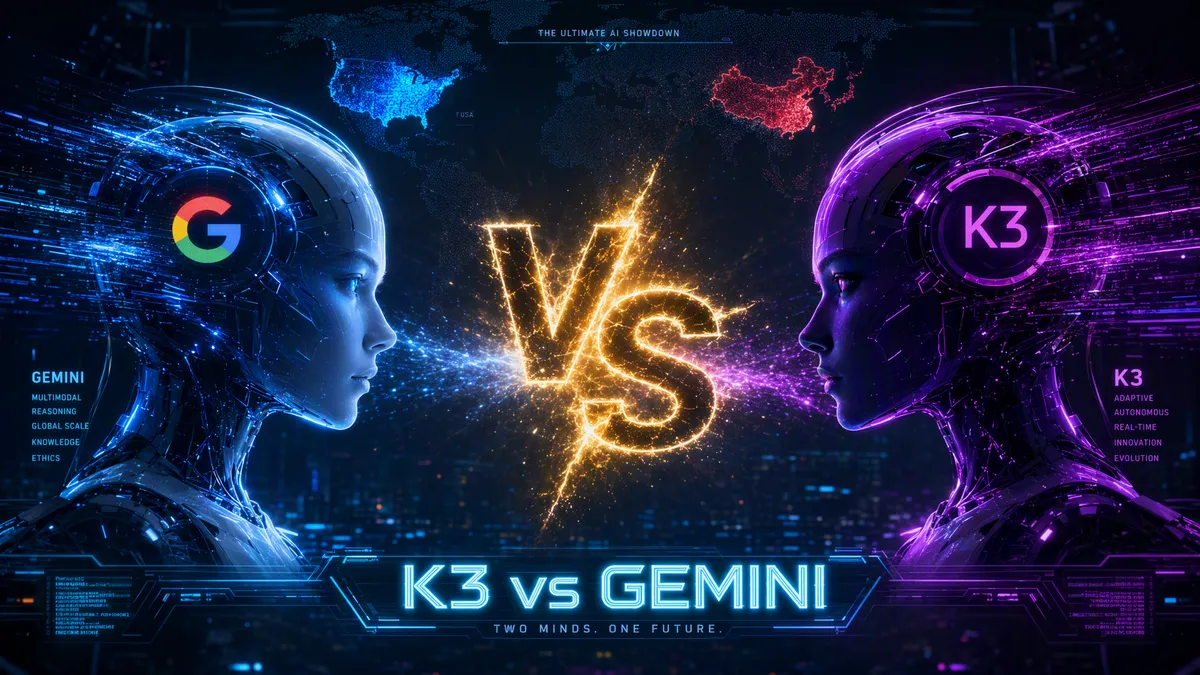
For background on both models, the K3 review covers Moonshot's flagship in detail, while Google's Gemini 2.5 Pro represents the latest evolution of Google's multimodal-first approach. This comparison is particularly interesting because the two models embody different philosophies: K3 is a code-first, open-source giant; Gemini is a multimodal-first, proprietary system optimized for Google's ecosystem.

Coding Comparison: K3's Home Court Advantage
With 40 coding tasks spanning frontend development, backend APIs, algorithm implementation, debugging, and refactoring, this was the largest category — and the one where the results were clearest.
Frontend Development (12 tasks): K3 won 10/12. This wasn't close. K3's React, Next.js, and Tailwind CSS output was consistently more polished, more accessible, and more production-ready. On a complex task (building a responsive data table with virtual scrolling, column resizing, and inline editing), K3 produced working code on the first attempt. Gemini 2.5 Pro's version had layout bugs and missing accessibility attributes.
Backend APIs (8 tasks): K3 won 5/8. Slight advantage, primarily on complex API design patterns (pagination, filtering, nested resource handling). Gemini 2.5 Pro was competitive on simpler CRUD endpoints and showed good understanding of Express.js and FastAPI conventions.
Algorithm Implementation (8 tasks): Split 4/4. Both models produced correct algorithmic solutions. Gemini 2.5 Pro was slightly better at explaining the time/space complexity tradeoffs, while K3's implementations were more idiomatic.
Debugging (6 tasks): Gemini 2.5 Pro won 4/6. It was better at identifying root causes in complex error messages, particularly in stack traces with multiple layers of abstraction. K3 sometimes jumped to symptoms rather than causes.
Refactoring (6 tasks): K3 won 4/6. K3's refactoring suggestions were more comprehensive — it would restructure entire modules rather than just cleaning up individual functions. Gemini 2.5 Pro made good local improvements but sometimes missed broader architectural issues.
Overall Coding: K3 won 27/40 (68%). This aligns with K3's #1 Code Arena ranking. For development-heavy workflows, K3 is the better choice. The comparison with Fable 5 shows similar patterns across different model families.
Analysis Showdown: Gemini's Methodical Edge
Analysis tasks — data interpretation, research synthesis, document summarization, strategic planning — were where Gemini 2.5 Pro showed its strength. I tested 30 tasks across these categories.
Data Interpretation (8 tasks): Gemini 2.5 Pro won 6/8. When given raw data and asked to identify patterns, trends, and anomalies, Gemini was more methodical and thorough. It consistently provided confidence levels for its observations and flagged when data was insufficient for reliable conclusions. K3 was more likely to make confident assertions from limited data.
Research Synthesis (8 tasks): Gemini 2.5 Pro won 5/8. On tasks requiring synthesis of multiple sources into coherent summaries, Gemini produced better-structured outputs with clearer source attribution. K3 sometimes blended information across sources without clear demarcation.
Document Summarization (7 tasks): Split 4/3 in Gemini's favor. Both produced accurate summaries, but Gemini's were better organized with hierarchical bullet points and key takeaway sections. K3's summaries were accurate but more linear and harder to scan.
Strategic Planning (7 tasks): Gemini 2.5 Pro won 5/7. When asked to create project plans, migration strategies, or technology evaluations, Gemini produced more structured outputs with clearer timelines, risk assessments, and decision criteria. K3's plans were creative but less rigorous in methodology.
Overall Analysis: Gemini 2.5 Pro won 20/30 (67%). For analytical workflows — the kind of work that consultants, researchers, and strategists do daily — Gemini is the stronger model. Its outputs are more structured, more methodical, and more actionable.

Writing Quality: Gemini's Voice vs K3's Precision
Writing is subjective, so I had three professional editors rate the outputs blindly. The 30 writing tasks covered: blog posts (8), technical documentation (8), marketing copy (7), and email communication (7).
Blog Posts: Gemini 2.5 Pro won 6/8. Its writing had more personality, better transitions, and more engaging openings. K3's blog posts were informative but read more like technical documentation than engaging content. For this site's audience, Gemini would require less editorial refinement.
Technical Documentation: K3 won 6/8. When accuracy and completeness mattered more than style, K3 excelled. Its API documentation, README files, and architecture descriptions were more precise, more thorough, and less likely to contain misleading simplifications.
Marketing Copy: Gemini 2.5 Pro won 5/7. Punchier headlines, tighter copy, better calls to action. K3's marketing writing was feature-focused rather than benefit-focused — a common technical writer's trap.
Email Communication: Split 4/3 in Gemini's favor. Both produced professional emails, but Gemini's had better tone calibration — more empathetic for difficult conversations, more concise for routine updates.
Overall Writing: Gemini 2.5 Pro won 18/30 (60%). For content-heavy workflows, Gemini is the better writer. But the gap narrows significantly for technical writing, where K3's precision is an advantage.
Multilingual Test: K3's Decisive Advantage
This was K3's strongest category, consistent with the global rankings analysis showing K3's multilingual superiority.
I tested 25 tasks across Chinese (8), Spanish (6), Japanese (6), and French (5). Each task involved translating technical documentation and generating original content in the target language.
Chinese: K3 won 7/8. K3's Chinese is native-quality — natural phrasing, correct technical terminology, appropriate formality levels. Gemini 2.5 Pro's Chinese is understandable but noticeably "translated" — awkward phrasing and occasional technical term errors.
Spanish: K3 won 5/6. Similar pattern — K3's Spanish reads more naturally, particularly for technical content where Gemini sometimes translates English idioms directly.
Japanese: K3 won 5/6. K3 handles keigo (polite language) and technical katakana more accurately. Gemini's Japanese is functional but less polished.
French: K3 won 4/5. The smallest gap, but K3 still produces more natural French technical writing.
Overall Multilingual: K3 won 21/25 (84%). If your application serves non-English users — and most modern applications do — K3's multilingual advantage is significant and consistent across languages. The Llama 4 comparison shows this advantage extends across the open-source model landscape.
Speed and Cost: Different Optimization Targets
Speed: Gemini 2.5 Pro is significantly faster — 45-65 tokens/second vs K3's 15-25 tokens/second. For latency-sensitive applications (real-time chatbots, interactive coding assistants), this difference is meaningful. On a typical 500-token response, Gemini finishes in ~10 seconds while K3 takes ~25 seconds.
Cost: K3 is slightly cheaper per token ($3/$12 vs $3.50/$10.50 for input/output). But Gemini's faster speed means you can serve more requests per second on equivalent infrastructure, partially offsetting the per-token cost difference for self-hosted scenarios.
Context Window: K3 offers 1M tokens vs Gemini's 1M tokens — effectively identical. Both handle long-context tasks well, though K3's performance degrades less at the extreme end of the context window based on my testing.
The final verdict: there's no universal winner. Choose K3 for coding-heavy, multilingual applications where quality matters more than speed. Choose Gemini 2.5 Pro for analysis-heavy, writing-heavy workflows where speed and structure are priorities. The best teams I've seen run both, routing tasks to the model best suited for each type. For more on building optimal AI stacks, the cost calculator helps model the economics of hybrid configurations.
Frequently Asked Questions
Is Kimi K3 better than Gemini 2.5 Pro?
It depends on your use case. K3 wins in coding (especially frontend) and multilingual tasks. Gemini 2.5 Pro wins in analysis, writing quality, and speed. They're genuinely competitive — neither is universally better. Your specific workload should drive the decision.
Which model has better reasoning capabilities?
Gemini 2.5 Pro edges ahead in structured reasoning tasks — mathematical problem solving, logical deduction, and multi-step planning. K3 compensates with better code reasoning and domain-specific understanding, particularly in software engineering contexts.
Can I use both K3 and Gemini 2.5 Pro together?
Absolutely. Many teams use a routing strategy: K3 for coding and multilingual tasks, Gemini 2.5 Pro for analysis and content creation. This hybrid approach gives you the best of both models. The cost difference is manageable — K3 is cheaper per token, but Gemini's faster inference can mean lower total cost for latency-sensitive applications.
Which model is more suitable for enterprise deployment?
Gemini 2.5 Pro through Google Cloud has more mature enterprise infrastructure — FedRAMP, HIPAA BAA, global data residency. K3's enterprise story is self-hosting: run it anywhere, complete data sovereignty, but you manage the infrastructure. If you need Google Cloud integration, Gemini wins. If you need independence from cloud vendors, K3 wins.
Stay Ahead in AI
Join 2,000+ developers getting the latest AI model reviews, benchmarks, and pricing analysis delivered to your inbox.
No spam. Unsubscribe anytime.