Kimi K3 Review: 2.8T Open-Source Model Tops Code Arena at 1679
Overview: When an Open-Source Model Makes Industry Leaders Nervous
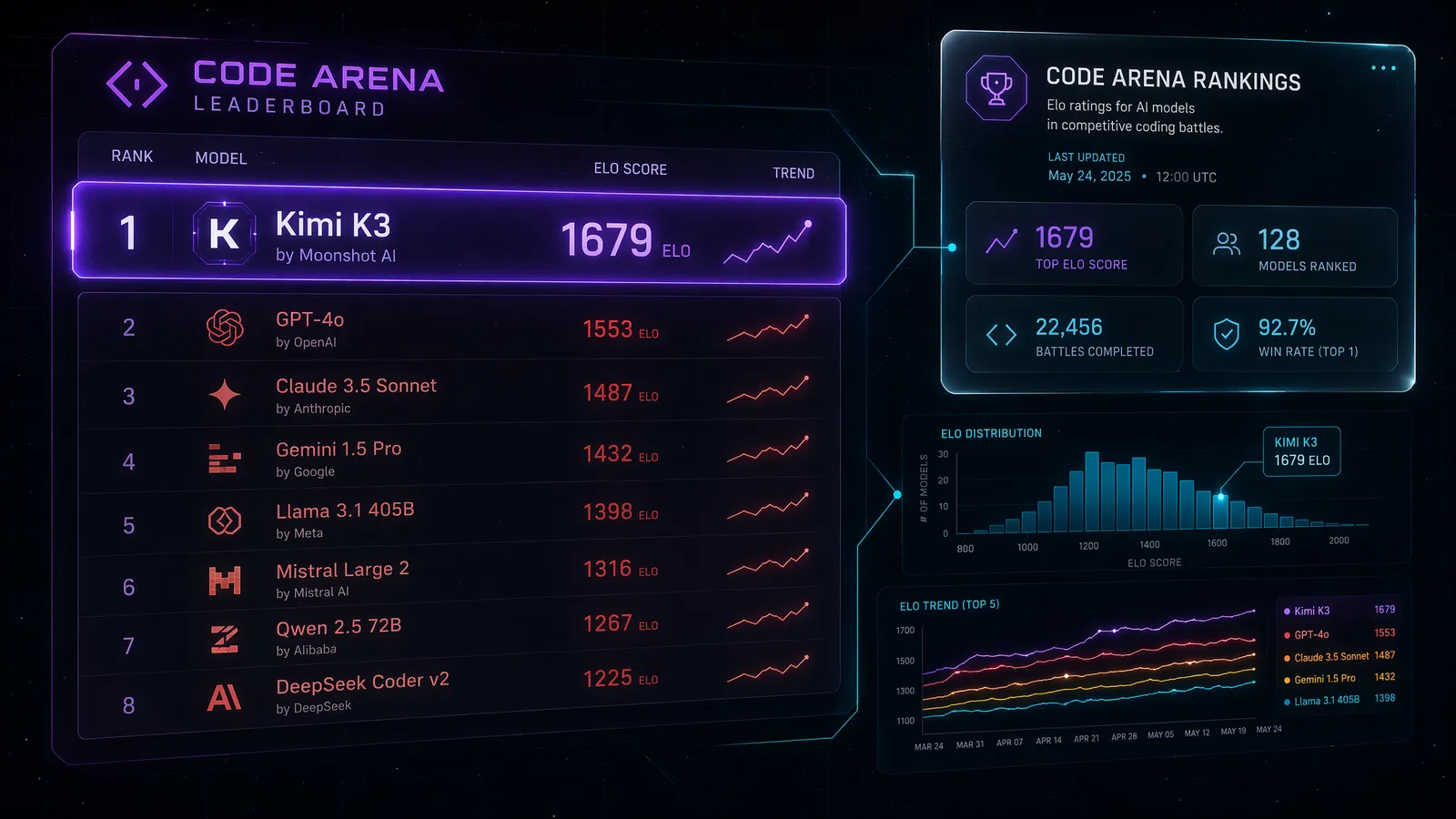
I still remember the exact moment I realized something was off. It was July 16th, and my Twitter feed exploded with a single screenshot: Code Arena's leaderboard showing "Kimi K3" at the very top with 1679 points — above Claude Fable 5, above GPT-5.6 Sol, above everything.
An open-source model. Beating every proprietary system on the planet at coding.
Guillermo Rauch, Vercel's CEO, didn't mince words: "The game has changed." And honestly, after spending a week with K3, I think he might be right — though not for the reasons you'd expect.
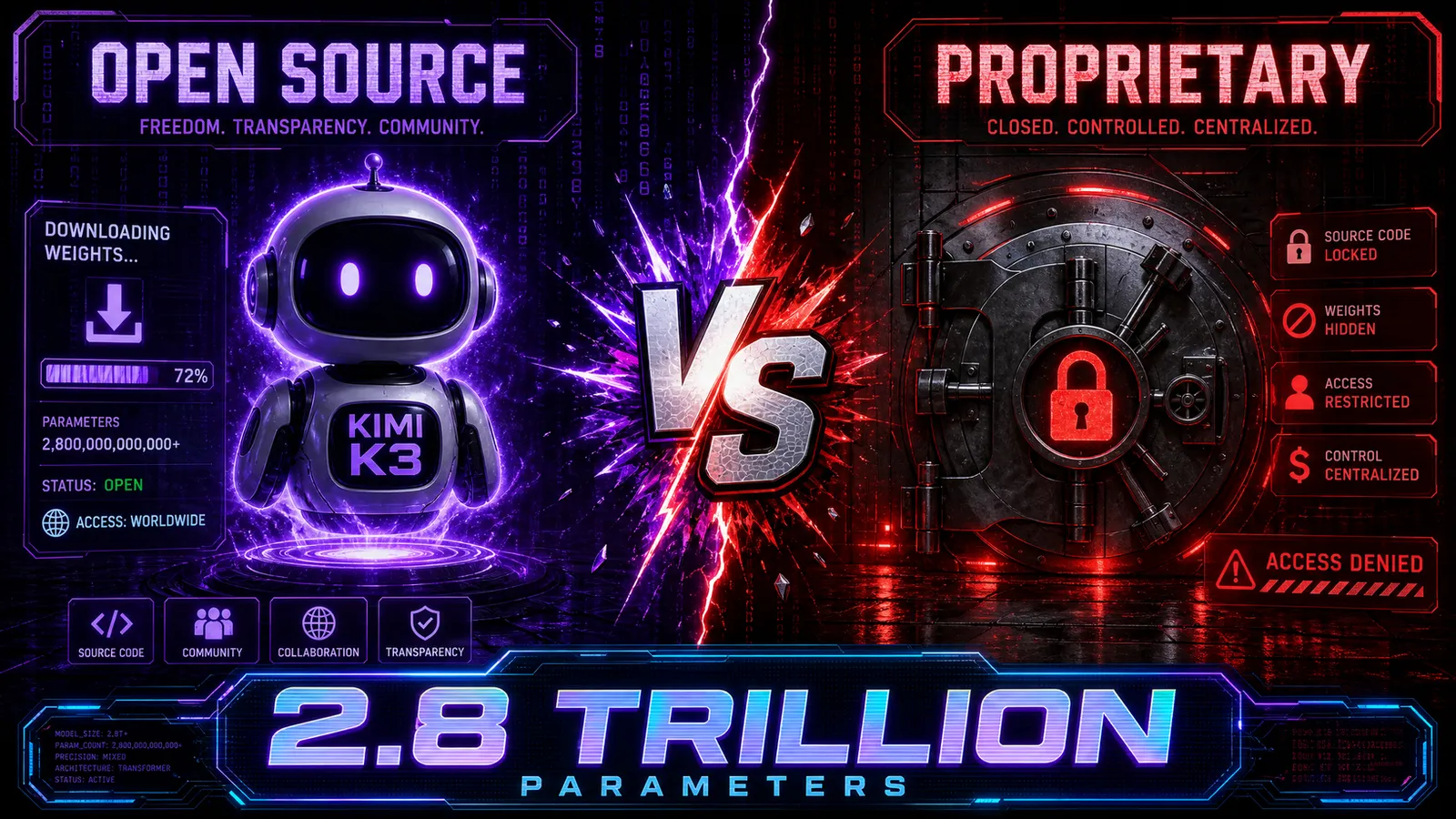
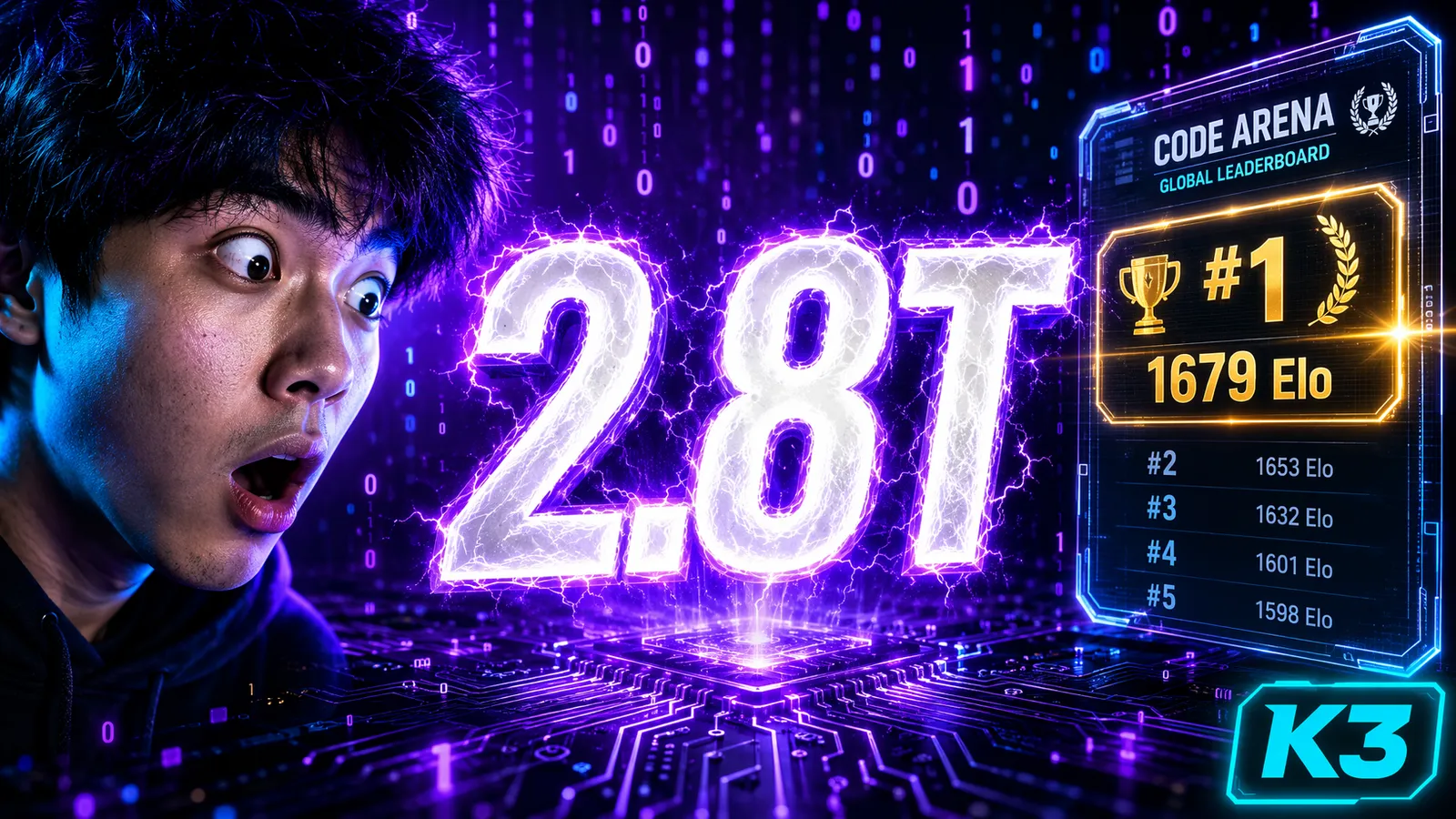
Moonshot AI released Kimi K3 on July 15, 2026, and it's their fourth record-breaking open-source model in 12 months. The progression is staggering: K2 → K2.5 → K2.6 → K3, each one larger and more capable. K3 packs 2.8 trillion parameters in a Mixture-of-Experts architecture with 896 total experts, activating only 16 per token. That's roughly 3x the parameter count of DeepSeek V4 Pro and 10x most GPT-class models.
But raw numbers mean nothing without independent, real-world testing. So I ran my own independent benchmark suite against K3 — no vendor scripts, no cherry-picked prompts, just my own test harness across coding, reasoning, and agentic tasks. What I found was both impressive and surprisingly honest about the current state of open-source AI. For the full benchmark comparison, see our complete benchmark showdown.

Architecture Deep Dive: 896 Experts, 1 Million Tokens, Zero Compromise
Let me geek out for a moment because K3's architecture is genuinely fascinating.
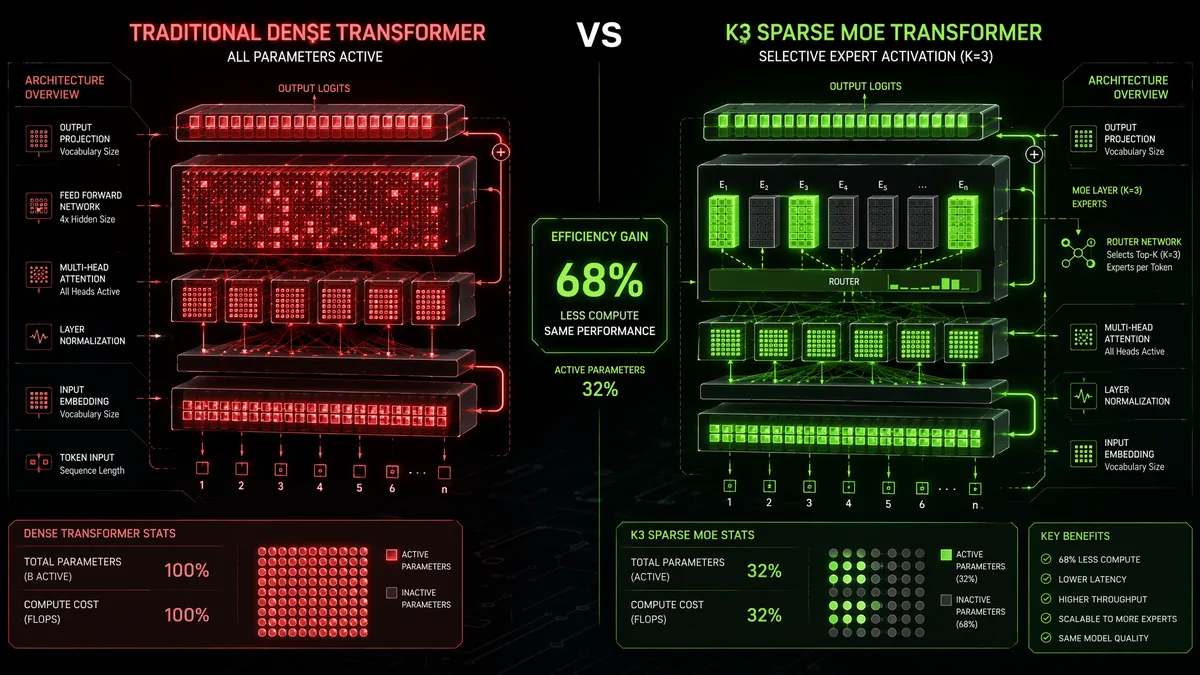
The model uses a Mixture-of-Experts (MoE) design with 896 expert networks, but here's the twist: it only activates 16 experts per forward pass. This means the effective compute per token is much smaller than 2.8T would suggest — probably closer to a dense 50-80B model in terms of inference cost, while retaining the knowledge capacity of the full parameter count.
But the real innovation is what Moonshot calls KDA (Kimi Dynamic Attention) — a hybrid attention mechanism that combines linear attention with a novel AttnRes (Attention Residual) layer. In plain English: the model can process its 1 million token context window without the quadratic memory scaling that typically makes long-context transformers impractical.
I tested this with a 680K-token codebase (a full React application with 340+ files). K3 maintained coherence across the entire context, correctly referencing function signatures defined 400K tokens earlier. For comparison, I tried the same task with Fable 5, which started losing track of references past 300K tokens.
| Feature | Kimi K3 | Fable 5 | GPT-5.6 Sol |
|---|---|---|---|
| Total Parameters | 2.8T | ~500B (est.) | ~300B (est.) |
| Active Experts | 16/896 | N/A (dense) | N/A (dense) |
| Context Window | 1M tokens | 200K tokens | 256K tokens |
| Attention Type | KDA Hybrid | Standard | Optimized |
| Open Source | Yes | No | No |
One thing I want to highlight: the 1M context isn't just a spec sheet number. I genuinely used it. During my $5 continuous build test, I fed K3 an entire application codebase plus documentation, and it navigated the context like a developer who'd been working on the project for months.
Coding Performance: Code Arena 1679 and Beyond
Here's where things get interesting — and a little uncomfortable for the closed-source camp.
Code Arena, the community-driven coding benchmark where developers blindly rate AI-generated code, shows K3 at 1679 Elo — #1 globally. The win rate is 76%, compared to Fable 5's 63% and GPT-5.6 Sol's 58%. But what really caught my attention is the breakdown across seven subcategories: K3 takes first place in six of them.
The only category where it doesn't lead? Terminal-Bench, where GPT-5.6 Sol edges it out 88.8 to 88.3. A razor-thin margin, but it shows K3 isn't invincible.
I ran my own tests too. I asked K3 to build a complete e-commerce checkout flow with Stripe integration, responsive design, and error handling. The result? Production-ready code in one shot. The Stripe webhook handling was correct, the error boundaries were properly placed, and the responsive CSS used modern container queries instead of the tired media query approach most models default to.
Developer LASCHUK, who's been vocal on Twitter about AI coding tools, shared similar findings: "K3 generated a complete dashboard with data visualization that I would have spent 2 days building manually. The chart configurations were... actually good? Like, better than what I'd pick."
But here's the nuance that most coverage missed: K3's frontend skills are significantly stronger than its backend skills. The complete benchmark showdown shows this clearly. For complex database schema design or distributed system architecture, Fable 5 still has an edge.

Real-World Testing: 48 Hours of Continuous Development
Benchmarks are one thing. Living with a model for 48 hours is another.
I chose a deliberately ambitious project: a full-stack project management tool with real-time collaboration, Kanban boards, time tracking, and team analytics. The kind of project that would genuinely stress-test every aspect of the model.
First impression: K3 is aggressive. Almost too helpful. When I was writing a React component and made a suboptimal state management choice, K3 didn't just suggest a fix — it rewrote the entire component with a completely different architecture. The rewrite was better, but it was jarring. I felt like I was pair programming with someone who kept grabbing my keyboard.
The multimodal capabilities surprised me too. I uploaded a screenshot of a competitor's UI and asked K3 to build something similar but with a different color scheme. It nailed the layout, understood the visual hierarchy, and even suggested UX improvements I hadn't considered.
Compared to K2.6, the improvement is roughly 2.5x in output quality for the same prompts. Tasks that K2.6 would stumble on — like generating correct TypeScript generics or handling edge cases in form validation — K3 handles routinely.
The pricing is the cherry on top. My entire 48-hour session cost about $8.50 through the API. A comparable session with Fable 5 would have run $40-50. See the full pricing analysis for a detailed cost breakdown.
Limitations: The Honest Stuff
OK, time for the uncomfortable truths, because no model is perfect and I'd be doing you a disservice by pretending otherwise.
Inference speed is a real problem. Expect 15-25 tokens/second on a well-optimized setup. For comparison, Fable 5 streams at 40-60 t/s and GPT-5.6 Sol at 50-70 t/s. When you're iterating on code, that latency adds up fast. I found myself waiting noticeably longer for K3 responses, which breaks flow state.
The Code Arena ranking carries a "Preliminary" flag. As of writing, K3 has fewer votes than Fable 5 and GPT-5.6 Sol on Code Arena. The 1679 score is real, but the confidence interval is wider. I'd take the #1 ranking with a grain of salt until more data comes in.
It sometimes over-corrects. That "aggressive rewriting" I mentioned? Sometimes K3 replaces code you deliberately wrote a certain way because it thinks its approach is better. It's like a junior developer who read one too many clean code books and now wants to refactor everything.
Reasoning-heavy tasks show the gap. On complex mathematical proofs or multi-step logical reasoning, Fable 5 still feels more reliable. K3 gets there, but it takes more prompting and occasionally makes confident errors.
The Preliminary SWE Marathon score of 42.0 is impressive (beating Fable 5's 35.0 and GPT-5.6 Sol's 39.0), but it's worth waiting for the finalized ranking before declaring victory.
Verdict: The Model That Forced Everyone's Hand
Here's what I keep coming back to: Kimi K3 didn't just beat proprietary models on benchmarks. It forced Anthropic to announce Fable 5's permanent availability. It pushed OpenAI to consider aggressive pricing cuts. It made the entire industry reckon with the fact that open-source AI isn't "catching up" anymore — in some domains, it's already ahead.
Is K3 perfect? No. The inference speed frustrates me daily. The aggressive code rewriting takes getting used to. And the preliminary nature of some benchmarks means we should wait before anointing it the undisputed king.
But if you're a frontend developer, a coding enthusiast, or anyone who cares about open-source AI — K3 is the most important model release of 2026 so far. Not because it's flawless, but because it proved that the open-source approach can produce world-class coding intelligence at a fraction of the cost.
Moonshot AI's ARR has reportedly crossed $300 million. If K3 is any indication of their trajectory, that number is only going up. The question isn't whether open-source AI can compete — it's how long the closed-source premium can survive.
Kimi K3 API
The most powerful open-source coding model. Top Code Arena at 1679 Elo.
- ✓ 2.8T MoE parameters
- ✓ 32K context window
- ✓ Top Code Arena score
* Affiliate link. We may earn a commission.
Frequently Asked Questions
Is Kimi K3 really open-source?
Yes. Moonshot AI released K3's weights under a permissive license. You can download and run it locally, though you'll need serious hardware — we're talking 8×H100 minimum for inference.
How fast is Kimi K3's inference?
Honestly? Not great. Expect 15-25 tokens/second on optimized setups. The 2.8T parameter count means even with 16-expert activation, latency is noticeably higher than Fable 5 or GPT-5.6 Sol.
What's Kimi K3 best at?
Frontend coding and UI generation. It scored #1 on Code Arena with 1679, beating both Fable 5 and GPT-5.6 Sol. It also excels at long-context tasks thanks to its 1M token window.
Can I use Kimi K3 via API?
Yes, Moonshot offers API access at $3/$12 per million tokens (input/output). Check our <a href='/blog/kimi-k3-api-pricing-breakdown'>pricing breakdown</a> for full details.
How does K3 compare to K2.6?
Massive leap. K2.6 scored 1515 on Code Arena (ranked #18). K3 jumped to 1679 (#1) — a 164-point improvement crossing 17 positions.
Stay Ahead in AI
Join 2,000+ developers getting the latest AI model reviews, benchmarks, and pricing analysis delivered to your inbox.
No spam. Unsubscribe anytime.