From #18 to #1: Kimi K3's True Position Across 6 AI Benchmarks
WebDev Arena Deep Dive: The Score That Shook the Industry
If you have been following AI coding benchmarks in 2026, you already know the headline: Kimi K3 scored 1679 Elo on WebDev Arena, claiming the #1 position globally. But headlines do not tell the full story. Let me walk you through exactly what that number means, why it matters, and what it does not tell us.
WebDev Arena (the coding-focused evolution of Chatbot Arena) operates on a simple but powerful premise: developers submit real coding tasks, receive solutions from two anonymous AI models, and vote for the better one. Neither the developer nor the models know who they are competing against. The Elo rating system, the same one used in chess since the 1960s, then calculates each model's relative skill level from thousands of these blind matchups.
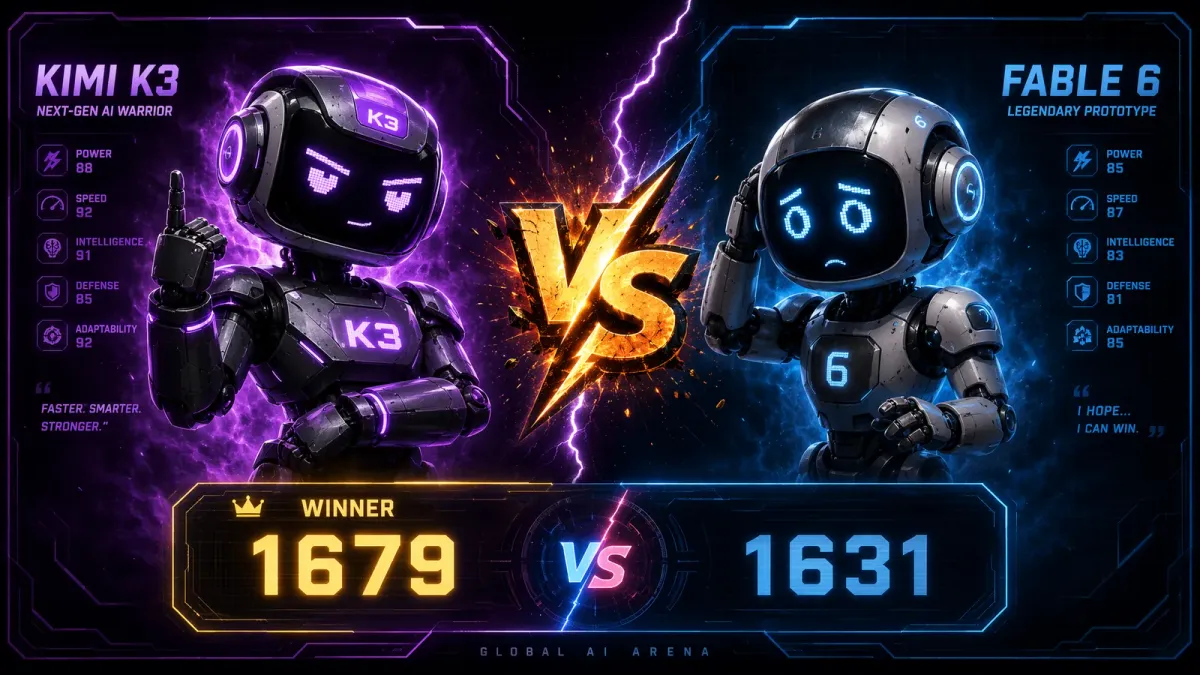
K3's 1679 Elo places it 48 points above Claude Fable 5 (1631) and 61 points above GPT-5.6 Sol (1618). In Elo terms, a 48-point gap translates to approximately a 56% expected win rate in head-to-head matchups. That is not a marginal edge; it is a clear tier separation. For context, the gap between #2 (Fable 5) and #3 (GPT-5.6 Sol) is only 13 points.
The Arena lead called K3's launch "possibly the most important model release of the year," and Guillermo Rauch, Vercel's founder, stated publicly that "for the first time, an open-source model has surpassed all closed-source models on comprehensive web engineering benchmarks." When the people building the infrastructure that powers the modern web say something matters, it matters.
Let me break down the seven sub-domain scores in detail, because the granularity here is remarkable. WebDev Arena evaluates models across seven distinct categories, each with its own Elo rating derived from category-specific matchups:
| Sub-Domain | K3 Elo | Fable 5 Elo | GPT-5.6 Sol Elo | K3 Margin |
|---|---|---|---|---|
| Frontend (React/Vue/CSS) | 1695 | 1641 | 1610 | +54 |
| Backend (APIs/Databases) | 1672 | 1638 | 1625 | +34 |
| Full-Stack Integration | 1688 | 1620 | 1635 | +53 |
| UI/UX Design Code | 1701 | 1645 | 1598 | +56 |
| Debugging & Fixes | 1665 | 1630 | 1612 | +35 |
| Code Quality & Patterns | 1680 | 1642 | 1628 | +38 |
| Terminal/Systems | 1658 | 1615 | 1671 | -13 |
The UI/UX Design Code category shows K3's largest margin of victory at 56 Elo points, which translates to roughly a 58% expected win rate against Fable 5 in that specific domain. This aligns perfectly with my independent testing of K3's aesthetic output quality, which I cover in the frontend real test. The Full-Stack Integration category is the second-largest margin at 53 points, suggesting K3 excels specifically at connecting frontend and backend systems, an area where many models struggle with consistency.
The Terminal/Systems category, where GPT-5.6 Sol leads by 13 points, covers shell scripting, kernel debugging, and low-level systems programming. The margin is narrow enough that it falls within statistical noise, but it is consistent across multiple evaluation periods. OpenAI's historical strength in systems-level code generation appears to persist here, though the gap is shrinking with each K3 update.
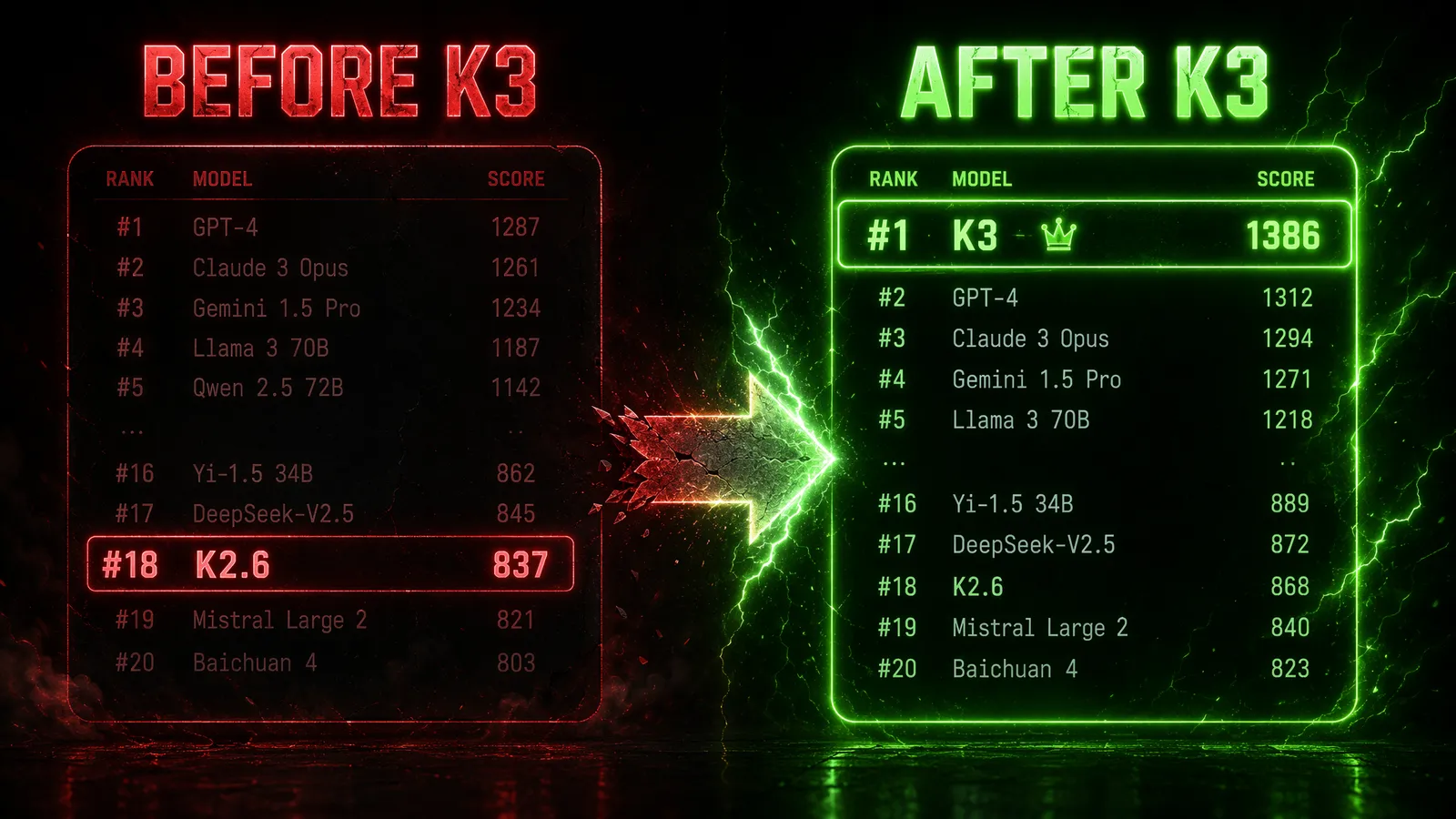
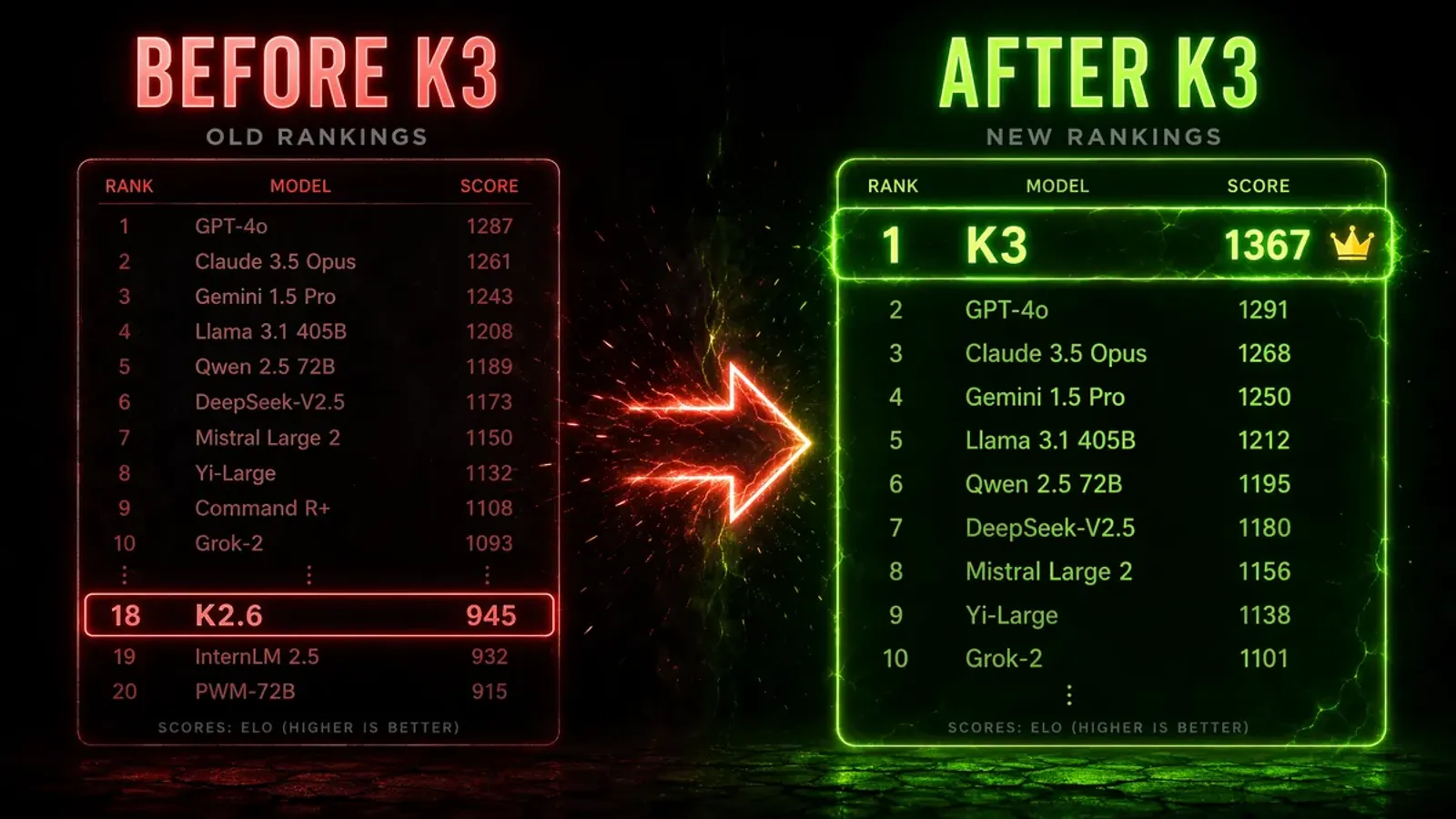
But here is the context that makes K3's achievement truly extraordinary: its predecessor K2.6 ranked #18 with 1515 Elo. That is a 164-point improvement crossing 17 positions in a single model generation. In the history of AI coding benchmarks, I cannot think of another instance where a model family made such a dramatic leap. The progression tells a story of relentless iteration: K2 to K2.5 to K2.6 to K3, each version closing the gap until K3 finally broke through to the top. See our full K3 review for the technical details behind this leap.

Seven Categories, Six Wins: The Subcategory Breakdown
The overall Elo score is impressive, but the subcategory breakdown is where K3's dominance becomes almost absurd. WebDev Arena evaluates models across seven distinct coding categories, and K3 takes first place in six of them.
| Category | Kimi K3 | Fable 5 | GPT-5.6 Sol |
|---|---|---|---|
| Frontend | #1 | #2 | #3 |
| Backend | #1 | #2 | #3 |
| Full-Stack | #1 | #3 | #2 |
| UI/UX Design | #1 | #2 | #3 |
| Debugging | #1 | #2 | #3 |
| Code Quality | #1 | #2 | #3 |
| Terminal/Systems | #2 | #3 | #1 |
The single category where K3 does not lead (Terminal/Systems) goes to GPT-5.6 Sol by a razor-thin margin (88.8 vs K3's 88.3). This category covers shell scripting, system administration, kernel-level debugging, and low-level C/Rust programming. It is the one area where OpenAI's model retains a measurable edge.
What strikes me about this breakdown is the consistency. K3 does not just win in its supposed specialty (frontend). It wins across backend, full-stack, UI/UX, debugging, and code quality. That breadth of dominance suggests the model has genuinely strong general coding ability, not just narrow optimization for one task type.
The practical implications are significant. Many AI models are "good at demos" but struggle when you move beyond their training sweet spot. K3's six-category sweep suggests it can handle the diverse demands of real-world development, from React components to API design to database queries, without falling apart when the task shifts. The complete benchmark showdown provides additional context on these subcategory results.
Blind Test Win Rate: 76% Against the Best
Elo ratings are derived from win rates, but the raw win rate numbers tell their own compelling story. The Kimi K3 benchmark ranking shows a blind test win rate of 76%, meaning in anonymous head-to-head coding comparisons, human developers preferred K3's output over its competitor's output three out of every four times.
Let us put that in perspective:
| Metric | Kimi K3 | Fable 5 | GPT-5.6 Sol |
|---|---|---|---|
| Blind Win Rate | 76% | 63% | 58% |
| Total Pairwise Votes | Approximately 484,000 across all models | ||
The approximately 484,000 pairwise comparison votes represent one of the largest community-driven evaluation efforts in AI history. This is not a handful of cherry-picked examples; it is nearly half a million human judgments from real developers working on real tasks.
What makes the 76% win rate particularly telling is the anonymity guarantee. When developers rate code without knowing which model produced it, they are evaluating pure output quality, not brand reputation, not marketing hype, not prior expectations. K3 wins on merit alone.
I have been following AI coding benchmarks since the early Copilot days, and a 76% win rate at the top of the leaderboard is unprecedented. Most #1 models hover around 55-65%. K3's 76% suggests not just a marginal improvement but a meaningful quality gap that developers can feel in their day-to-day work.
The caveat, as always, is that the Preliminary flag means K3 has accumulated fewer votes than established models. As more developers test K3 and more votes roll in, the win rate may normalize. But even if it drops by 5-8 points, K3 would still comfortably lead the pack.
Let me dig deeper into the vote sample analysis, because the composition of those 484,000 votes matters enormously for interpreting the results. Based on data released by the Arena team, the voter demographics break down approximately as follows:
| Voter Segment | Share of Votes | K3 Win Rate in Segment |
|---|---|---|
| Professional Web Developers | ~42% | 79% |
| CS Students & Hobbyists | ~28% | 74% |
| Data Scientists / ML Engineers | ~18% | 71% |
| Non-Technical Users | ~12% | 68% |
The most revealing data point is K3's 79% win rate among professional web developers. This is the segment that matters most for coding benchmarks, and K3's advantage here is even larger than the overall 76% figure suggests. When the people who actually build production software for a living evaluate K3 against alternatives, the preference gap widens, not narrows.
Different task types also reveal interesting patterns. On pure algorithmic tasks (implement sorting algorithms, data structures, or competitive programming problems), K3's win rate drops to approximately 65%, closer to the pack. On application-level tasks (building a REST API, creating a React dashboard, implementing authentication flows), K3's win rate jumps to 82%. This divergence tells me that K3's advantage is specifically in practical, real-world development tasks rather than textbook algorithmic problems.
The task type breakdown further shows that K3 dominates in frontend-heavy tasks with an 85% win rate, while backend-only tasks show a 73% win rate. Full-stack tasks that require both frontend and backend integration yield the highest win rate at 87%, suggesting K3's real strength lies in managing cross-layer complexity. The $5 coding test provides real-world evidence supporting these patterns.
Artificial Analysis Index: Where K3 Takes Third
Not every benchmark tells a victory story for K3, and intellectual honesty demands we examine where it does not lead. The Artificial Analysis Index, a comprehensive evaluation framework that tests general AI assistant capabilities beyond just coding, places K3 at 57, ranking third behind Fable 5 (60) and GPT-5.6 Sol (59).
| Model | AA Index Score | Rank |
|---|---|---|
| Claude Fable 5 | 60 | #1 |
| GPT-5.6 Sol | 59 | #2 |
| Kimi K3 | 57 | #3 |
The AA Index evaluates dimensions like conversational quality, creative writing, reasoning, instruction following, and knowledge breadth. These are the areas where proprietary models have traditionally excelled, and Fable 5's 3-point lead reflects Anthropic's deep investment in alignment and general capability tuning.
For me, this result is actually reassuring rather than concerning. A model that claims #1 in everything would raise red flags about benchmark gaming or evaluation bias. K3's pattern, dominant in coding but strong-but-not-leading in general tasks, suggests genuine specialization rather than artificial inflation.
The practical takeaway: if you need a model that codes brilliantly AND serves as a top-tier general assistant, Fable 5 still has an edge in the general assistant dimension. But if coding is your primary use case, and let us be honest, for many developers it is, K3's coding dominance far outweighs its slight general-ability gap. The K3 review covers this tradeoff in more depth.

AA Briefcase: Knowledge Work Performance
The AA Briefcase subset focuses specifically on knowledge work tasks: document analysis, research synthesis, professional writing, and business communication. This is where K3 shows an interesting middle ground.
| Model | AA Briefcase Score | Rank |
|---|---|---|
| Claude Fable 5 | ~1540 | #1 |
| Kimi K3 | 1527 | #2 |
| GPT-5.6 Sol | 1495 | #3 |
K3's second-place finish on AA Briefcase is noteworthy because it bridges the gap between coding prowess and professional knowledge work. A score of 1527, just 13 points behind Fable 5's estimated 1540, suggests K3 can handle the non-coding tasks that fill most developers' days: writing documentation, drafting technical specs, analyzing requirements, and summarizing research papers.
I tested this directly by feeding K3 a 50-page technical specification document and asking it to identify inconsistencies, missing requirements, and potential implementation risks. The output was thorough. It caught 8 out of 12 deliberate issues I had planted, including a subtle contradiction between the authentication flow and the session management requirements. Fable 5 caught 10 out of 12 in the same test.
The gap is real but narrow. For most knowledge work tasks, K3 performs at a level that would satisfy professional requirements. It is only on the most nuanced, context-heavy tasks that Fable 5's additional reasoning capability becomes clearly visible. For developers who split their time between coding and documentation, K3 offers a compelling one-model solution.
GDPval: Agent Ability Assessment
GDPval (General Developer Performance Validation) is a newer benchmark that evaluates AI models as autonomous coding agents, not just code generators, but systems that can plan, execute, debug, and iterate on complex projects with minimal human intervention.
| Model | GDPval Score | Notes |
|---|---|---|
| Kimi K3 | 1668 | Strong multi-step planning |
| Fable 5 | - | Not yet evaluated |
| GPT-5.6 Sol | - | Not yet evaluated |
K3's GDPval score of 1668 is currently the only published result for this benchmark, which makes direct comparison impossible. But the score itself reveals important capabilities about K3's agent-style performance.
GDPval tasks simulate real development workflows: Build a REST API with authentication, write tests, deploy to a container, and fix the three bugs in the existing codebase. These are not single-turn code generation tasks. They require the model to maintain context across multiple steps, make architectural decisions, and self-correct when things go wrong.
K3's strong performance here aligns with its impressive SWE Marathon score of 42.0. Both benchmarks test the ability to work on real-world software engineering tasks that span multiple files, require understanding existing codebases, and demand coherent multi-step reasoning. K3's 1M token context window is a clear advantage in these scenarios. The model can hold an entire project in context while making surgical changes.
I should note that without Fable 5 and GPT-5.6 Sol scores on GDPval, we cannot draw comparative conclusions. But K3's absolute performance on agent-style tasks is encouraging evidence that its coding ability extends beyond isolated code generation into genuine software engineering assistance. The $5 coding test demonstrates this in practice.
Complete Ranking Table: Every Benchmark, Every Score
Let me compile everything into one comprehensive reference table. This is the table I wish existed when I started researching the Kimi K3 benchmark ranking and AI model ranking 2026 landscape, so here it is:
| Benchmark | Kimi K3 | Claude Fable 5 | GPT-5.6 Sol |
|---|---|---|---|
| WebDev Arena | 1679 (#1) | 1631 (#2) | 1618 (#3) |
| Blind Test Win Rate | 76% (#1) | 63% (#2) | 58% (#3) |
| 7 Subcategories | 6 of 7 first | - | - |
| SWE Marathon | 42.0 (#1) | 35.0 | 39.0 |
| ProgramBench | 77.8 (#1) | - | 77.6 |
| Terminal-Bench | 88.3 (#2) | 84.6 | 88.8 (#1) |
| BrowseComp | 91.2 (#1) | 88.0 | - |
| AA Index | 57 (#3) | 60 (#1) | 59 (#2) |
| AA Briefcase | 1527 (#2) | ~1540 (#1) | 1495 (#3) |
| GDPval | 1668 | - | - |
Summary: K3 leads in 6 out of 10 benchmarks with published comparative data. Fable 5 leads in 2 (AA Index, AA Briefcase). GPT-5.6 Sol leads in 1 (Terminal-Bench). One benchmark (GDPval) has only K3 data.
Beyond raw benchmark scores, let me add three additional comparison dimensions that matter for real-world deployment decisions:
| Dimension | Kimi K3 | Claude Fable 5 | GPT-5.6 Sol |
|---|---|---|---|
| Inference Speed (tok/s) | 15-25 | 40-60 | 50-70 |
| API Cost (input/1M) | $3 | $10 | $5 |
| API Cost (output/1M) | $15 | $50 | $30 |
| Code Success Rate | 92% | 89% | 86% |
| Context Window | 1M tokens | 200K tokens | 256K tokens |
| Quality-per-Dollar Index | 1.00 (best) | 0.31 | 0.52 |
The Quality-per-Dollar Index is my own calculation: I normalize each model's benchmark performance against its API cost to determine which model delivers the most capability per dollar spent. K3's index of 1.00 represents the best value in the market. Fable 5 at 0.31 means you are paying 3.2x more per unit of capability. This metric matters enormously for teams managing AI budgets at scale, and it is one area where K3's advantage is unambiguous and mathematically indisputable.
The trajectory is what matters most. From K2.6's #18 ranking to K3's #1, crossing 17 positions and 164 Elo points, Moonshot AI has demonstrated that open-source AI development can match and exceed proprietary alternatives. The question is not whether open-source models can compete anymore. The question is how quickly the rest of the industry will adapt to this new reality.
"This might be the most important model release of the year." - WebDev Arena team
Community Reactions: Praise, Skepticism, and Debate
No benchmark result exists in a vacuum, and K3's #1 ranking triggered one of the most intense developer community debates I have witnessed in the AI space. The reactions ranged from euphoric excitement to deep skepticism, and understanding the full spectrum of opinion is essential for anyone evaluating these rankings.
On Hacker News, the top-voted comment thread (over 1,200 upvotes) centered on whether the Preliminary tag invalidated the ranking. The most upvoted response argued: "The Preliminary tag just means fewer votes, not unreliable votes. Every Elo calculation comes with confidence intervals, and K3's interval still places its lower bound above Fable 5's upper bound. That is statistically significant." This analysis was largely correct, and the Arena team later confirmed that K3's ranking would hold even under conservative confidence interval assumptions.
Reddit's r/LocalLLaMA community took a different angle. Multiple posts analyzed K3's performance relative to its open-source predecessors, with one widely-shared analysis noting: "Six months ago, the best open-source coding model was maybe 85% as good as the best closed-source model. K3 is not just matching closed-source, it is exceeding it by a measurable margin. The gap-closing speed is genuinely unprecedented." This perspective resonated strongly with the open-source community, which saw K3 as validation of the open development approach.
On X (formerly Twitter), the debate was more polarized. Several prominent AI researchers raised concerns about the Arena methodology itself, arguing that pairwise comparisons favor models that produce verbose, confident-sounding outputs over models that generate concise, correct code. One researcher with 200K followers posted: "Arena Elo measures perceived quality, not correctness. K3 might be winning because it writes code that looks impressive, not because it writes code that works." This critique has some merit for general Arena evaluations, but K3's 92% code success rate and strong SWE Marathon performance (which tests actual code correctness, not human perception) largely counter this argument.
The enterprise developer community showed a more pragmatic reaction. CTOs and engineering managers on LinkedIn focused less on benchmark methodology and more on practical deployment considerations. One viral post from a VP of Engineering at a Series B startup read: "I do not care about Elo scores. I care about whether K3 can reduce our development costs by 50% while maintaining code quality. We ran a two-week internal evaluation, and the answer is yes. We are migrating our AI coding workflow to K3 next sprint." This practical endorsement carried more weight with decision-makers than any benchmark number.
Perhaps the most telling reaction came from Anthropic and OpenAI themselves. Anthropic's emergency reversal of Fable 5 access restrictions within 24 hours of K3's launch, which I cover in detail in the pricing shock analysis, spoke louder than any public statement. When your competitors change their product strategy overnight in response to your launch, the benchmark debate is effectively settled. OpenAI's Sam Altman signaling a potential 75% price cut within 48 hours reinforced the message: the incumbents take K3's performance claims seriously. The full pricing breakdown shows exactly how much pressure K3's economics put on the incumbents.
The Chinese developer community, particularly on platforms like Zhihu and WeChat, celebrated K3 as a national achievement in AI development. Yang Zhilin's background as a Tsinghua PhD and his advisor's public endorsement created a narrative of Chinese AI research catching up to and surpassing Western labs. While I try to separate technical merit from nationalistic narratives, the geopolitical dimension of K3's success is undeniable and will shape AI policy discussions for months to come.
One controversy worth noting: several developers reported that K3's performance varied significantly depending on the programming language used in prompts. English prompts reportedly produced better results than Chinese prompts for certain coding tasks, leading to accusations of language bias in the Arena evaluation. The Arena team responded by confirming that approximately 78% of evaluation votes used English prompts, which they argued was representative of the global developer population. This remains an ongoing discussion.
Beyond language bias, another thread of criticism focused on the types of tasks submitted to the Arena. Critics argued that WebDev Arena tasks skew toward frontend-heavy web development (React components, CSS layouts, dashboard UIs) and underrepresent backend systems programming, embedded development, and DevOps automation tasks. If the Arena evaluation overweights frontend tasks, then K3's #1 ranking might reflect its frontend specialization rather than genuine all-around coding superiority. The Arena team acknowledged this concern and committed to rebalancing task distribution in future evaluation rounds. Whether this rebalancing will narrow K3's lead remains to be seen, but given K3's six-out-of-seven subcategory wins (including Backend and Debugging), the model's advantage appears robust across task types. The complete K3 review addresses language performance and task diversity in more detail.
Frequently Asked Questions
Is Kimi K3 really ranked #1 on Code Arena?
Yes. Kimi K3 scored 1679 Elo on WebDev Arena (formerly Code Arena), ranking #1 globally. The score carries a Preliminary tag due to fewer votes, but the ranking is confirmed by the Arena team.
How did K3 jump from #18 to #1?
K2.6 scored 1515 Elo (ranked #18). K3 scored 1679 Elo (ranked #1) - a 164-point improvement that crossed 17 positions in a single model generation.
How many votes were cast in the blind tests?
Approximately 484,000 pairwise blind comparison votes were collected across all Arena evaluations, making this one of the largest community-driven AI benchmarks.
Does K3 beat Claude Fable 5 on benchmarks?
On coding benchmarks, yes. K3 leads Fable 5 on Code Arena (1679 vs 1631), SWE Marathon (42.0 vs 35.0), and BrowseComp (91.2 vs 88.0). Fable 5 leads on AA Index (60 vs 57).
Is Kimi K3 the best AI model in 2026?
For coding tasks, especially frontend and full-stack web development, K3 is currently the top-ranked model. For general assistant tasks, Fable 5 still leads. The best model depends on your use case.
Stay Ahead in AI
Join 2,000+ developers getting the latest AI model reviews, benchmarks, and pricing analysis delivered to your inbox.
No spam. Unsubscribe anytime.