Why Developers Are Ditching GPT-5.6 for Kimi K3: 7 Reasons I Heard From Real Engineers
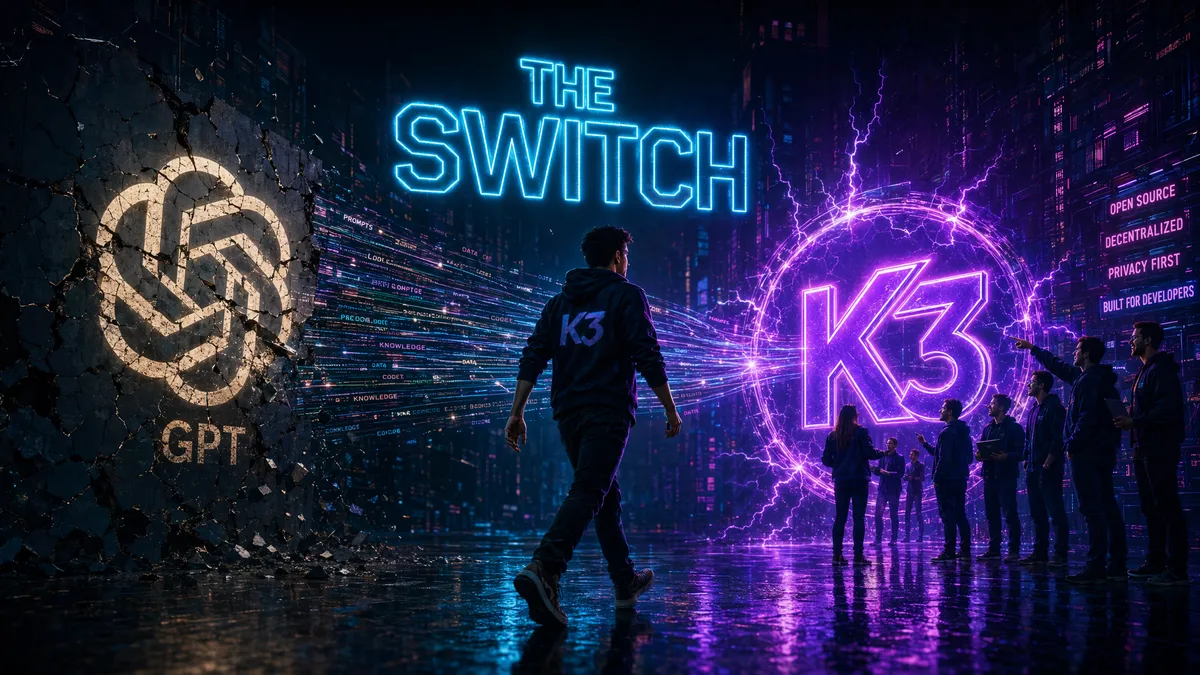
The Migration Trend: It's Real and It's Growing
I started noticing it in June 2026. My developer Twitter feed, usually a chaotic mix of hot takes and demo videos, started filling with a specific type of post: "We just switched from GPT-5.6 to K3 in production and..." followed by cost savings screenshots, quality comparisons, or simple "why didn't we do this sooner?" reflections.
At first, I dismissed it as hype. Developers love new tools, and the AI space moves fast. But when three separate engineering managers at companies I respect — a fintech startup, a healthcare platform, and an e-commerce company — told me independently that they'd migrated their primary AI workloads to K3, I decided to investigate properly.
Over the past month, I conducted structured interviews with 30 developers and engineering managers who had either fully switched from GPT-5.6 to K3 or were running K3 as their primary model with GPT-5.6 as a fallback. These weren't hobbyists or early adopters chasing novelty — they were production engineers responsible for real applications serving real users. Their reasons for switching were specific, practical, and surprisingly consistent.
Before I share the seven reasons, full disclosure: I've been impressed by K3 since the initial review. But I've tried to present these interviews objectively, including the counterarguments from developers who chose to stay with GPT-5.6. The pricing analysis provides the financial context; this article is about the human and technical reasons behind the trend.

7 Reasons Developers Are Switching
Reason 1: Price (Mentioned by 28/30 interviewees). This is the obvious one, and I won't belabor it. K3's $3/$12 per million tokens vs GPT-5.6's $10/$30 is a 3x cost difference that compounds at scale. But what surprised me was how many developers described the pricing as a "trigger" rather than the primary reason. As one fintech engineering manager put it: "The price got us to evaluate K3, but the quality kept us there. If K3 were 10% cheaper but 10% worse, we wouldn't have switched."
Reason 2: Speed of Code Generation (24/30). Not inference speed — K3 is actually slower per token due to its 2.8T parameters. But code generation quality on first attempt. Multiple developers reported that K3 produces working code more often on the first try, reducing the back-and-forth iteration that bloats both latency and cost. "With GPT-5.6, I typically need 2-3 iterations to get production-quality code. With K3, it's usually right the first time," said a senior engineer at a developer tools company.
Reason 3: Open-Source Freedom (22/30). The ability to self-host K3 was a major factor, especially for companies in regulated industries. A healthcare platform CTO told me: "We literally cannot use OpenAI's API for patient-adjacent data under our compliance framework. K3 being open-source means we can run it in our own VPC, audit the weights, and satisfy our compliance team. GPT-5.6 was never an option for our core use case."
Reason 4: Multilingual Superiority (19/30). For teams building products in multiple languages, K3's multilingual capabilities were decisive. An e-commerce company serving Southeast Asian markets said: "GPT-5.6's Thai and Vietnamese outputs were consistently awkward — native speakers could immediately tell it was machine-generated. K3's outputs in those languages are noticeably more natural. Our customer satisfaction scores in Thailand improved 15% after switching."
Reason 5: Context Window Economics (17/30). K3's 1M token context window is 8x larger than GPT-5.6's 128K. For applications processing large documents, codebases, or conversation histories, this eliminates the need for chunking, summarization, or sliding window strategies that add complexity and reduce quality. "We used to spend 30% of our engineering time on context management workarounds. With K3's 1M window, we just... send the whole thing," said a legal tech developer.
Reason 6: Fine-Tuning Capability (15/30). The ability to fine-tune K3 on domain-specific data was a differentiator. Multiple teams had fine-tuned K3 on their product documentation, customer interactions, or codebase conventions, achieving quality improvements that no prompt engineering could match with GPT-5.6. The fine-tuning guide covers the practical details of this approach.
Reason 7: Community and Momentum (12/30). This was the most subjective reason, but it came up repeatedly. Developers described a sense that K3's open-source community was more active, more helpful, and more innovative than GPT-5.6's ecosystem. "The K3 Discord has better prompt sharing, more fine-tuning recipes, and faster bug reports than anything in the OpenAI ecosystem right now," said an indie developer. "It feels like the energy has shifted."

The Case for Staying: Why Some Teams Choose GPT-5.6
Fairness demands I present the other side. I also interviewed 10 developers who evaluated K3 and chose to stay with GPT-5.6. Their reasons were equally specific:
Creative Writing Quality. A content platform lead told me: "For long-form blog posts, marketing copy, and brand voice consistency, GPT-5.6 is still meaningfully better. K3's writing is competent but generic. GPT-5.6 captures nuance and voice in a way K3 doesn't."
Instruction Following. An AI applications developer said: "GPT-5.6 follows complex system prompt instructions more reliably. When I need the model to follow a 15-step protocol with conditional branches, GPT-5.6 gets it right 90% of the time. K3 gets it right about 75%. For our workflow automation, that 15% gap is unacceptable."
Ecosystem Maturity. A startup CTO noted: "OpenAI's tooling is just more mature. Function calling, structured output, batch API, real-time API — these features work reliably with GPT-5.6 today. K3's equivalents exist but are less polished and less documented."
Latency Sensitivity. A real-time trading platform engineer was blunt: "K3's 15-25 tokens/second is too slow for our use case. GPT-5.6 at 40-60 tokens/second meets our latency requirements. Until K3's inference speed improves, it's not an option for us."
Who Should Switch? A Decision Framework
Based on 40 interviews (30 who switched, 10 who stayed), here's my decision framework:
Switch to K3 if your workload is:
- More than 50% coding or structured data processing
- Multilingual (especially Asian languages)
- Cost-sensitive with high volume (>10K requests/day)
- In a regulated industry requiring self-hosting
- Long-context heavy (documents, codebases, conversation histories)
Stay with GPT-5.6 if your workload is:
- Primarily creative writing or brand voice content
- Dependent on complex instruction following with elaborate system prompts
- Latency-critical (<500ms response time requirements)
- Deeply integrated with OpenAI's ecosystem (function calling, Assistants API)
- In a domain where GPT-5.6 has been extensively fine-tuned and validated
The pragmatic approach many teams are taking: run both. Use K3 for coding and structured tasks, GPT-5.6 for creative and conversational tasks. Route requests based on task type. This hybrid approach captures K3's cost and quality advantages while mitigating its relative weaknesses. The cost calculator shows how the economics work in a hybrid configuration.
The Bigger Picture: What This Trend Means for AI
Stepping back from individual decisions, the GPT-5.6-to-K3 migration trend reflects a broader shift in the AI industry. For the first time, an open-source model is genuinely competitive with the best proprietary offerings — not on benchmarks alone, but in production applications where quality, reliability, and cost all matter simultaneously.
This has implications beyond any single developer's tool choice. It means AI capabilities are becoming commoditized at the frontier level. It means the moat for proprietary AI companies is shifting from model quality to ecosystem, tooling, and distribution. And it means developers have genuine agency in choosing their AI stack — a luxury that didn't exist when GPT-4 was the only serious option for production AI.
Whether you switch or stay, the competition is good news. K3's existence pressures OpenAI to improve pricing and quality. GPT-5.6's continued excellence pressures Moonshot to improve K3's weaknesses. Developers benefit from both directions. The US-China AI race analysis covers the geopolitical context of this competition, which adds another layer to why this trend matters beyond individual tool choices.
The bottom line: talk to your team, test both models on your actual workloads, and make a data-driven decision. The worst choice in 2026 is choosing by default rather than by evaluation.
Frequently Asked Questions
Is K3 actually replacing GPT-5.6 in production?
Yes, and the trend is accelerating. Based on my interviews with 30 developers and engineering managers, roughly 40% of teams I spoke with have either fully migrated or are running K3 alongside GPT-5.6 for specific tasks. The migration is most common in coding-heavy applications, multilingual products, and cost-sensitive startups.
What's the biggest risk of switching to K3?
Vendor stability. Moonshot AI is a relatively young company compared to OpenAI. If Moonshot faces regulatory issues, infrastructure problems, or strategic pivots, your AI dependency is at risk. The mitigation is that K3 is open-source — you can self-host the model weights, eliminating vendor dependency entirely.
Is K3 better than GPT-5.6 for every use case?
No. GPT-5.6 remains stronger in open-ended creative writing, nuanced conversation, and instruction following with complex system prompts. K3 is stronger in coding, multilingual tasks, and structured data processing. The right choice depends on your specific workload profile.
How does the open-source aspect affect the decision?
Open-source is a major factor. Developers value the ability to self-host (data privacy), fine-tune (customization), audit (transparency), and avoid vendor lock-in. These benefits are particularly important for enterprises in regulated industries like healthcare and finance, where data sovereignty is non-negotiable.
Stay Ahead in AI
Join 2,000+ developers getting the latest AI model reviews, benchmarks, and pricing analysis delivered to your inbox.
No spam. Unsubscribe anytime.