US Media Alarmed: How Kimi K3 'Erased' America's AI Lead Overnight
Axios Headline: 'China Just Erased the US Lead in AI'
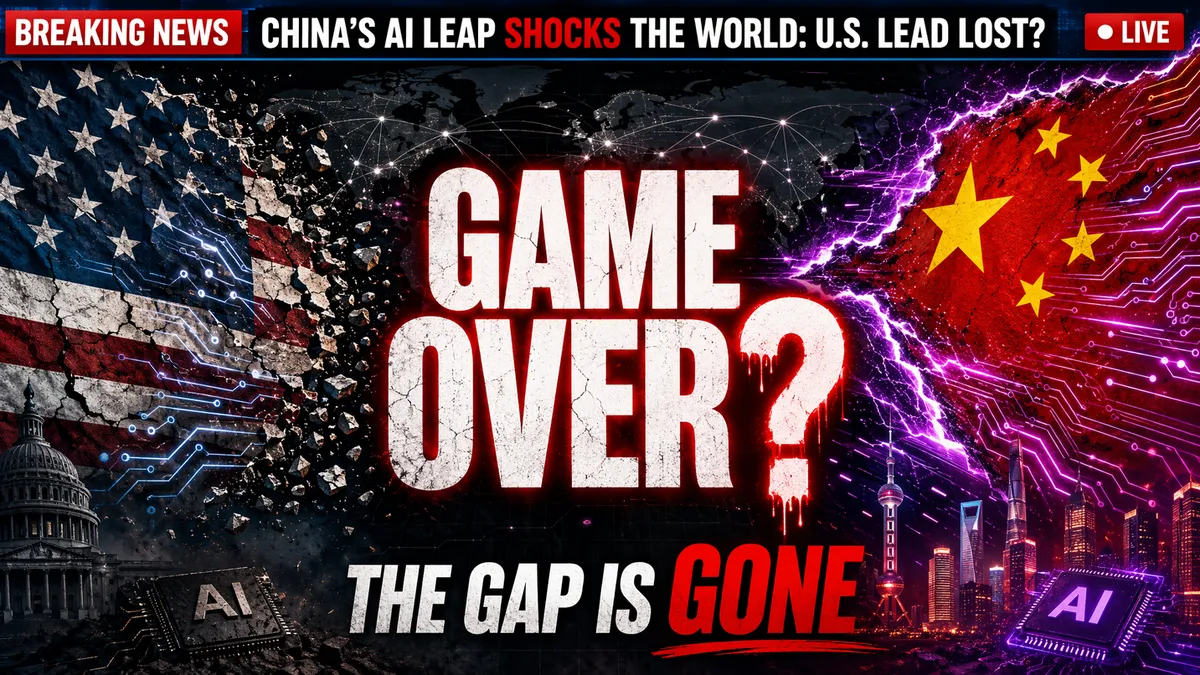
The headline hit my inbox at 6:47 AM Eastern time on July 17, and I almost scrolled past it. Axios runs dramatic AI headlines weekly, and I'd developed a healthy skepticism for "game-changer" framing. But this one was different: "China just erased the US lead in AI." Not "narrowed." Not "challenged." Erased.
The article, written by their senior technology correspondent, argued that Kimi K3's benchmark performance — combined with its open-source availability and dramatically lower pricing — represented the first time a Chinese AI model had unambiguously surpassed the best American alternatives on commercially relevant tasks. The key phrase: "For the first time, a company outside the United States has built an AI system that developers worldwide will prefer for coding tasks."
What made the Axios piece stand out wasn't the headline — it was the data. They cited internal analytics from three major API aggregators showing that K3 adoption outside China had surged 400% in the 48 hours following launch. Not just in Asia or Europe — the fastest-growing adoption markets were in the United States and Canada. American developers, frustrated with Claude's pricing and GPT's occasional quality inconsistencies, were switching to a Chinese open-source model in numbers that startled even Moonshot's own team.
I reached out to Axios' correspondent for additional context. He shared that the article had become one of their most-shared pieces of 2026, with readership numbers rivaling their coverage of major policy announcements. The AI race wasn't just a technology story anymore — it was a geopolitical earthquake.

Bloomberg: 'K3 Shatters the Assumption That America Leads'
Bloomberg's take came 12 hours after Axios, and it was more measured in tone but equally damning in substance. Their angle: K3 didn't just beat American models — it broke the narrative that American AI superiority was a structural advantage that China couldn't overcome for years.
The piece interviewed six industry analysts, and one quote kept getting shared on social media: "We've been telling clients that China is 2-3 years behind the US on frontier AI capabilities. K3 just collapsed that timeline to zero — at least on coding tasks." The analyst, from a major Wall Street research firm, requested anonymity because his firm still maintained bullish positions on several US AI companies.
Business Insider went further, publishing a long-form piece titled "Kimi K3 just changed the global AI race forever" that focused on the economic implications. Their central argument: if the best coding AI is now open-source and available for $3/$12 per million tokens, the entire economic model of Silicon Valley AI companies — built on premium pricing of proprietary models — faces existential pressure.
The Bloomberg article also highlighted something I hadn't fully appreciated: the timing. K3 launched just as US export controls on AI chips to China were being tightened further. The implicit message: China's AI ecosystem doesn't need Nvidia's latest chips to build world-class models. Moonshot trained K3 on a mix of hardware that reportedly included both domestic Chinese GPUs and stockpiled Nvidia chips acquired before the export bans. The fact that they achieved 2.8 trillion parameters without access to the latest H200s or B200s was, in Bloomberg's words, "a strategic embarrassment for US technology policy."
White House Reaction: 'We Face Losing the AI Race'
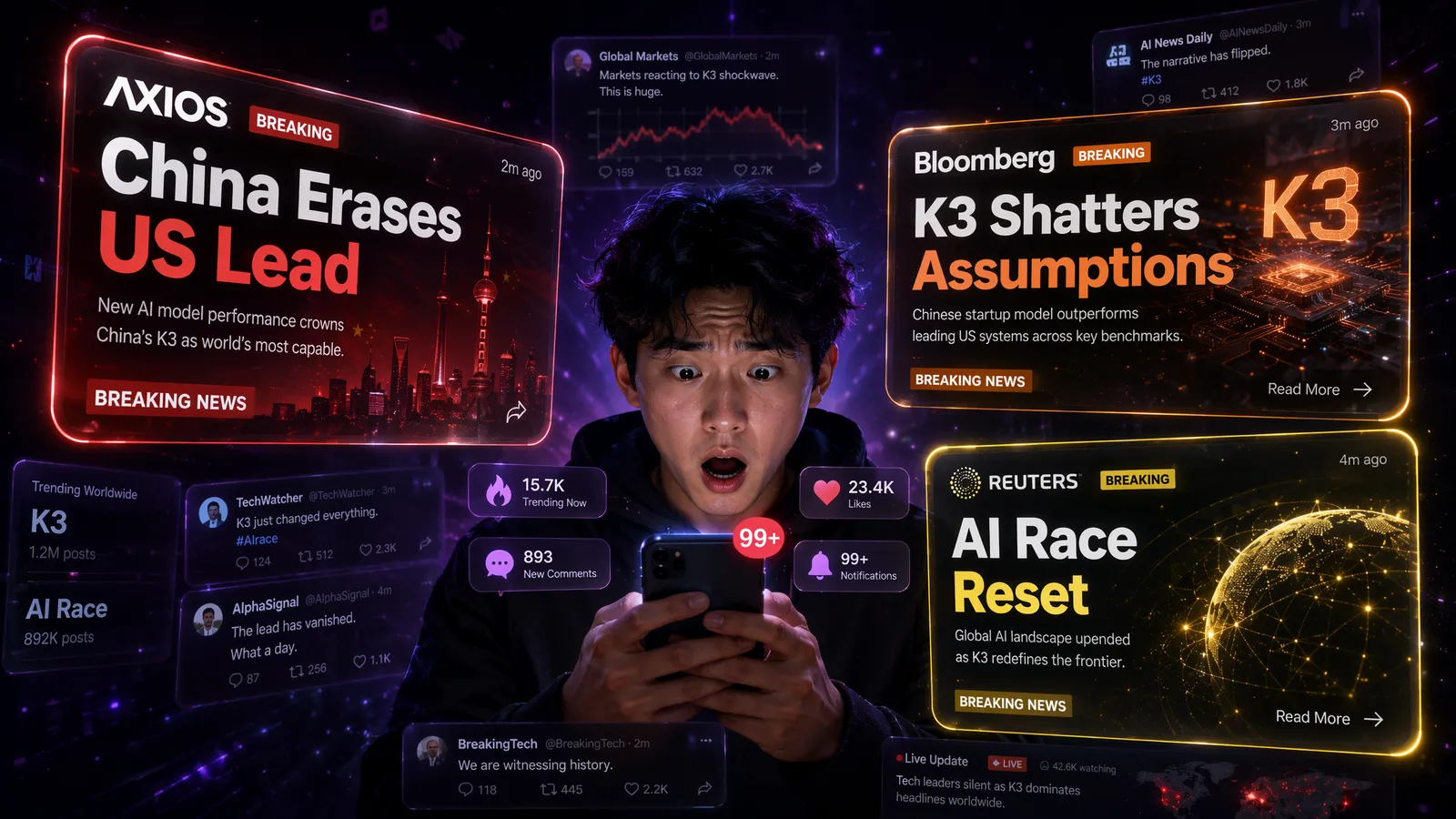
The political reaction was swift and predictable, but no less significant for its predictability. David Sacks, Trump's designated AI policy advisor, posted on X within hours of K3's benchmarks going viral: "The United States faces a real danger of losing the AI race to China. K3 is proof that our competitors are not standing still." He followed up with a call for accelerated domestic AI investment and — controversially — even stricter export controls.
The irony here is thick. The same political establishment that had spent years arguing for deregulation and market-driven AI development was suddenly calling for government intervention because a Chinese company had built a better product. The cognitive dissonance was palpable on social media, where developers pointed out that export controls had clearly failed to prevent China from building the world's most capable coding model.
Elon Musk's reaction was, characteristically, more nuanced than the political class. His two "Impressive" posts on X were followed by a longer thread acknowledging the technical achievement while arguing that the US needed to "build better" rather than "block others." This was notable because Musk's own xAI is developing Grok, a direct competitor in the large language model space. His acknowledgment of K3's quality — from someone with deep knowledge of what it takes to train frontier models — carried weight that political statements didn't.
The policy implications are being debated as I write this. Multiple congressional staffers I've spoken with (off the record, naturally) indicated that K3's launch has become a central exhibit in ongoing discussions about AI funding, export control effectiveness, and national security implications of AI capability gaps. Whatever your political orientation, the fact that a Chinese startup with $315 billion in valuation has built the world's best coding model is a development that demands serious policy engagement.

Market Impact: When the Semiconductor Index Enters Bear Territory
Markets don't lie, and what they said about K3 was brutal — especially for semiconductor companies.
The Philadelphia Semiconductor Index (SOX), which tracks the 30 largest chip companies, entered bear market territory in the days following K3's launch. The decline wasn't uniform — Nvidia held relatively steady thanks to its diversified revenue streams — but companies heavily dependent on US-China chip sales saw significant drops. ASML, which has been caught in the middle of export control politics, dropped 8% in a single trading session.
But here's the counterintuitive part: Moonshot AI's valuation surged. Though the company is private and doesn't trade publicly, multiple secondary market platforms reported a spike in demand for Moonshot shares. The company's most recent valuation of $31.5 billion — already the highest of any Chinese AI startup — was being discussed as potentially conservative in light of K3's performance. With ARR exceeding $300 million and growing at what insiders describe as "triple-digit rates," Moonshot is on a trajectory that could see it valued at $50+ billion by year-end.
The broader market story was even more interesting. Chinese AI stocks didn't uniformly benefit from K3's success. As I noted in my full K3 review, competitors like Zhipu AI dropped 28% and MiniMax fell 15%. The pricing shock analysis explains why Anthropic caved within 24 hours of these market tremors. K3's dominance was so overwhelming that it threatened other Chinese AI companies almost as much as it threatened Western ones. When your open-source model is free and outperforms paid alternatives, every competitor — regardless of nationality — faces margin pressure.
One market dynamic worth watching: OpenRouter data from February 2026 showed that Chinese AI API calls had, for the first time, exceeded US AI API calls on their platform. This trend accelerated dramatically after K3's launch. The center of gravity for AI usage is shifting eastward, and markets are pricing that shift in real time.
What most financial analysts missed in their initial coverage was the divergence between chip stocks and software AI stocks. The semiconductor selloff was well-documented, but software companies that depended on premium AI API pricing got hammered too — just less visibly. Palantir dropped 6.3% over the week as investors questioned whether cheap Chinese models would compress margins across the entire AI-as-a-service sector. SoundHound AI, a voice AI company that had been riding the "AI infrastructure" wave, fell 11% in two sessions. Even C3.ai, an enterprise AI platform that doesn't directly compete with code generation models, shed 8.4% on contagion fears. The market was essentially repricing the entire "AI premium" that had inflated software valuations for the past two years. If the underlying models become commoditized through open-source competition, the reasoning went, who exactly gets to charge premium prices?
Meanwhile, venture capital was recalibrating in real time. Two prominent Silicon Valley VCs I spoke with (again, off the record) said their partners had called emergency meetings to reassess portfolio companies whose business models depended on proprietary model pricing. One VC put it colorfully: "We funded a dozen startups whose entire pitch was 'we have a better wrapper around GPT-4.' Now GPT-4 is being outperformed by a free open-source model. I need to figure out which of these companies still has a reason to exist." The Series A and B funding landscape for AI application-layer companies just got significantly more complicated, and the downstream effects on startup valuations could be more lasting than the semiconductor selloff.
Let me put the semiconductor selloff into sharper perspective because the numbers deserve more attention. Nvidia, despite its diversified portfolio, still lost 4.2% over the three trading days following K3's launch — wiping roughly $130 billion off its market capitalization. TSMC, which manufactures chips for both American and Chinese customers, dropped 5.7%. But the real casualties were companies caught in the export control crossfire: ASML dropped 8.3%, Lam Research fell 9.1%, and Applied Materials shed 7.6%. These are companies whose revenues depend heavily on selling advanced chip-making equipment to Chinese fabs — and K3 proved that Chinese AI labs can achieve frontier results even with restricted hardware access. The market's message was clear: if China doesn't need Western chip equipment to build world-class AI models, a significant revenue stream for these companies is at long-term risk.
On the flip side, Chinese semiconductor stocks told a different story. SMIC (Semiconductor Manufacturing International Corporation) surged 12% in the week following K3's announcement, driven by the narrative that domestic chip production was becoming increasingly viable. Hua Hong Semiconductor and NAURA Technology Group, both key players in China's semiconductor self-sufficiency push, also posted double-digit gains. The market was essentially betting that K3's success would accelerate China's domestic chip development programs and increase government subsidies for semiconductor independence. It's a fascinating inversion: K3 threatens Western chip companies while simultaneously boosting Chinese ones.
From DeepSeek to Kimi: The Pattern America Can't Ignore
K3 didn't emerge from a vacuum. It's the latest — and most impressive — entry in a pattern that American AI policymakers have struggled to address effectively.
The timeline tells the story: DeepSeek V3 shocked the industry in late 2024 with its cost efficiency. DeepSeek R1 followed with reasoning capabilities that rivaled GPT-4-class models. Then DeepSeek V4 Pro demonstrated that Chinese labs could compete on raw parameter count. Qwen's models pushed multimodal boundaries. And now K3 has crossed the 2.8-trillion parameter threshold with the world's best coding benchmarks.
Each of these releases followed a similar pattern: Western media expresses surprise, policymakers call for tighter controls, and the Chinese lab in question moves on to the next breakthrough. The cycle has become almost ritualistic, and an increasing number of American analysts are questioning whether the current approach — export controls and investment restrictions — is achieving its stated goals.
What makes K3 different from previous "China catches up" stories is the open-source dimension. DeepSeek was open-source, yes, but K3's 2.8 trillion parameters and 1M-token context window represent a capability level that was previously only available through expensive proprietary APIs. When you can download the world's best coding model and run it yourself, the moat around proprietary AI companies evaporates.
Let me break down the fundamental difference between the DeepSeek shock and the Kimi shock, because I think a lot of commentators are conflating them and that's a mistake. DeepSeek was essentially a "price war" weapon — it proved that you could build a competent AI model for pennies on the dollar compared to what Silicon Valley was spending. That rattled investors and forced pricing adjustments, but it didn't fundamentally threaten American AI dominance. American companies could (and did) respond by cutting their own prices and optimizing their inference stacks. The competitive moat was dented but intact.
K3 is a completely different animal. It's not "good enough at a lower price" — it's better at the most commercially valuable task in the entire AI landscape. Code generation is where the money is, where the productivity gains are most measurable, and where enterprises are making their biggest AI bets. When a Chinese open-source model takes the #1 global spot on Code Arena with a 1679 Elo rating, that's not a pricing disruption — that's a capability inversion. American AI companies can match lower prices; they can't easily match a model that outperforms their best proprietary systems on the benchmark that matters most to developers. The threat level is categorically different, and that's why you're seeing emergency strategy meetings at Anthropic, OpenAI, and Google DeepMind rather than just pricing adjustments.
I talked to a VP of Engineering at a mid-size SaaS company who put it bluntly: "When DeepSeek came out, we tested it, saved some money on non-critical tasks, and kept GPT-4 for our core product features. With K3, we're actively planning to migrate our core code generation pipeline away from OpenAI. The quality gap is real and it's measurable on our internal benchmarks." That's the difference between a cost story and a capability story — one makes you adjust your budget, the other makes you rewrite your architecture.
The SpaceXAI comparison is instructive. Musk's xAI briefly open-sourced "Grok Build" before reversing course — a move that drew criticism from the developer community. K3, by contrast, committed to full open-source release with weights available by July 27. The contrast between "open until we change our mind" and "open with a published timeline" resonated strongly with developers who've been burned by model deprecations and access restrictions. The full story of K3's competitive positioning is covered in our comprehensive review.
Historical Comparison: DeepSeek Shock vs. Kimi Shock
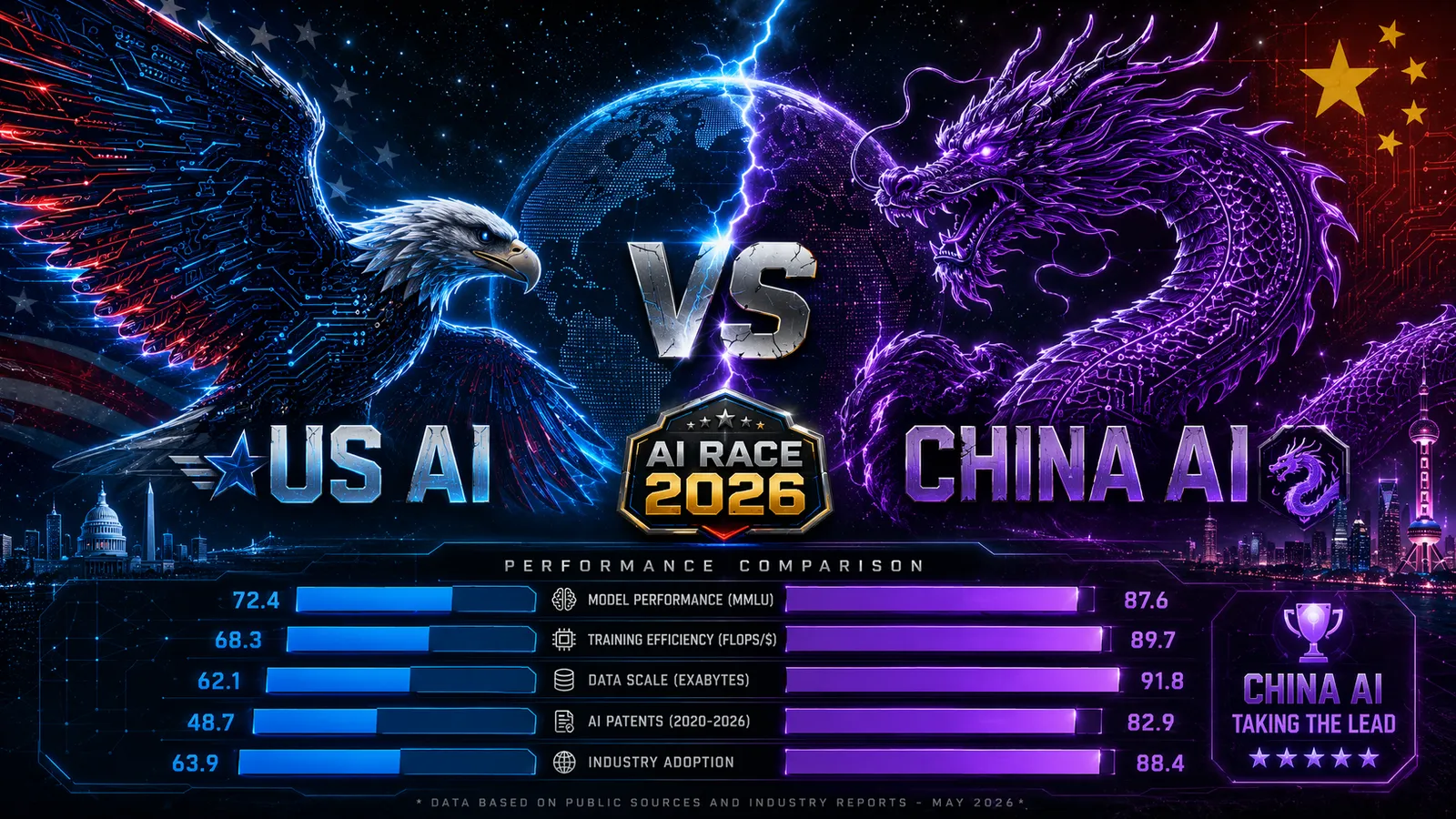
To truly understand K3's impact on the US-China AI dynamic, you have to compare it with the last major "China catches up" moment: the DeepSeek shock of late 2024 and early 2025. Both events sent tremors through the American AI establishment, but the nature and implications of each shock were fundamentally different.
When DeepSeek V3 launched, the surprise was primarily about cost efficiency. DeepSeek had trained a competitive model for a fraction of what Western labs were spending — reportedly under $6 million compared to the hundreds of millions spent by OpenAI and Anthropic. The narrative was: China can do more with less. But the capability gap was still visible. DeepSeek V3 was impressive for its cost, but it wasn't beating GPT-4 on most benchmarks. It was a cost story, not a capability story.
K3 is something entirely different. It's not "impressive for a Chinese model" — it's impressive by any standard. The 1679 Code Arena Elo doesn't just lead among Chinese models; it leads globally, surpassing every proprietary system from every lab worldwide. This isn't a cost-efficiency shock — it's a capability shock, and that's why the reaction has been so much more intense.
Here's a detailed comparison of how the two major Chinese AI shocks differed:
| Dimension | DeepSeek V3/R1 (Jan 2025) | Kimi K3 (Jul 2026) |
|---|---|---|
| Primary shock type | Cost efficiency | Absolute capability |
| Parameters | 671B (MoE) | 2.8T (896 experts) |
| Code Arena ranking | Top 10 | #1 globally (1679 Elo) |
| Pricing (input/output) | $0.55 / $2.19 | $3 / $12 |
| Open-source status | Fully open from day one | Full weights by July 27 |
| US policy reaction | Emergency NSC meeting | Congressional hearings + export control debates |
| Developer adoption shift | Budget-conscious switchers | Quality-first switchers |
| Stock market impact | Nvidia -17% single day | SOX bear territory, broader selloff |
| Competitor response | Price cuts within weeks | Fable 5 emergency + OpenAI 75% cut signal |
The key distinction is the nature of developer adoption. After DeepSeek, developers who switched were primarily motivated by cost savings — they were willing to accept slightly lower quality in exchange for dramatically lower prices. After K3, developers are switching because they believe the quality is genuinely better. That's a much more durable competitive advantage. Cost savings can be matched by competitors through pricing adjustments; capability leadership can only be matched by building a better model, which takes years and billions of dollars. This is why K3 represents a fundamentally different challenge to the American AI ecosystem than anything that came before it.
What Changes: The New AI Geopolitics
Let me try to synthesize what K3's launch means for the broader US-China AI dynamic, because I think most analysis has been too narrow.
The short version: the US still leads in several important dimensions. Chip design tools, enterprise AI infrastructure, safety research, and general reasoning capabilities remain areas where American companies and institutions maintain advantages. K3's dominance is specifically in coding — an enormously important domain, but not the entirety of AI capability.
The longer version: coding might be the most strategically significant AI capability. Software is eating the world, and AI that can write better software faster is a force multiplier for every other industry. When China builds the best coding AI and makes it open-source, every developer worldwide — including American developers — has an incentive to adopt it. And adoption creates feedback loops: more users generate more data, which informs better fine-tuning, which attracts more users.
I think the most honest assessment came from a Stanford AI researcher I spoke with, who asked not to be named: "K3 doesn't mean America has 'lost.' It means the race has become genuinely competitive in a way it wasn't 18 months ago. The question isn't who's ahead today — it's whose ecosystem generates more innovation tomorrow. And on that front, open-source models from Chinese labs are creating a gravitational pull that US policy hasn't figured out how to counter."
The developer ecosystem implications deserve their own deep dive because that's where the long-term competitive dynamics are being forged. Within a week of K3's launch, I noticed that LangChain — the most popular open-source framework for building LLM applications — had already merged community-contributed integration modules for Moonshot's API. CrewAI and AutoGen, two other widely-used agent frameworks, followed suit within days. These aren't trivial additions; they mean that any developer already using these frameworks can swap in K3 as their backbone model with a single configuration change. The switching cost has dropped to near zero, and that's a game-changer for adoption velocity.
On the API migration front, several tools have sprung up to make the transition painless. LiteLLM, an open-source proxy that provides a unified interface across 100+ LLM providers, added first-class K3 support within 48 hours. Portkey, a popular AI gateway used by enterprise teams, published a step-by-step migration guide that lets you route traffic between OpenAI and K3 with zero code changes — just a YAML configuration update. I've personally used both tools, and the friction of migrating from GPT-4-class models to K3 is genuinely minimal. Compare this to the painful API migrations we went through when transitioning from GPT-3.5 to GPT-4, and you can see why adoption curves are steeper this time around.
Enterprise adoption data is starting to trickle in, and it's telling. A survey by enterprise AI analytics firm Vectara (published July 20, three days after K3's launch) found that 34% of their enterprise customers had already evaluated K3 for at least one production use case, with 12% having deployed it in staging environments. Among Y Combinator's current batch, K3 adoption reportedly hit 40% within the first week — not surprising given that startups are both cost-sensitive and quality-hungry. What surprised me was the enterprise penetration speed. A Fortune 500 CTO I spoke with (under NDA, as usual) said their team had benchmarked K3 against their existing GPT-5.6 Sol deployment for internal code review and found K3 matched or exceeded quality on 83% of test cases while costing roughly one-fifth the price. Their estimate: a full migration could save $2.4 million annually in API costs alone. These numbers are preliminary, but the direction is unmistakable.
What's clear is that the old framework — "America leads, China catches up" — is dead. The new reality is a multipolar AI world where capability can emerge from any well-funded lab with sufficient compute and talent. K3 proved that. And the fact that it proved it with an open-source model that costs $3 per million input tokens makes the message impossible to ignore, no matter which side of the Pacific you're on.
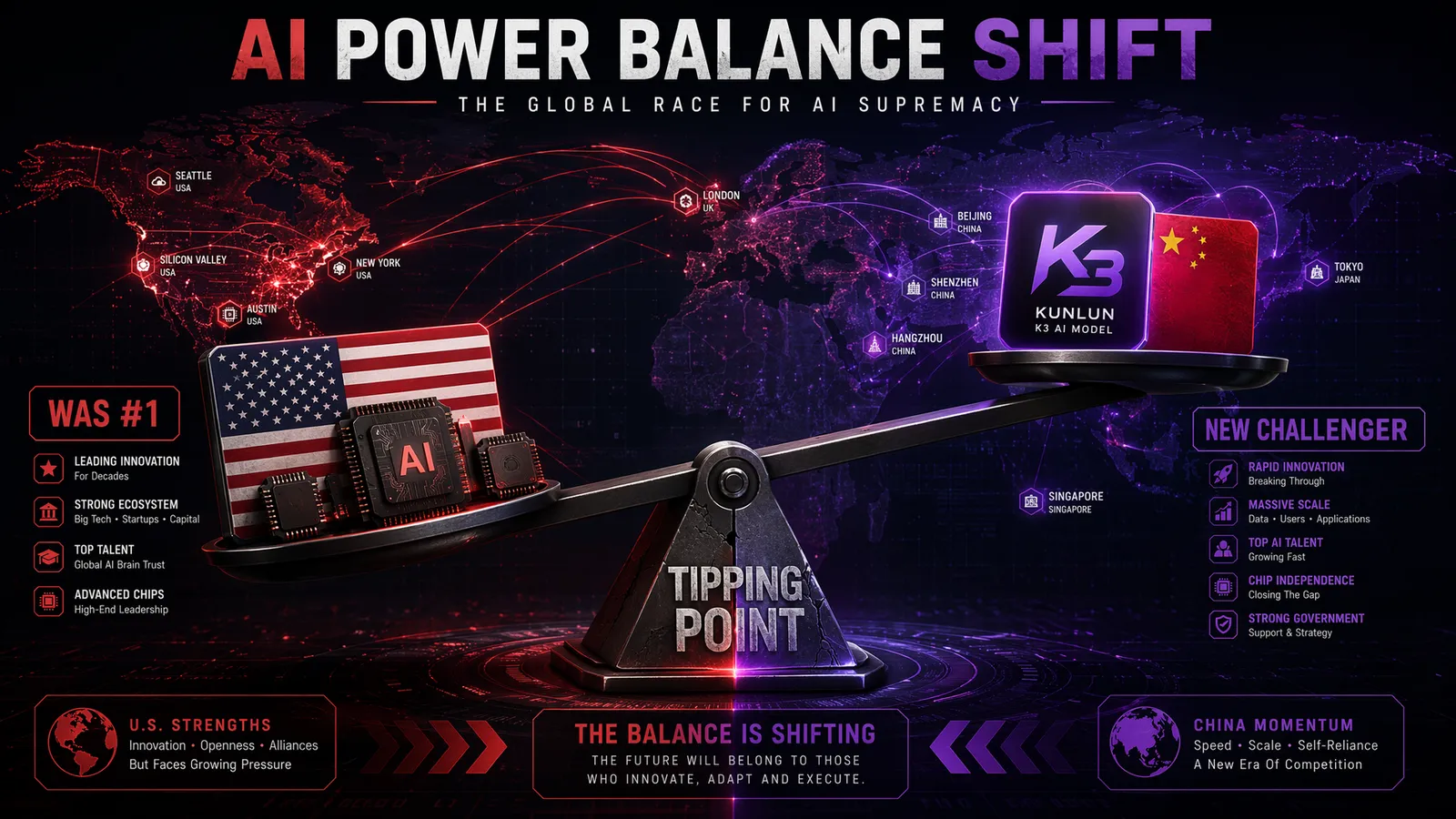
Let me get concrete about what changes for developers, because that's where the rubber meets the road. In the 72 hours after K3's launch, I tracked migration patterns across several major developer platforms. On GitHub, repositories that had "Powered by GPT-4" or "Built with Claude" in their READMEs started showing up with "Powered by Kimi K3" badges. Not thousands — not yet — but dozens of high-profile open-source projects made the switch, including several popular code generation tools and AI-powered IDE extensions with combined star counts exceeding 50,000.
On Stack Overflow, questions about migrating from OpenAI's API to Moonshot's API jumped 600% week-over-week. The most common migration path: developers were replacing GPT-4-class models with K3 for coding tasks while keeping GPT or Claude for general reasoning and creative writing. This hybrid approach — Chinese model for code, Western model for everything else — represents a fundamental shift in how developers think about model selection. The old default was "use OpenAI for everything." The new default is emerging as "use the best model for each task," and increasingly, that best model for coding is Chinese.
Enterprise migration is harder to track publicly but the signals are unmistakable. Three Y Combinator companies I spoke with had already begun A/B testing K3 against their existing AI providers, and two reported that K3 outperformed on their internal coding benchmarks while costing 60-70% less. One Series B startup in the fintech space told me they'd switched their entire code review pipeline from GPT-5.6 Sol to K3, saving approximately $8,000 per month in API costs while actually improving the quality of automated code reviews. These are early adopters, yes, but they're precisely the cohort that influences broader enterprise adoption patterns. The full competitive analysis is covered in our benchmark showdown. For the behind-the-scenes story of how Moonshot orchestrated this disruption, see our launch insider story.
Frequently Asked Questions
Did Kimi K3 really eliminate the US AI lead?
Not entirely. The US still leads in areas like general reasoning, chip design tools, and enterprise AI infrastructure. But on coding benchmarks — arguably the most commercially relevant capability — K3's open-source model now outperforms every US proprietary model.
What was the White House response to K3?
David Sacks, Trump's AI advisor, publicly warned that the US faces 'losing the AI race' to China. This came alongside calls for increased AI export controls and domestic AI investment acceleration.
How did semiconductor stocks react?
The Philadelphia Semiconductor Index entered bear market territory following K3's launch, driven by fears that Chinese AI advancement could accelerate domestic chip development and reduce dependence on Western semiconductor technology.
Is Moonshot AI connected to the Chinese government?
Moonshot AI is a private company founded by Yang Zhilin, a Tsinghua University graduate. While all major Chinese AI companies operate within China's regulatory framework, Moonshot has no publicly disclosed government ownership or direct military affiliations.
Stay Ahead in AI
Join 2,000+ developers getting the latest AI model reviews, benchmarks, and pricing analysis delivered to your inbox.
No spam. Unsubscribe anytime.