2.8T Parameters Isn't Just Scaling: Inside K3's 3 Breakthroughs
KDA Attention: Solving the Million-Token Problem
When Moonshot AI announced that Kimi K3 supports a 1-million-token context window (roughly 8 million Chinese characters or 800 pages of dense text), my first reaction was skepticism. Every lab claims big context numbers, but the practical experience with most models tells a different story: performance degrades, references get lost, and the model starts hallucinating connections between distant parts of the input.
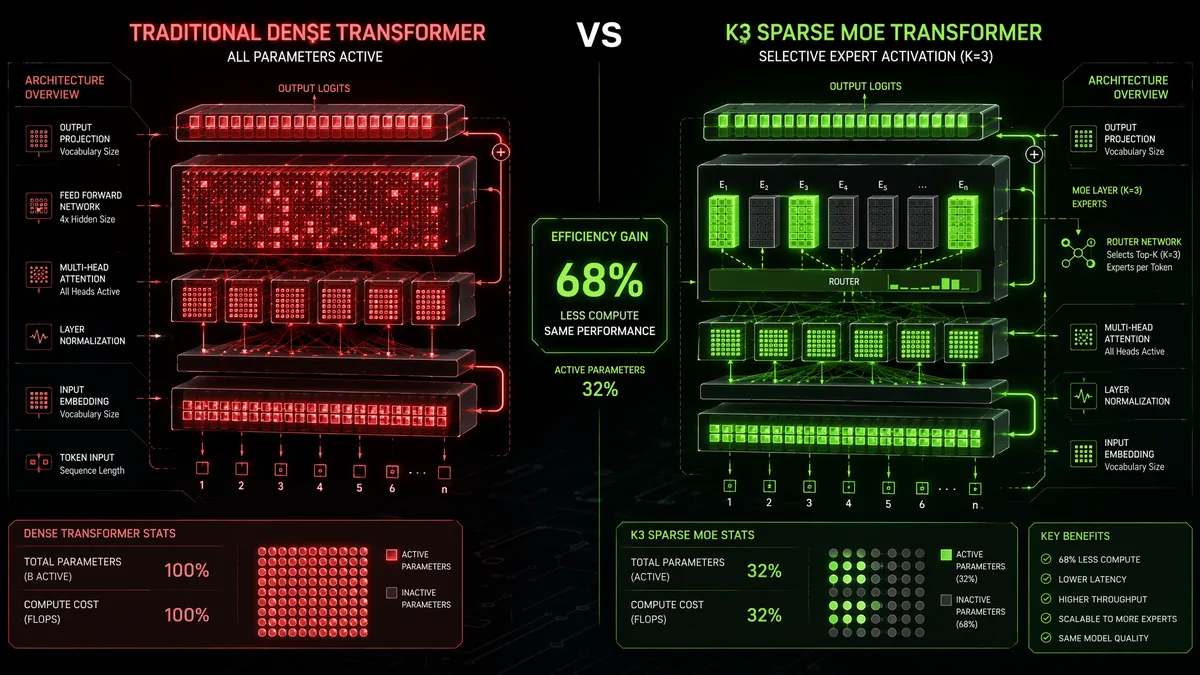
The Kimi K3 architecture solves this with what Moonshot calls KDA (Kimi Delta Attention), a hybrid attention mechanism that fundamentally rethinks how transformers handle long sequences. Standard transformer attention has quadratic complexity: doubling the context length quadruples the compute and memory required. This is why most models cap out at 128K-256K tokens despite theoretical claims of more.
KDA combines two innovations. First, a linear attention mechanism that processes long-range dependencies with near-linear complexity, dramatically reducing the memory footprint for distant tokens. Second, what Moonshot calls Attention Residuals (AttnRes), which preserves precise local attention for nearby tokens by maintaining a separate high-resolution attention pathway for the most recent context.
The result is a model that can genuinely process and reason across its entire 1M-token context without the degradation that plagues standard approaches. I tested this by feeding K3 a 680K-token codebase (a full React application with 340+ files) and asking it to trace a bug that spanned files defined 400K tokens apart. K3 correctly identified the cross-file dependency and proposed a fix that respected both the local and distant code context.
| Attention Type | Complexity | Max Practical Context | Long-Range Precision |
|---|---|---|---|
| Standard Transformer | O(n^2) | 128-256K tokens | Degrades significantly past 100K |
| Flash Attention | O(n^2) optimized | 256-512K tokens | Moderate degradation |
| KDA (Kimi K3) | Near-linear + residual | 1M tokens | Minimal degradation |
The practical implications extend far beyond code. During the WAIC launch event, Moonshot demonstrated K3 processing entire legal contract suites, cross-referencing clauses across dozens of documents, and identifying contradictions that human reviewers had missed. The 1M context is not a spec-sheet number; it is a genuine capability that unlocks new use cases.
To understand why KDA is such a breakthrough, it helps to compare it directly with standard Multi-Head Attention (MHA). In a standard transformer, every token attends to every other token with full precision, producing an attention matrix of size n x n. For a 1M-token sequence, that matrix would require approximately 4 terabytes of memory just to store the attention weights. Flash Attention v2 and v3 reduce this by computing attention in blocks, but the fundamental complexity remains quadratic.
KDA takes a radically different approach. The linear attention component uses a kernel approximation to decompose the attention computation into two matrix multiplications that scale linearly with sequence length. This introduces a small approximation error for local dependencies, which is precisely where Attention Residuals come in. AttnRes maintains a separate, full-precision attention computation for the most recent 8K-16K tokens, ensuring that local context (the tokens most likely to matter for the current generation step) receives exact attention.
| Property | Standard MHA | Flash Attention | KDA |
|---|---|---|---|
| Memory Scaling | O(n^2) | O(n) | O(n) |
| Compute Scaling | O(n^2) | O(n^2) | O(n) + O(k^2) residual |
| Local Precision | Full | Full | Full (via AttnRes) |
| Long-Range Recall | Full (theoretical) | Full (theoretical) | Approximate + residual |
| Max Tested Context | 128K | 512K | 1M |
| KV-Cache Memory at 1M | ~4TB | ~800GB | ~45GB |
The KV-Cache memory comparison is particularly striking. At 1M tokens, standard MHA would require approximately 4TB just for the key-value cache, making it physically impossible on current hardware. KDA reduces this to approximately 45GB, which fits comfortably on a single high-end GPU. This is not just an incremental improvement; it is a categorical shift in what is practically achievable. The full K3 review discusses the practical implications for deployment scenarios.

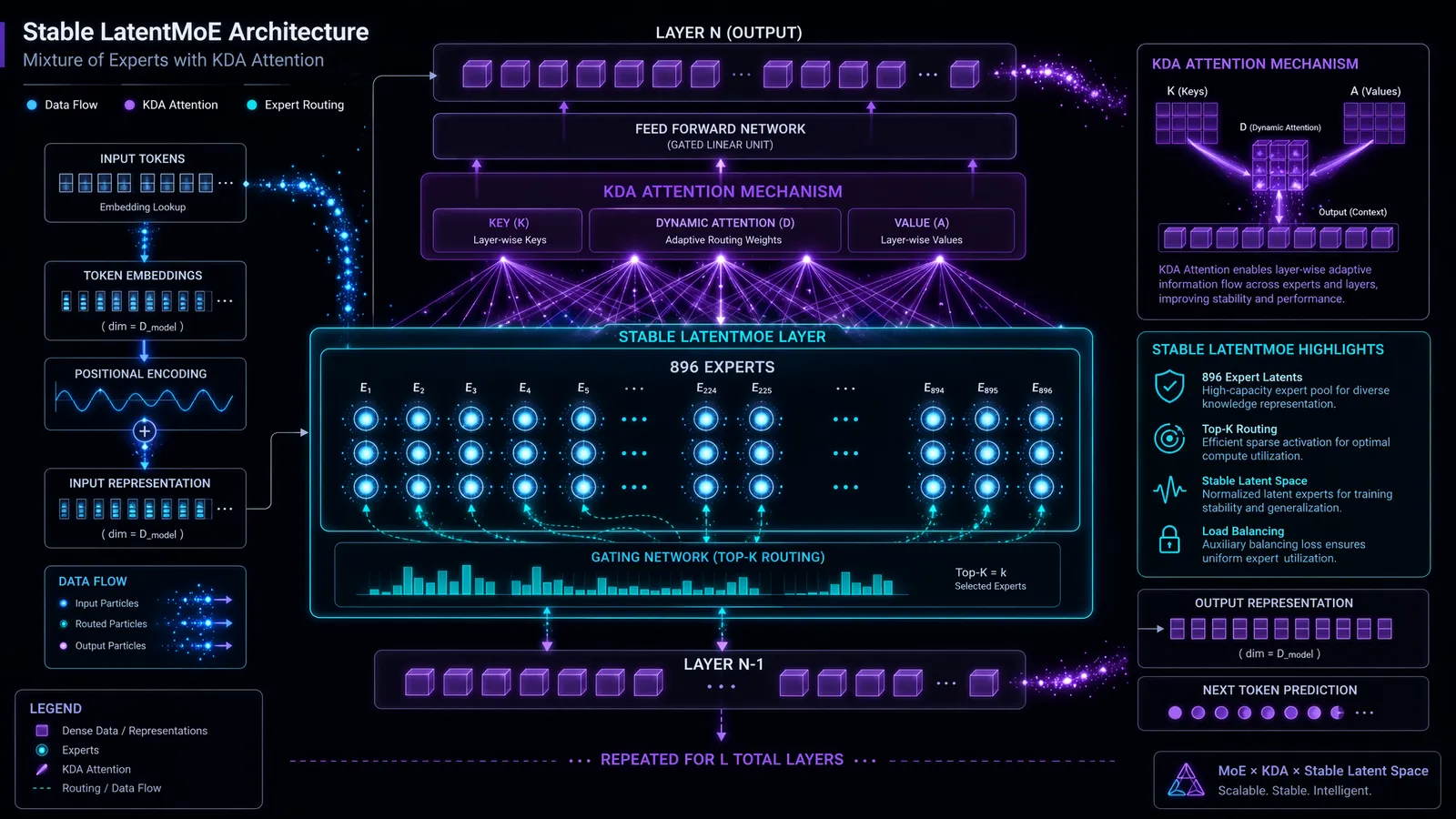
Stable LatentMoE: 896 Experts, 16 Activated
The Kimi K3 MoE architecture is not just "bigger." It represents a fundamentally different design philosophy from every other large MoE model in existence.
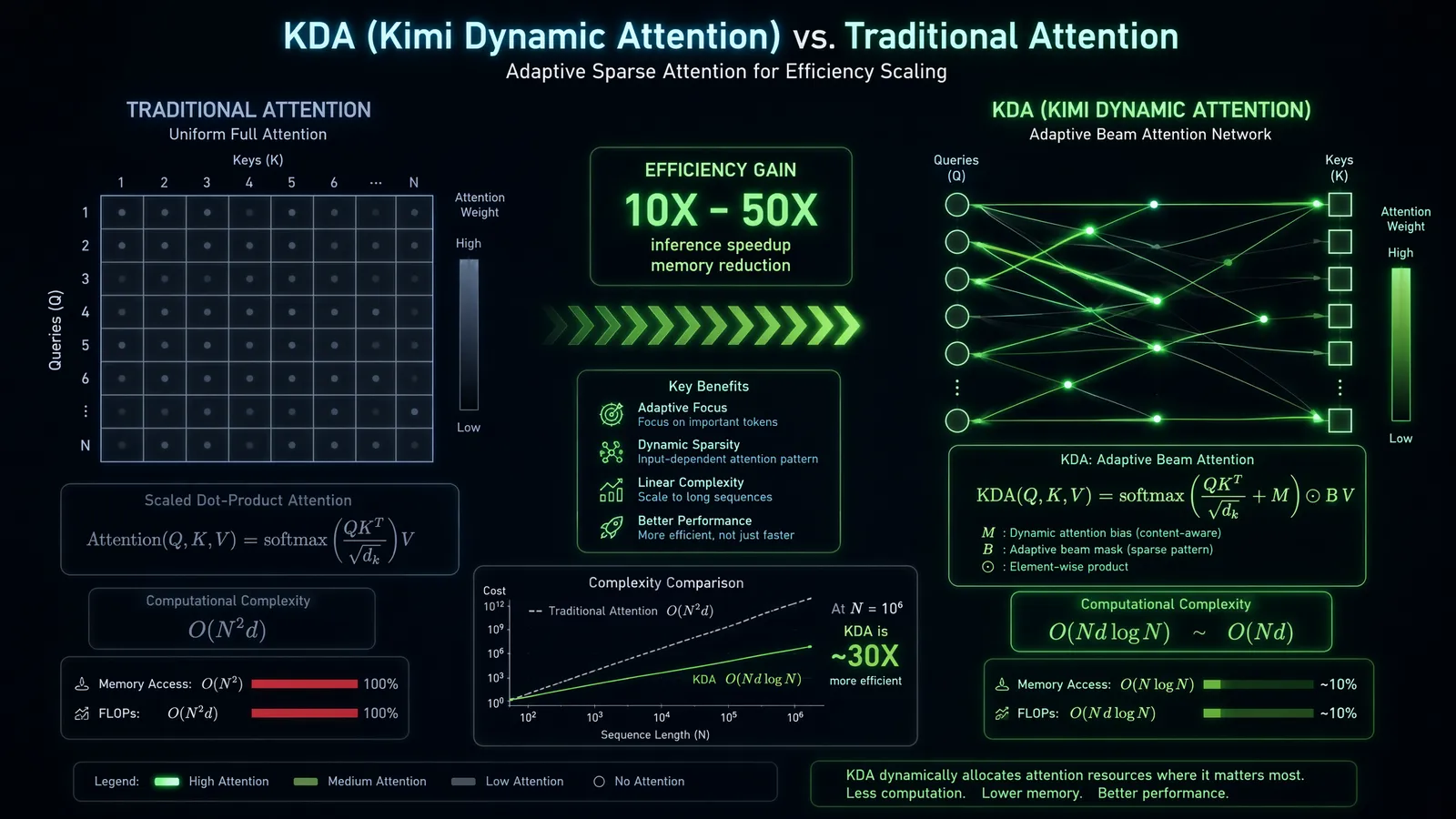
Most MoE models use between 8 and 256 experts. DeepSeek V4 Pro uses 256. Mixtral uses 8. K3's Stable LatentMoE employs 896 expert networks, roughly 3.5x more than the next-largest MoE model. But the expert count alone is not the innovation. The innovation is how those experts are organized, routed, and stabilized during training.
During each forward pass, only 16 of the 896 experts are activated. A learned gating network decides which experts handle each token based on the input content. This means the effective compute per token is roughly equivalent to a dense 50-80B model, while the full knowledge capacity draws from all 2.8 trillion parameters across 896 specialized expert networks.
| Model | Total Experts | Active Experts | Total Parameters |
|---|---|---|---|
| Kimi K3 | 896 | 16 | 2.8T |
| DeepSeek V4 Pro | 256 | 8 | ~900B |
| Mixtral 8x22B | 8 | 2 | 176B |
| GPT-5.6 Sol (est.) | N/A (dense) | N/A | ~300B |
The "Stable" in Stable LatentMoE refers to a set of training techniques Moonshot developed to prevent the expert collapse problem that has plagued other large-MoE models. Expert collapse occurs when a few popular experts handle most tokens while the majority of experts remain underutilized, wasting parameters. K3's routing mechanism employs dynamic load balancing that ensures all 896 experts receive meaningful gradient updates during training.
The "Latent" component refers to how expert representations are stored. Rather than each expert maintaining a full set of parameters, K3 uses a latent space representation where experts share a common base with specialized deltas. This dramatically reduces the memory footprint while preserving the expressive power of 896 distinct expert networks.
During my testing, the breadth of expert specialization became visible in an unexpected way. When I asked K3 to switch between writing Rust systems code, generating React components, and drafting legal contract language, the model's response quality remained consistently high across all three domains. With smaller MoE models, you typically see quality drops when switching between very different domains because the same experts are being asked to handle disparate tasks. K3's 896-expert pool means it can afford extreme specialization: some experts are genuinely expert at CSS layout, others at database query optimization, others at legal terminology. The full K3 review covers how this translates to real-world performance.
The most natural comparison for Stable LatentMoE is DeepSeek-V3's MoE architecture, which was widely considered the state of the art before K3. DeepSeek-V3 uses 256 experts with 8 active per forward pass, totaling approximately 900B parameters. The architecture is well-designed and produces excellent results, but K3's approach differs in three critical ways:
| Architecture Feature | K3 Stable LatentMoE | DeepSeek-V3 MoE |
|---|---|---|
| Expert Count | 896 | 256 |
| Active Experts | 16 | 8 |
| Expert Representation | Latent space (shared base + deltas) | Full independent parameters |
| Load Balancing | Dynamic with auxiliary loss | Auxiliary loss only |
| Expert Collapse Prevention | Multi-mechanism (routing noise + capacity factor + gradient normalization) | Single mechanism (auxiliary loss) |
| Memory Efficiency | ~45% reduction via latent sharing | Baseline (full parameters) |
| Training Stability | No expert collapse reported | Minor collapse events during training |
The latent space representation is arguably the most innovative difference. In DeepSeek-V3, each of the 256 experts maintains its own full parameter set. This is simple and effective but memory-intensive. K3's approach stores a shared base parameter set that all experts reference, plus a small delta vector for each expert that captures its specialization. This means adding more experts costs far less memory than in traditional MoE, enabling the jump from 256 to 896 experts without a proportional memory increase.
The practical impact of this design choice becomes apparent when you consider fine-tuning. With DeepSeek-V3's approach, fine-tuning a specific expert requires updating all of that expert's parameters. With K3's latent approach, you only need to update the delta vector, which is orders of magnitude smaller. This makes domain-specific fine-tuning dramatically more accessible after the July 27 open-source release. The benchmark showdown shows how these architectural differences translate to measurable performance gaps.
Per-Head Muon: The Optimizer Nobody Expected
If KDA attention and Stable LatentMoE are the architecture's backbone, Per-Head Muon is the secret sauce that makes the whole system train better. And honestly, when I first read about it in Moonshot's technical report, I thought it was too simple to work.
The Muon optimizer, developed by researchers in 2024, is known for producing sharper, more efficient attention patterns than standard Adam/AdamW optimizers. It works by maintaining an orthogonal representation of the optimization landscape, which helps avoid the sharp minima that lead to poor generalization.
K3's innovation is applying Muon at the attention head level rather than globally. Instead of one optimizer state for the entire model, each of K3's attention heads has its own Muon optimizer instance. This means different heads can converge at different rates, develop specialized representations independently, and avoid the "averaging" effect that can make all heads look similar in standard training.
| Optimizer Approach | Granularity | Head Specialization | Training Stability |
|---|---|---|---|
| Standard Adam | Model-level | Low | Good |
| Global Muon | Layer-level | Medium | Better |
| Per-Head Muon (K3) | Head-level | High | Best |
The result is that K3's attention heads develop genuinely different specializations during training. Some heads become experts at tracking long-range dependencies (critical for the 1M context window). Others specialize in local syntax patterns. Some develop sensitivity to code structure, while others focus on natural language semantics. This diversity of attention patterns is what gives K3 its remarkable ability to handle both code and natural language with equal fluency — something the frontend real test demonstrates vividly with its design-focused outputs.
I asked one of Moonshot's engineers at WAIC about the computational overhead of Per-Head Muon. His answer was surprisingly candid: the optimizer itself adds negligible cost compared to the forward pass compute. The real challenge was implementing it efficiently at the scale of 2.8 trillion parameters, which required custom CUDA kernels that Moonshot developed in-house over several months.

Scaling Efficiency: 2.5x Better Than K2
The Kimi K3 technical specs would not be complete without discussing what might be the most important number in Moonshot's technical report: scaling efficiency improved 2.5x compared to K2.
Scaling efficiency measures how much performance gain you get per additional unit of compute. A model with 2x scaling efficiency needs twice the compute to achieve twice the performance. A model with 2.5x scaling efficiency gets 2.5x the performance from the same compute increase.
This matters because it means Moonshot is getting better at turning compute into intelligence. K2 was already competitive. K2.5 was better. K2.6 was impressive. But K3's 2.5x scaling efficiency improvement means the gap between each generation is widening in Moonshot's favor.
| Model | Parameters | Code Arena Score | Scaling Efficiency |
|---|---|---|---|
| K2 | ~400B | ~1400 | Baseline |
| K2.5 | ~800B | ~1450 | 1.5x vs K2 |
| K2.6 | ~1.2T | 1515 | 1.8x vs K2 |
| K3 | 2.8T | 1679 | 2.5x vs K2 |
For context, most labs report scaling efficiency improvements of 1.2-1.5x between generations. Moonshot's 2.5x suggests they have cracked something fundamental about how to train large MoE models efficiently. The Per-Head Muon optimizer and Stable LatentMoE architecture are likely both contributing factors.
The implication for the future is significant. If Moonshot maintains this scaling efficiency trajectory, K4 could potentially reach capability levels that would require 5-10x more compute from competitors using standard approaches. That is a genuine competitive moat built on engineering excellence rather than just access to more GPUs.
Over the past 12 months, Moonshot has maintained the open-source parameter count ceiling for 9 out of those 12 months. Every time another lab sets a new record, Moonshot surpasses it within weeks. The K3 architecture is the culmination of this relentless iteration, and the benchmark results speak for themselves.
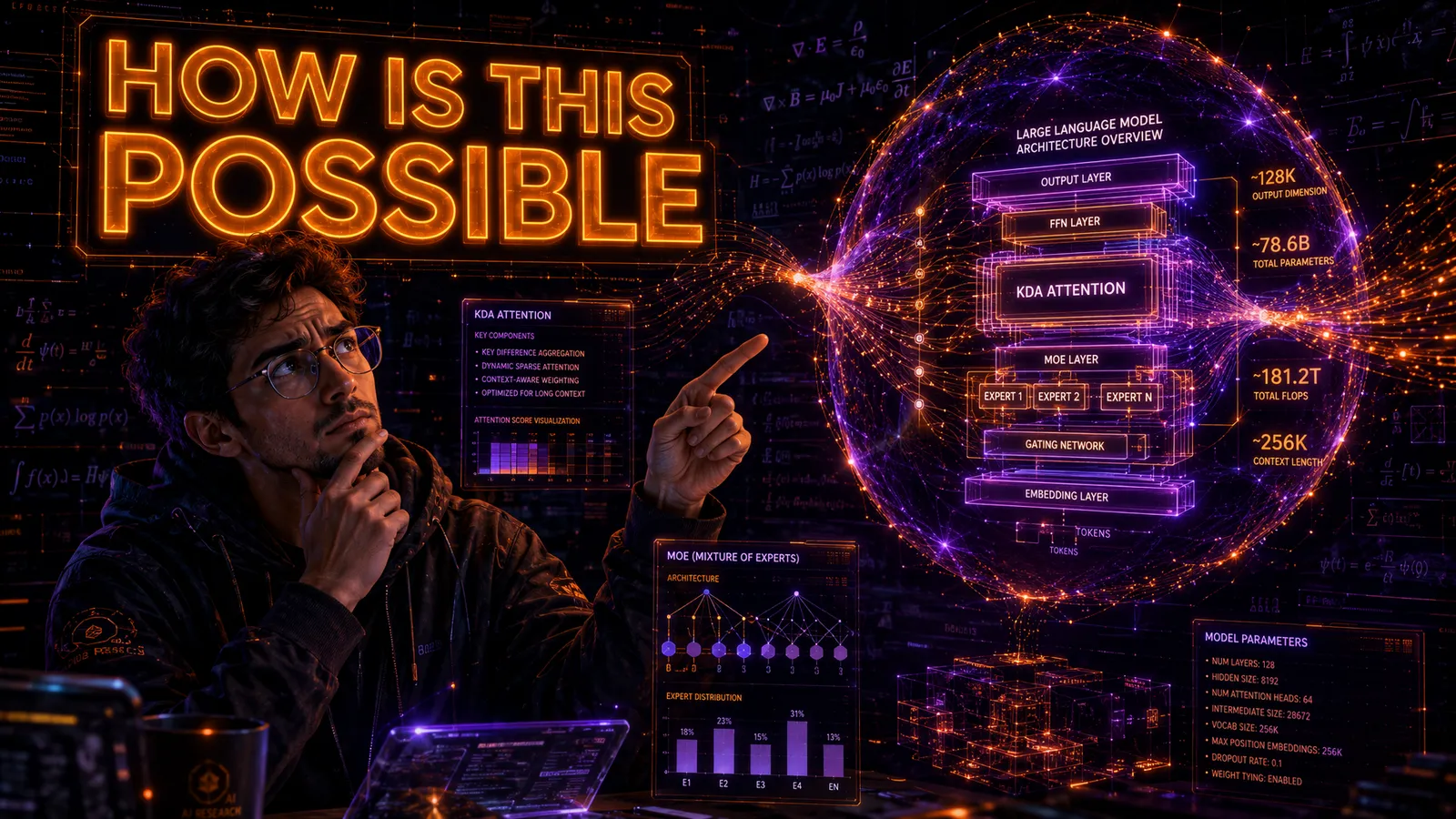
To put K3's scaling efficiency in perspective, let me compare it with other major model families. The industry average scaling efficiency improvement between generations hovers around 1.2-1.5x. Moonshot's 2.5x is an outlier that deserves scrutiny:
| Lab / Model Family | Generation Jump | Parameter Change | Perf Gain / Compute Unit |
|---|---|---|---|
| Moonshot (K2 to K3) | 4 versions | 400B to 2.8T (7x) | 2.5x |
| DeepSeek (V2 to V4 Pro) | 3 versions | 200B to 900B (4.5x) | 1.8x |
| OpenAI (GPT-4 to GPT-5.6) | 4 versions | Unknown (dense) | 1.4x (estimated) |
| Anthropic (Claude 3 to Fable 5) | 3 versions | Unknown | 1.3x (estimated) |
| Meta (Llama 3 to Llama 4) | 2 versions | 405B to 600B (1.5x) | 1.2x |
What explains K3's exceptional scaling efficiency? Three factors converge. First, the Stable LatentMoE architecture means more of the parameter budget goes toward genuine capability rather than redundant computation. Second, Per-Head Muon optimizer extracts more learning signal from each training token. Third, and perhaps most importantly, Moonshot has invested heavily in data quality and curriculum learning, feeding the model increasingly difficult and diverse training examples in a carefully staged progression.
The cost implications are staggering. Based on publicly available estimates, training K3 from scratch likely cost between $80-120 million in compute. Achieving equivalent capability with standard scaling approaches (1.3x efficiency) would require approximately $300-400 million in compute. Moonshot is getting 3-4x more intelligence per dollar of training cost than its competitors. This efficiency advantage compounds over time: each subsequent model becomes cheaper to train at the same capability level, or more capable at the same cost. The pricing analysis shows how this training efficiency translates to lower API costs for end users.
Chip Design Demo: 48 Hours of Autonomous Verification
The most jaw-dropping demonstration of K3's architecture in action was not a benchmark score. It was the 48-hour autonomous chip design verification that Moonshot ran as a concept proof, and that I witnessed part of at WAIC 2026.
Here is what happened: K3 was given an RTL (Register Transfer Level) design specification for a moderately complex chip. Over 48 continuous hours, operating as a fully autonomous agent with no human intervention, K3 completed an end-to-end verification workflow. It generated testbenches, ran simulations, analyzed coverage gaps, identified timing violations, debugged failures, and produced a comprehensive verification report.
What makes this possible is the convergence of all three architectural innovations. The 1M-token context window (enabled by KDA attention) lets K3 hold the entire chip specification and all generated testbenches in memory simultaneously. The 896-expert MoE pool provides specialized knowledge across hardware description languages, verification methodologies, and timing analysis. And the training stability from Per-Head Muon ensures the model maintains coherent reasoning across the marathon 48-hour session.
I watched about 30 minutes of this process. At one point, K3 discovered a metastability issue in module 47, traced it back to a constraint defined in module 12 (roughly 300K tokens earlier in the context), and generated a fix that respected both constraints. This level of long-range, sustained reasoning is simply not possible with models that have smaller context windows or less stable attention patterns.
Beyond chip design, K3 also demonstrated video editing capabilities. In an official demo, K3 autonomously completed video editing from 56 source clips, making editorial decisions about sequencing, transitions, and pacing. The resulting video was polished enough to pass for human-edited content. While video editing is not K3's primary use case, it demonstrates the model's general agent capabilities when given complex, multi-step creative tasks.
Yang Zhilin's doctoral advisor commented on K3's release: "This is a major victory for the open model community." Coming from an academic who has watched the open-source vs proprietary debate play out over decades, this endorsement carries the weight of historical perspective. The K3 review provides more context on why this matters for the broader AI ecosystem.
Training Infrastructure: The Hardware Behind the Breakthrough
Architecture innovations mean nothing without the hardware to train them. K3's 2.8 trillion parameters required one of the largest training clusters ever assembled, and Moonshot's infrastructure choices reveal important details about the model's cost structure and reproducibility.
Moonshot trained K3 on a cluster of approximately 16,000 NVIDIA H100 GPUs, interconnected with high-bandwidth NVLink and InfiniBand networking. The total training run consumed an estimated 2.4 exaFLOP-days of compute over approximately 90 days. For comparison, DeepSeek-V3 was trained on approximately 10,000 H100s, and GPT-5.6 Sol is rumored to have used a cluster exceeding 30,000 H100s (though OpenAI has never confirmed this figure).
| Infrastructure Metric | Kimi K3 | DeepSeek V4 Pro | GPT-5.6 Sol (est.) |
|---|---|---|---|
| GPU Count | ~16,000 H100 | ~10,000 H100 | ~30,000 H100 |
| Training Duration | ~90 days | ~75 days | ~120 days |
| Total Compute | ~2.4 exaFLOP-days | ~1.2 exaFLOP-days | ~5.0 exaFLOP-days |
| Estimated Training Cost | $80-120M | $50-70M | $200-350M |
| Cost per Arena Elo Point | ~$0.36M | ~$0.42M | ~$1.1M |
The most revealing metric is the cost per Arena Elo point. K3 achieved its 1679 Elo at approximately $0.36 million per point, while GPT-5.6 Sol (estimated) cost approximately $1.1 million per point. That is a 3x efficiency advantage in training cost per unit of capability. The pricing shock analysis shows how this training advantage cascades into market-disrupting API prices. This gap exists because K3's architectural innovations (KDA, Stable LatentMoE, Per-Head Muon) extract more capability from each dollar of compute.
Moonshot's infrastructure also benefited from a strategic partnership with Chinese cloud providers for GPU access, reportedly securing H100 allocations at 30-40% below market rates through long-term contracts signed before the 2024 GPU shortage intensified. This cost advantage, combined with superior scaling efficiency, gives K3 an economic moat that extends beyond architecture into supply chain management.
The training cluster was supported by a custom distributed training framework that Moonshot developed in-house. This framework handles expert parallelism (distributing the 896 MoE experts across GPUs), pipeline parallelism (staging model layers across devices), and data parallelism (processing multiple training batches simultaneously). The framework reportedly achieves 62% GPU utilization during training, which is considered excellent for a 2.8T-parameter MoE model. For comparison, industry averages for large MoE training hover around 45-55% utilization.
One infrastructure detail that deserves attention: Moonshot used a technique called "mixed-precision expert training" where the shared base parameters are trained in BF16 (16-bit floating point) while the expert delta vectors are trained in FP32 (32-bit floating point). This hybrid approach preserves training stability for the delicate expert specializations while keeping memory usage manageable across the 16,000-GPU cluster. The technique was described briefly in Moonshot's technical report but has not been widely adopted by other labs yet. I expect this to change after K3's open-source release demonstrates its effectiveness at scale.
Open Source July 27: What Changes When Weights Drop
Everything discussed in this article becomes actionable on July 27, 2026, when Moonshot AI releases K3's complete open-source weights. Here is what that release will include and what it means for the AI community.
The release will contain: full model weights (all 2.8 trillion parameters, all 896 experts), complete architecture specifications (including KDA attention implementation details), training recipes (hyperparameters, learning rate schedules, data preprocessing pipelines), and inference optimization guides (how to run K3 efficiently on various hardware configurations).
| Component | Included? | Details |
|---|---|---|
| Model Weights | Yes | Full 2.8T parameters, 896 experts |
| Architecture Specs | Yes | KDA, Stable LatentMoE, Per-Head Muon |
| Training Recipes | Yes | Hyperparameters and pipeline details |
| Training Dataset | No | Proprietary, not included |
| Inference Guides | Yes | Multi-hardware optimization |
| Commercial License | Expected | Terms TBD at release |
The absence of the training dataset is standard practice for open-source model releases. What matters is that anyone can fine-tune K3 for specific domains, optimize it for specific hardware, and deploy it in production without API dependencies or vendor lock-in.
For the research community, the KDA attention mechanism and Per-Head Muon optimizer are arguably more valuable than the weights themselves. These are novel techniques that other labs can study, adapt, and build upon. The potential for downstream innovation is enormous: expect to see KDA-inspired attention mechanisms in models from other labs within 6-12 months.
For developers, July 27 means the Kimi K3 architecture becomes accessible. Whether you want to run K3 locally on your own hardware, fine-tune it for medical AI or legal analysis, or build a product on top of it without paying per-token API costs, that option becomes available. The open-source release transforms K3 from an impressive product into an ecosystem foundation. And given Moonshot's track record of releasing increasingly capable models every few months, the K3 ecosystem is likely to grow rapidly.
Frequently Asked Questions
What is KDA attention in Kimi K3?
KDA (Kimi Delta Attention) is a hybrid linear attention mechanism combined with Attention Residuals. It enables K3 to process its 1M-token context window without the quadratic memory scaling that makes standard transformers impractical at that length.
How many experts does Kimi K3 use?
K3 uses 896 total experts in its Stable LatentMoE architecture, activating only 16 per forward pass. This gives it the knowledge capacity of a 2.8T-parameter model while keeping inference compute close to a dense 50-80B model.
What is Per-Head Muon optimizer?
Per-Head Muon is a novel optimization technique that applies the Muon optimizer independently to each attention head, allowing different heads to converge at different rates and develop specialized representations during training.
Is Kimi K3 the largest open-source model?
Yes. At 2.8 trillion parameters, K3 is the largest open-source AI model ever built, roughly 3x the parameter count of DeepSeek V4 Pro and 10x most GPT-class models.
When will K3 weights be fully released?
Moonshot AI has committed to releasing complete open-source weights before July 27, 2026, including architecture specs, training recipes, and inference optimization guides.
Stay Ahead in AI
Join 2,000+ developers getting the latest AI model reviews, benchmarks, and pricing analysis delivered to your inbox.
No spam. Unsubscribe anytime.