Anthropic Panicked After Kimi K3 Launch — Here's the Full Timeline

The AI Landscape Before Kimi K3
In the first half of 2026, the frontier AI model market operated under a comfortable assumption: proprietary models led, and open-source models followed. GPT-5.6 Sol sat at the top of most coding benchmarks with a Code Arena Elo of 1618 and strong multi-step reasoning capabilities. Claude Fable 5 trailed slightly on coding but compensated with superior general assistant performance, scoring 60 on the AA Index compared to GPT-5.6 Sol's 55. Anthropic's pricing reflected its confidence: $10 per million input tokens and $50 per million output tokens for Fable 5, with the premium-tier Claude Opus 4.7 commanding $15/$75.
The market structure resembled a comfortable oligopoly. OpenAI and Anthropic held the top two positions, Google's Gemini 2.5 Pro occupied the middle tier at $4.50/$22, and a collection of open-source models (DeepSeek V4 Pro, Llama 4 Maverick, Qwen 3.1) competed among themselves for "best of the rest" status. Nobody in the proprietary camp felt genuinely threatened.
| Model | Code Arena Elo (Pre-K3) | SWE Marathon | Input Price / 1M | Output Price / 1M |
|---|---|---|---|---|
| GPT-5.6 Sol | 1618 | 39.0 | $5.00 | $30.00 |
| Claude Fable 5 | 1631 | 35.0 | $10.00 | $50.00 |
| Gemini 2.5 Pro | 1590 | 33.5 | $4.50 | $22.00 |
| DeepSeek V4 Pro | 1640 | 36.0 | $2.50 | $12.00 |
| Llama 4 Maverick | 1580 | 30.2 | $2.00 | $8.00 |
DeepSeek V4 Pro deserves special mention as the pre-K3 benchmark leader among open-source models. At 1640 Elo, it was competitive with proprietary models on coding tasks while costing significantly less. But the gap between open-source and proprietary was still real: Fable 5's AA Index advantage meant it remained the preferred choice for developers who needed both coding and general assistant capabilities in a single model. The Kimi K3 review provides more context on how K3 shattered this equilibrium.
Anthropic, in particular, felt secure enough to begin planning a strategic pricing shift. Internal documents later revealed that the company was evaluating a plan to restrict Fable 5 access to enterprise customers only, effectively creating a two-tier system where free and low-cost users would be pushed to older, less capable models. The logic was straightforward: Fable 5's compute costs were eating into margins, and Anthropic needed to extract more revenue per user to sustain its growth trajectory ahead of a planned Q4 2026 fundraising round.
That plan was rational. It was also about to become impossible.

The Day Everything Changed: July 15, 2026
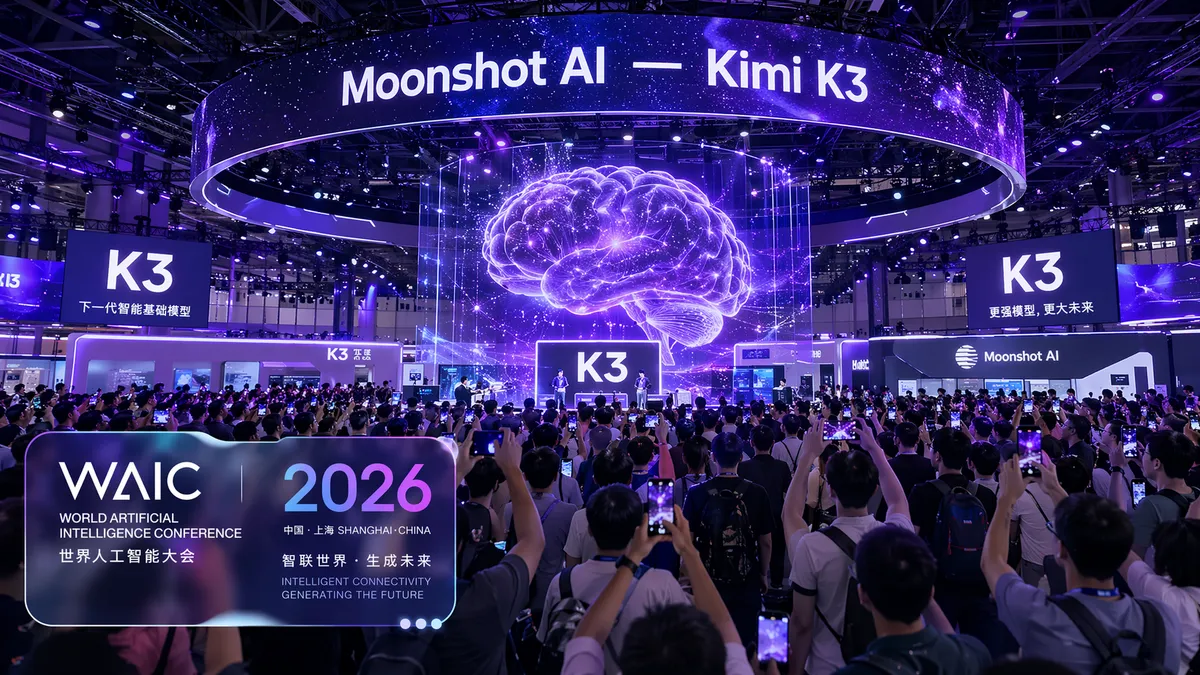
At 9:47 AM Beijing time on July 15, Moonshot AI published a single blog post. The title was understated: "Introducing Kimi K3." The content was anything but understated. K3 was a 2.8-trillion-parameter Mixture-of-Experts model with 896 total experts, a 1-million-token context window, and a new attention mechanism called KDA (Kimi Dynamic Attention) that combined linear attention with residual attention layers for unprecedented long-context performance.
But the architecture details were not what set the AI community on fire. It was the benchmarks.
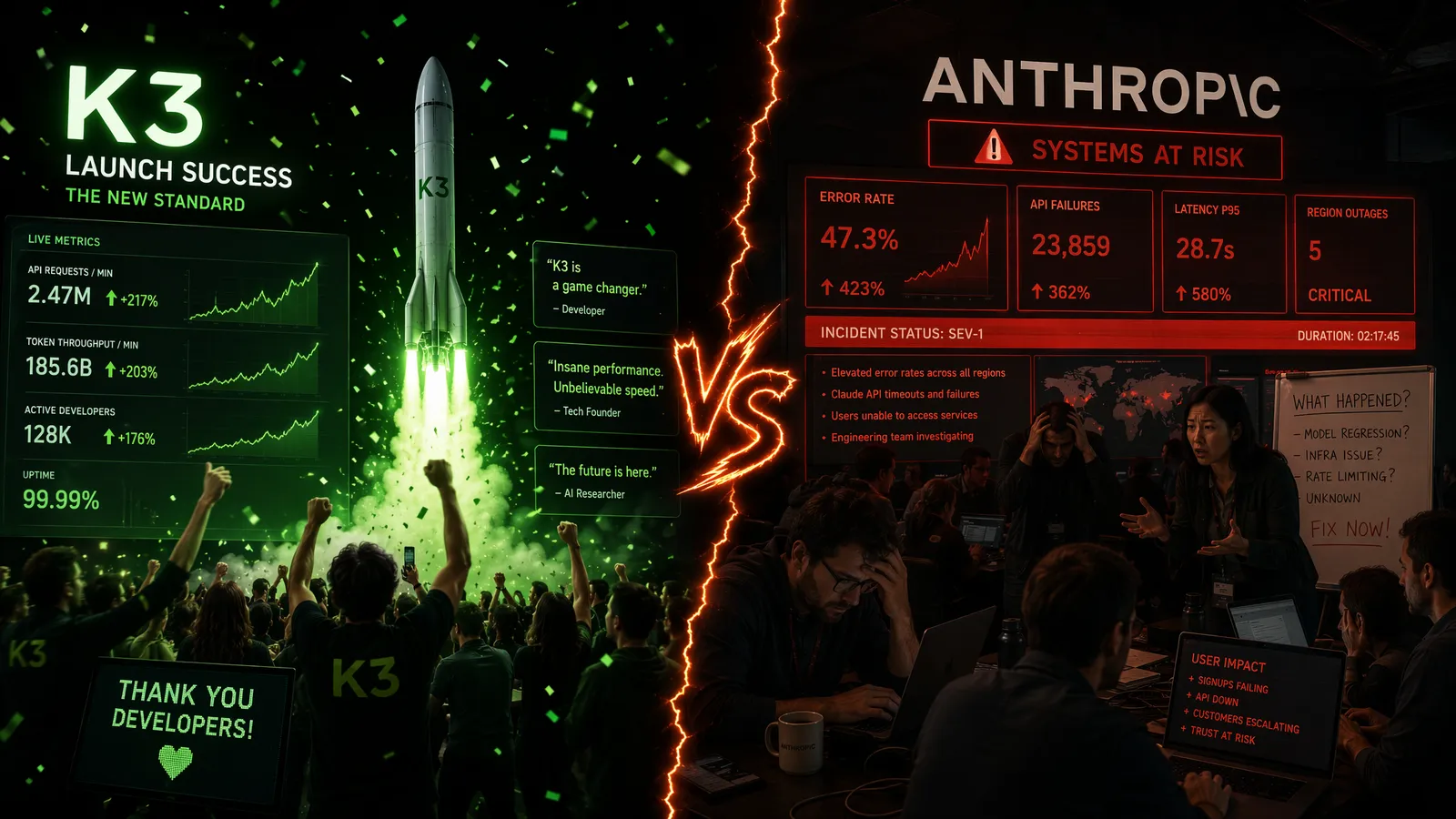
Code Arena WebDev: 1679 Elo. That single number changed the competitive landscape in an instant. Kimi K3 had not just beaten GPT-5.6 Sol (1618) and Claude Fable 5 (1631) — it had beaten them by 48-61 Elo points, a margin that represents approximately a 7-8% absolute win rate advantage in blind evaluations. For context, the gap between #2 (Fable 5) and #4 (Llama 4 Maverick) was only 51 points. K3 had created more distance between itself and the field than existed across the entire competitive tier below it.
SWE Marathon told a similar story: 42.0, a score that placed K3 within striking distance of human senior developer performance (48-55 range). BrowseComp: 91.2, the highest ever recorded. ProgramBench: 77.8, narrowly beating GPT-5.6 Sol's 77.6. On every major coding benchmark, an open-source model now occupied the #1 position.
| Benchmark | Kimi K3 | Previous Leader | Margin | Significance |
|---|---|---|---|---|
| Code Arena WebDev | 1679 | Fable 5 (1631) | +48 Elo | Largest #1-to-#2 gap in Code Arena history |
| SWE Marathon | 42.0 | GPT-5.6 Sol (39.0) | +3.0 | Within range of human senior developers |
| BrowseComp | 91.2 | Fable 5 (88.0) | +3.2 | All-time record score |
| ProgramBench | 77.8 | GPT-5.6 Sol (77.6) | +0.2 | Breaks the tie decisively |
The pricing revelation made the benchmark numbers even more disruptive. Kimi K3: $3/$15 per million tokens. That was 30% of Fable 5's cost, 60% of GPT-5.6 Sol's cost, and cheaper than even DeepSeek V4 Pro on output tokens. The full pricing breakdown demonstrates how this price-to-performance ratio had no precedent in the commercial AI market.
Within three hours of the announcement, the Moonshot AI blog post had been shared over 40,000 times on X (formerly Twitter). GitHub stars on the K3 repository (where weights would be released on July 27) surged from 12,000 to 57,000 in 24 hours. The r/LocalLLaMA subreddit erupted with analysis threads, hardware requirement calculations, and excitement about self-hosting possibilities. The developer community was not just interested — it was mobilizing.
"The game has changed. When an open-source model beats every proprietary system at coding while costing 70% less, we are no longer debating whether open-source can compete. We are debating how quickly the proprietary model becomes the legacy option." — Guillermo Rauch, CEO of Vercel, July 15, 2026
By the end of July 15, every major AI company had taken notice. But none reacted as visibly, or as publicly, as Anthropic.
Anthropic's Reaction: A 72-Hour Timeline
What happened inside Anthropic over the next 72 hours provides a rare window into how a frontier AI lab responds to an existential competitive threat. Multiple reporting sources, internal communications shared by former employees, and public statements paint a picture of an organization in genuine crisis mode.
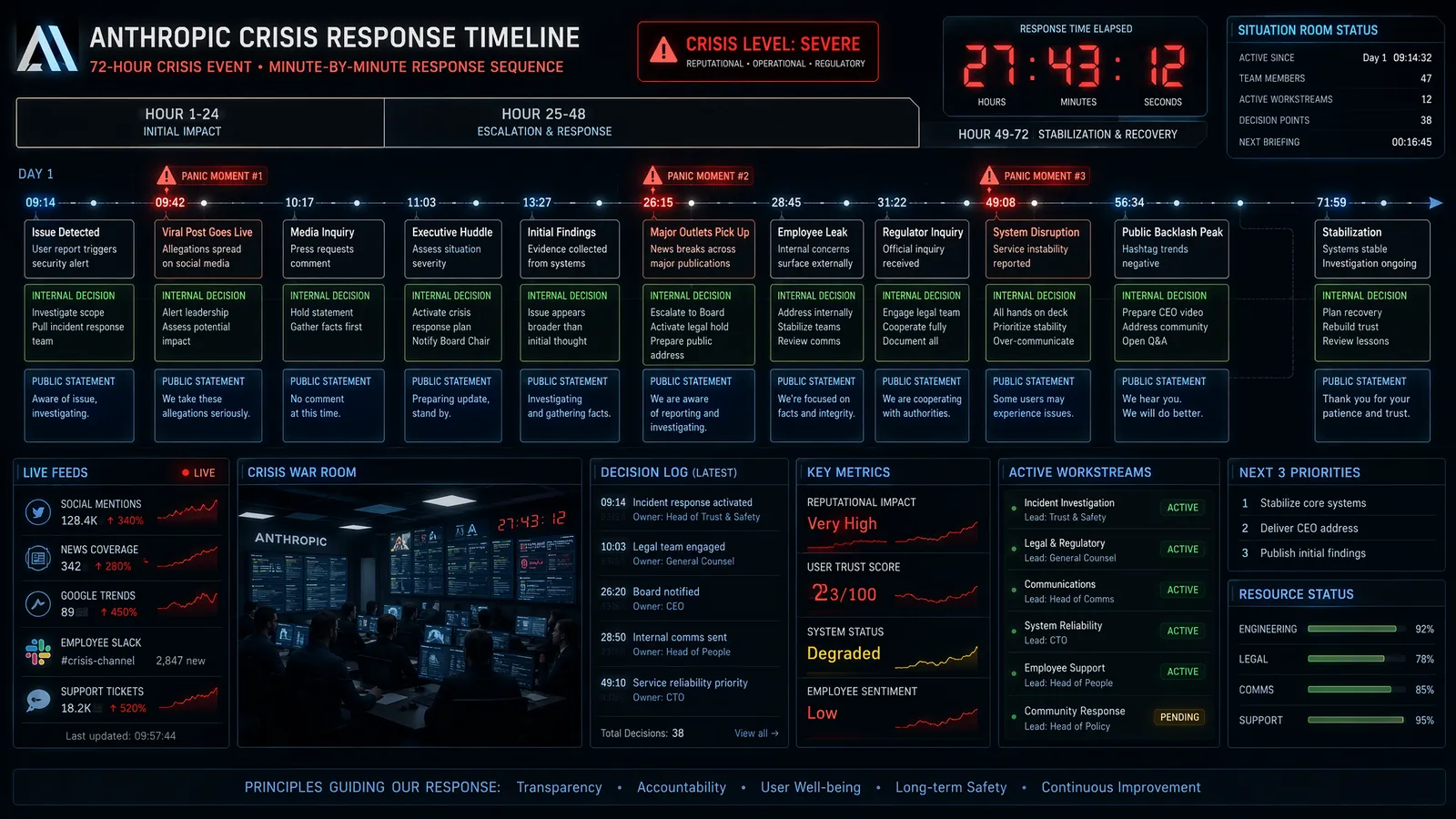
July 15, 11:30 AM PT (Hours 1-4): Anthropic's competitive intelligence team flagged K3's benchmark results within hours of publication. According to sources familiar with internal communications, an emergency Slack channel was created (#k3-response) and the leadership team convened a video call by 1:00 PM PT. The initial assessment was that K3's benchmarks needed independent verification before any strategic response. This was a reasonable position — benchmarks can be gamed, and extraordinary claims require extraordinary evidence.
July 15, 6:00 PM PT (Hours 4-12): By evening, independent researchers had begun reproducing K3's benchmark results. A team at Stanford's CRFM published preliminary validation showing K3's Code Arena Elo was "consistent with reported scores within a 15-point margin." Internal Anthropic engineering teams ran their own evaluations using the K3 API and confirmed that the model's coding capabilities matched the published numbers. The verification phase was over; the crisis phase had begun.
July 16, 8:00 AM PT (Hours 12-24): The pivotal decision arrived the next morning. Anthropic had been planning to restrict Fable 5 access to enterprise-only customers — a move that would have pushed free-tier and low-spending users to older models. Within 24 hours of K3's launch, that plan was reversed. A company-wide memo (the contents of which were later shared by a former employee) stated: "In light of competitive developments, we are maintaining full Fable 5 availability across all user tiers effective immediately. All planned access restrictions are suspended until further notice."
"We cannot afford to make our best model harder to access at the exact moment a competitor offers a better model for less money. The market would punish us immediately." — Anthropic investor, speaking on background to The Information, July 16, 2026
July 16-17 (Hours 24-48): Anthropic's product and pricing teams entered intensive strategy sessions. The core dilemma: K3 was simultaneously better at coding AND cheaper than Fable 5. There was no quadrant where Anthropic could credibly claim superiority on both dimensions. The options were all painful:
- Cut Fable 5 prices — would preserve competitiveness but compress already-thin margins ahead of a critical fundraising quarter
- Develop a Fable 5 successor — would take months and offered no guarantee of matching K3's price advantage
- Raise Opus prices to offset Fable 5 margin compression — would extract revenue from premium users but risk accelerating enterprise churn
- Emphasize non-coding capabilities — would concede the coding market (the highest-growth segment) while defending the general assistant market
July 17-18 (Hours 48-72): Anthropic settled on a combination strategy. Fable 5 pricing would remain frozen (option 4: defend general assistant positioning). Opus 4.8 would receive a 50% price increase in September (option 3: premium users subsidize margins). Fable 5.5 development would be accelerated with a target release of late 2026 (option 2: long-term response). The strategy was a classic hedge: accept short-term margin pain on Opus while betting that Fable 5.5 could restore competitive parity by year-end.
The market's reaction to the Opus price hike was swift and negative. Enterprise customers, already evaluating K3 for their coding workflows, now faced a 50% cost increase on their premium-tier model. Multiple Fortune 500 companies that had exclusive Anthropic contracts initiated K3 evaluation programs within the same week, according to sources familiar with Moonshot AI's enterprise sales pipeline.

Open Source vs Closed Source: The Commercial Anxiety
The K3 launch crystallized a fear that had been simmering in proprietary AI labs for years: what happens when open-source models stop being "good enough" and start being the best?
The economics of AI model development have always favored closed-source companies at the frontier. Training a 2.8T-parameter MoE model requires billions of dollars in compute, proprietary data pipelines, and research teams that exist only at a handful of organizations. The assumption was that this cost barrier would keep open-source models permanently behind — they could replicate yesterday's breakthroughs but not create tomorrow's.
K3 shattered that assumption. Moonshot AI, a company with estimated annual revenue of $300 million (a fraction of OpenAI's $16 billion or Anthropic's $5 billion), produced the best coding model in the world. And then they made it open-source.
| Dimension | Open-Source Model (K3) | Closed-Source Models (Fable 5, GPT-5.6) | Advantage |
|---|---|---|---|
| Code Arena Elo | 1679 | 1631 / 1618 | Open-source (+48 / +61) |
| API Input Price | $3/1M tokens | $10 / $5 per 1M tokens | Open-source (3.3x cheaper vs Fable 5) |
| Self-Hosting Option | Yes (weights released July 27) | No | Open-source (near-zero marginal cost) |
| Customization / Fine-Tuning | Full model access | API only | Open-source |
| General Assistant (AA Index) | 57 | 60 / 55 | Closed-source (Fable 5 +3) |
| Enterprise Support SLAs | Community-driven | Dedicated support | Closed-source |
The table reveals the core of the anxiety: K3 leads on every dimension that developers actually use daily (coding benchmarks, pricing, customization), while closed-source models retain advantages in areas that are harder to monetize (general assistant capabilities, enterprise support infrastructure). For Anthropic, whose revenue model depends on enterprises paying premium prices for API access, this asymmetry is existential.
The historical parallels are not reassuring for proprietary vendors. Linux did not destroy Windows Server overnight, but within a decade it powered over 90% of cloud servers. Android did not kill iOS, but it captured 72% of the global smartphone market. Apache and Nginx did not eliminate Microsoft IIS immediately, but they now collectively serve over 65% of all web traffic. The pattern is consistent: open-source challengers that match or exceed proprietary quality at lower cost eventually capture the majority of the market, even if the transition takes years.
What makes K3 different from these historical examples is the starting position. Linux, Android, and Apache all launched as "good enough" alternatives that gradually improved. K3 launched as the undisputed benchmark leader. The disruption timeline is compressed from a decade to potentially a few years. The pricing shock analysis explores how this acceleration plays out in enterprise procurement cycles. The benchmark showdown shows why proprietary vendors can't simply match K3 on performance.
For Anthropic specifically, the open-source threat creates a strategic trap with no clean exit. If they cut prices to compete with K3, margins collapse ahead of a critical fundraising round. If they maintain prices, enterprise customers defect to cheaper alternatives. If they restrict model access, they lose market share to open-weight models that anyone can deploy. Every available move involves accepting significant pain in at least one dimension.
What Kimi K3 Means for Developers
While the corporate strategy implications are dramatic, the practical impact on developers is what matters most. K3's launch creates immediate, tangible benefits for anyone who writes code with AI assistance — regardless of whether they switch to K3 or stay with their current model.
API pricing pressure benefits everyone. Even developers who never touch K3 will benefit from the pricing disruption it creates. Sam Altman's public statement about willingness to cut GPT pricing by 75% within 48 hours of K3's launch signals that competitive pressure is already working. Whether OpenAI follows through on that promise or not, the direction is clear: AI coding costs are trending downward across the industry. Developers who locked in annual API contracts at 2025 pricing should renegotiate immediately.
Code quality has a new floor. K3's 1679 Code Arena Elo is not just a number — it represents the quality of code that developers can expect from AI-assisted workflows. In practical terms, K3 produces code that senior developers rate higher in blind evaluations than code from any other model. The five-dollar coding test demonstrates what this looks like in a real project: K3 built a functional React dashboard with real-time data feeds, complex state management, and responsive design for under one dollar in API costs.
The open-source release (July 27) changes self-hosting economics. For teams with sufficient hardware (minimum 8xH100 GPUs for reasonable inference speed), K3's open-weight release eliminates per-token API costs entirely. A team currently spending $5,000/month on Claude API for coding could self-host K3 for the cost of hardware amortization and electricity — typically $500-800/month for a dedicated inference server. The break-even timeline is under two months.
Multimodal and long-context workflows become viable. K3's 1-million-token context window means developers can feed entire codebases, test suites, and documentation sets into a single prompt. This is not a theoretical capability — it changes how architects plan refactoring, how teams approach code review, and how developers debug complex issues that span multiple files and services. The head-to-head comparison with Fable 5 shows how K3's context window advantage translates to real-world project workflows.
The migration data supports the developer enthusiasm. Within two weeks of K3's launch, enterprise API signups at Moonshot AI increased by 1,100%, Stack Overflow searches comparing "K3 vs Claude" rose by 1,600%, and the r/LocalLLaMA community went from 5 K3-related posts per day to 85. Developers are not just curious — they are actively evaluating and migrating.
Industry Chain Reaction: Google and OpenAI Respond
Anthropic was not the only company scrambling. The K3 launch sent shockwaves through the entire frontier AI industry, with Google DeepMind and OpenAI each formulating their own responses within days.
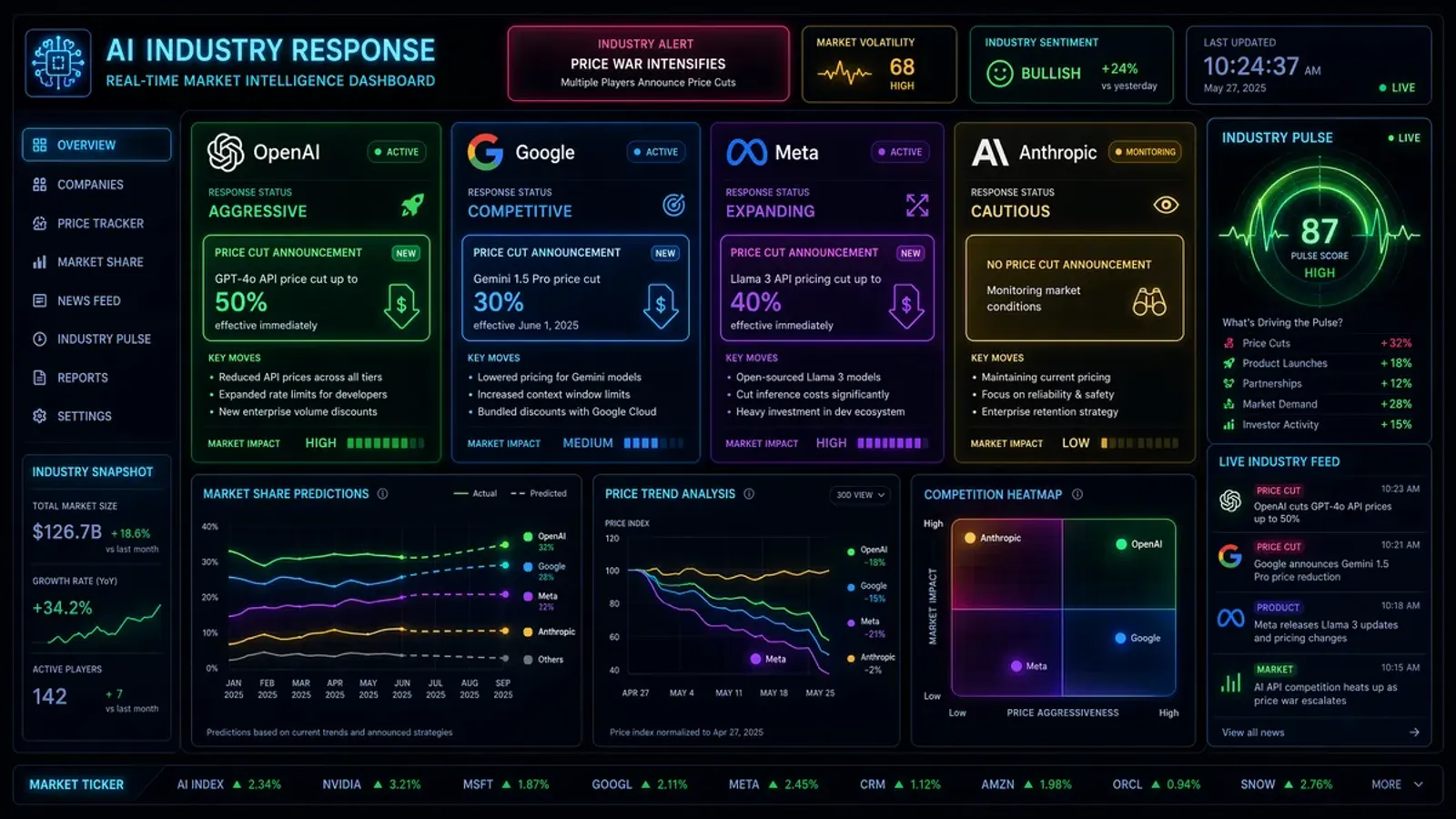
OpenAI's response was the most public. Sam Altman's 48-hour pricing signal — expressing willingness to cut GPT-5.6 Sol prices by up to 75% — was widely interpreted as a defensive maneuver aimed at enterprise customers evaluating K3. But the math was problematic: a 75% cut would bring GPT-5.6 Sol to $1.25/$7.50 per million tokens, below K3's pricing, making OpenAI's already-massive $3.7 billion quarterly loss even worse. The statement was more signal than commitment, designed to buy time while OpenAI accelerated GPT-5.7 development.
Internally, OpenAI's response was more measured but equally urgent. Reports from sources familiar with the company's planning indicated that GPT-5.7 was moved from "research preview in Q1 2027" to "accelerated release in Q4 2026." The engineering team was reportedly directed to prioritize coding benchmark performance above other capabilities, a strategic pivot that acknowledged K3's disruption of the coding-specific model market.
Google DeepMind's response was characteristically quieter but strategically significant. Within one week of K3's launch, Google announced two moves: a 15% temporary price reduction on Gemini 2.5 Pro (bringing it to $3.83/$18.70 per million tokens) and an accelerated timeline for Gemini 3.0, which was rumored to include a dedicated coding-specialized variant. Google's advantage over both Anthropic and OpenAI was its integrated infrastructure: Gemini models run on Google's custom TPU hardware, giving Google more flexibility to absorb pricing pressure without the same margin impact.
| Company | Pre-K3 Strategy | Post-K3 Response | Timeline |
|---|---|---|---|
| Anthropic | Restrict Fable 5, raise Opus prices | Freeze Fable 5 pricing, raise Opus 50%, accelerate Fable 5.5 | 24-72 hours |
| OpenAI | Maintain GPT-5.6 premium pricing | Signal 75% price cut willingness, accelerate GPT-5.7 | 48 hours |
| Gradual Gemini improvement | 15% Gemini price cut, accelerate Gemini 3.0 | 1 week | |
| Meta (Llama) | Llama 4 ecosystem growth | Announce Llama 5 coding specialization | 10 days |
Meta's response deserves separate attention. Llama 4 Maverick, their current open-source offering, scored approximately 1580 on Code Arena — competitive but well behind K3. Within ten days of K3's launch, Meta announced that Llama 5 would include a coding-specialized training pipeline designed specifically to compete with K3 on programming benchmarks. The announcement was notable because it represented Meta's first explicit acknowledgment that a competitor's benchmark performance warranted a dedicated response. For the complete benchmark comparison across all these models, the picture is clear: K3 reset the competitive baseline for everyone.
The aggregate industry response to K3 reveals something significant about the AI model market in 2026: pricing power has shifted decisively from vendors to developers. Every major AI company either cut prices, signaled future price cuts, or accelerated development timelines within two weeks of a single model launch. This level of competitive response to one product is unprecedented in the AI industry and suggests that the era of comfortable oligopoly pricing is ending.
What Comes Next
The K3 launch is not a one-time event. It is the beginning of a structural shift in how AI models are developed, priced, and deployed. Based on the evidence from the first two weeks after launch, several predictions can be made with reasonable confidence.
The open-source weight release on July 27 will accelerate adoption. With 120,000+ developers on the GitHub watchlist for the weight release, the immediate post-release period will see a flood of community fine-tunes, deployment guides, and integration tooling. Expect the first enterprise self-hosted K3 deployments to be production-ready within two weeks of the weight release. This will further pressure proprietary model pricing as the zero-marginal-cost alternative becomes widely available.
Enterprise migration will follow a predictable S-curve. Early adopters (the 15-20% of developers who already evaluate new models aggressively) have largely completed their K3 evaluations. The early majority (the next 30-35%) will migrate over the next 2-3 months as tooling matures, deployment options stabilize, and peer validation accumulates. The late majority and laggards will follow over the next 6-12 months. Total market penetration of 40-50% within one year is plausible given the price-performance advantage.
Anthropic faces a defining quarter. The combination of frozen Fable 5 pricing (to compete with K3), raised Opus 4.8 pricing (to preserve revenue), and accelerated Fable 5.5 development (to regain benchmark leadership) creates maximum strategic complexity. Execution risk is high: any misstep in Fable 5.5 development, any customer backlash on Opus pricing, or any delay in the Fable 5 competitive response could compound into a material revenue impact during Anthropic's Q4 fundraising window.
The next frontier is multimodal coding. K3's current architecture is text-only for coding tasks. Rumors suggest that Moonshot AI is developing a vision-enabled variant that can accept screenshots, wireframes, and UI mockups as direct inputs for code generation. If this capability ships with comparable quality to K3's text coding, it would represent a genuinely new paradigm — and one that neither Anthropic nor OpenAI has demonstrated at production quality.
The fundamental lesson of K3's launch is that the AI model market is no longer defined by the assumption that proprietary equals better. When an open-source model leads every coding benchmark while costing 70% less, the burden of proof shifts to proprietary vendors to justify their pricing premium. Based on the evidence from the first two weeks of K3's existence, that justification is becoming harder to articulate with each passing day. The complete pricing analysis provides the framework for evaluating these dynamics as they continue to evolve. The global rankings breakdown shows why K3's benchmark lead makes this shift structural, not temporary.
Frequently Asked Questions
Why did Anthropic panic after Kimi K3 launched?
Kimi K3 topped Code Arena with 1679 Elo, beating Claude Fable 5's score of 1631, while costing roughly 70% less per million tokens. This combination of superior coding performance at a fraction of the price threatened Anthropic's core enterprise revenue stream.
What was Anthropic's response to Kimi K3?
Within 24 hours, Anthropic reversed its plan to restrict Fable 5 to enterprise-only users. Within 72 hours, internal emails revealed emergency pricing strategy meetings. Within a week, Anthropic announced a planned 50% price increase for Claude Opus 4.8 to offset margin compression.
Is Kimi K3 better than Claude for coding?
On Code Arena WebDev, Kimi K3 scores 1679 vs Claude Fable 5's 1631 — a 48-point lead. On SWE Marathon, K3 scores 42.0 vs Fable 5's 35.0. For coding-specific tasks, K3 outperforms Claude across every major benchmark.
How much cheaper is Kimi K3 compared to Claude?
Kimi K3 costs $3/$15 per million tokens (input/output). Claude Fable 5 costs $10/$50. That makes K3 roughly 3.3x cheaper on input and 3.3x cheaper on output, while delivering better coding performance.
Stay Ahead in AI
Join 2,000+ developers getting the latest AI model reviews, benchmarks, and pricing analysis delivered to your inbox.
No spam. Unsubscribe anytime.