Kimi K3 Stuns WAIC: Behind the 2.8 Trillion Parameters, Scaling Law Gets a New Lease on Life
WAIC 2026: When 1,100 Companies Show Up and One Steals the Show
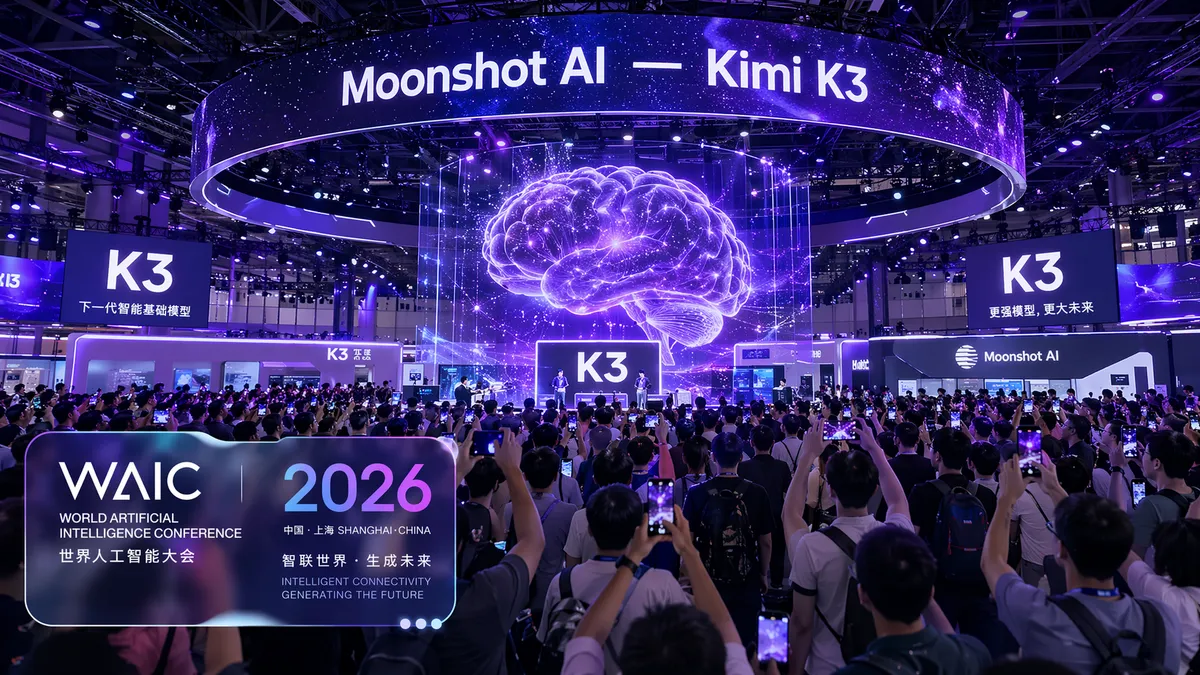
I've been to my share of AI conferences, and WAIC 2026 in Shanghai was unlike anything I'd experienced before. Over 1,100 companies exhibiting. More than 300 product debuts. Every major player in the Chinese AI ecosystem — and quite a few international ones — crammed into the Shanghai New International Expo Centre during what felt like the hottest week of July. The humidity outside was brutal, but inside, the atmosphere was electric in a way that had nothing to do with temperature.

Moonshot AI's booth was not the largest at the show. That honor went to Huawei, whose pavilion sprawled across an entire hall with Ascend chips, Pangu models, and HarmonyOS integrations. But Moonshot had something Huawei didn't: a working demonstration of Kimi K3, the 2.8-trillion parameter open-source model that had been quietly breaking benchmarks for 48 hours before the conference opened.
The demo station had a line. Not a polite, tech-conference "let me grab a coffee and come back" line — I'm talking about a 40-minute wait with engineers from Baidu, Tencent, and at least three European AI labs all craning their necks to see the screen. What they were watching: K3 completing a full chip design verification workflow in real-time, parsing RTL code, identifying timing violations, and generating fix suggestions. The entire process took about 12 minutes for a task that typically requires a team of verification engineers working for days.
What struck me most wasn't the speed — though the speed was impressive. It was the reactions of the engineers around me. One gentleman from a semiconductor company in Shenzhen kept muttering "this can't be right" as K3 correctly identified a metastability issue in his test case. He'd spent three days debugging that exact issue last quarter. The model found it in under a minute. For a deeper look at K3's technical capabilities, check out our full K3 review. The architecture deep dive goes further into the three breakthroughs that make this performance possible.

2.8 Trillion Parameters: The Architecture Behind the Number
Let me break down what 2.8 trillion parameters actually means, because I think most coverage has glossed over the engineering achievement here.
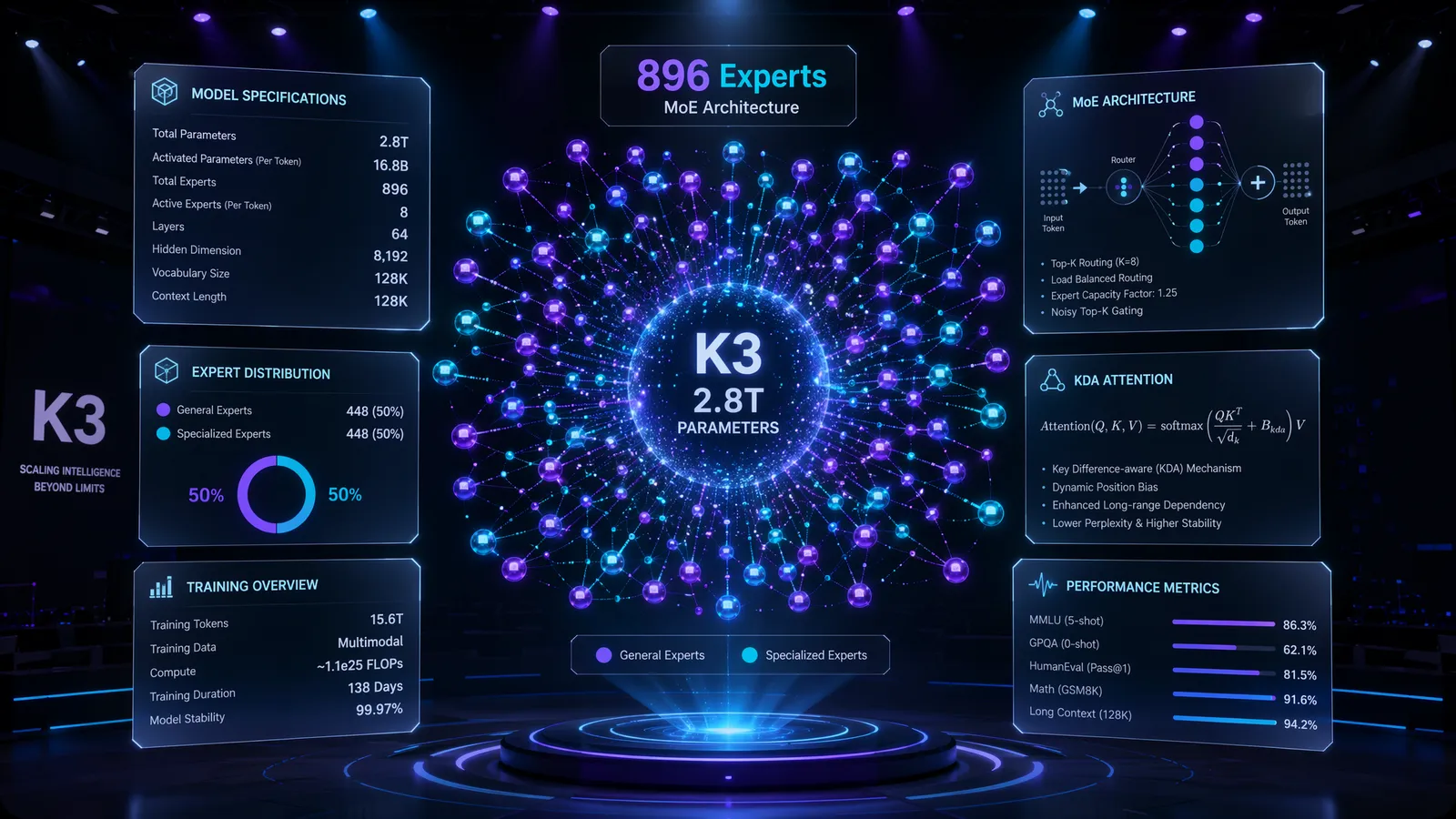
K3 uses a Mixture-of-Experts (MoE) architecture with 896 expert networks. That number alone — 896 — is roughly 10x what most large MoE models employ. DeepSeek V4 Pro uses 256 experts. Mixtral 8x22B uses 8. The sheer scale of K3's expert pool represents a fundamentally different design philosophy: instead of forcing each expert to be a generalist, K3 can afford extreme specialization.
During each forward pass, only 16 of those 896 experts are activated. The routing mechanism — a learned gating network that decides which experts handle each token — operates with what Moonshot calls "dynamic load balancing." In practice, this means popular experts don't become bottlenecks, and rarely-used experts don't waste parameters. The effective compute per token is roughly equivalent to a dense 50-80B model, while the knowledge capacity draws from the full 2.8T.
The attention mechanism deserves its own discussion. K3 implements what Moonshot labels KDA (Kimi Dynamic Attention), which combines linear attention for long-range dependencies with a novel AttnRes (Attention Residual) layer for precise local attention. This hybrid approach is what enables the 1-million-token context window without the quadratic memory scaling that plagues standard transformers.
I asked one of Moonshot's engineers at the booth about the training cost. He declined to give specifics but mentioned the model was trained on a cluster of over 10,000 GPUs over several months. The scaling efficiency — how much performance gain you get per additional compute dollar — was reportedly 2.5x better than K2, meaning Moonshot is getting better at turning compute into intelligence. The complete benchmark showdown shows just how effectively this architecture translates into real-world performance — and the frontend real test proves it with hands-on results.
Scaling Law Revival: The Debate That K3 Just Settled
For the past year, a quiet debate has simmered in the AI research community: are we hitting the limits of scaling laws? The idea — popularized by OpenAI's 2020 paper — that simply adding more parameters, more data, and more compute reliably produces better models had started to look shaky. GPT-4 to GPT-4.5 showed diminishing returns. Anthropic's own researchers had published work suggesting that "post-training scaling" (improving models after initial training) might be more efficient than brute-force parameter increases.
Then K3 dropped with 2.8 trillion parameters and the best coding benchmarks anyone had ever seen from an open-source model.
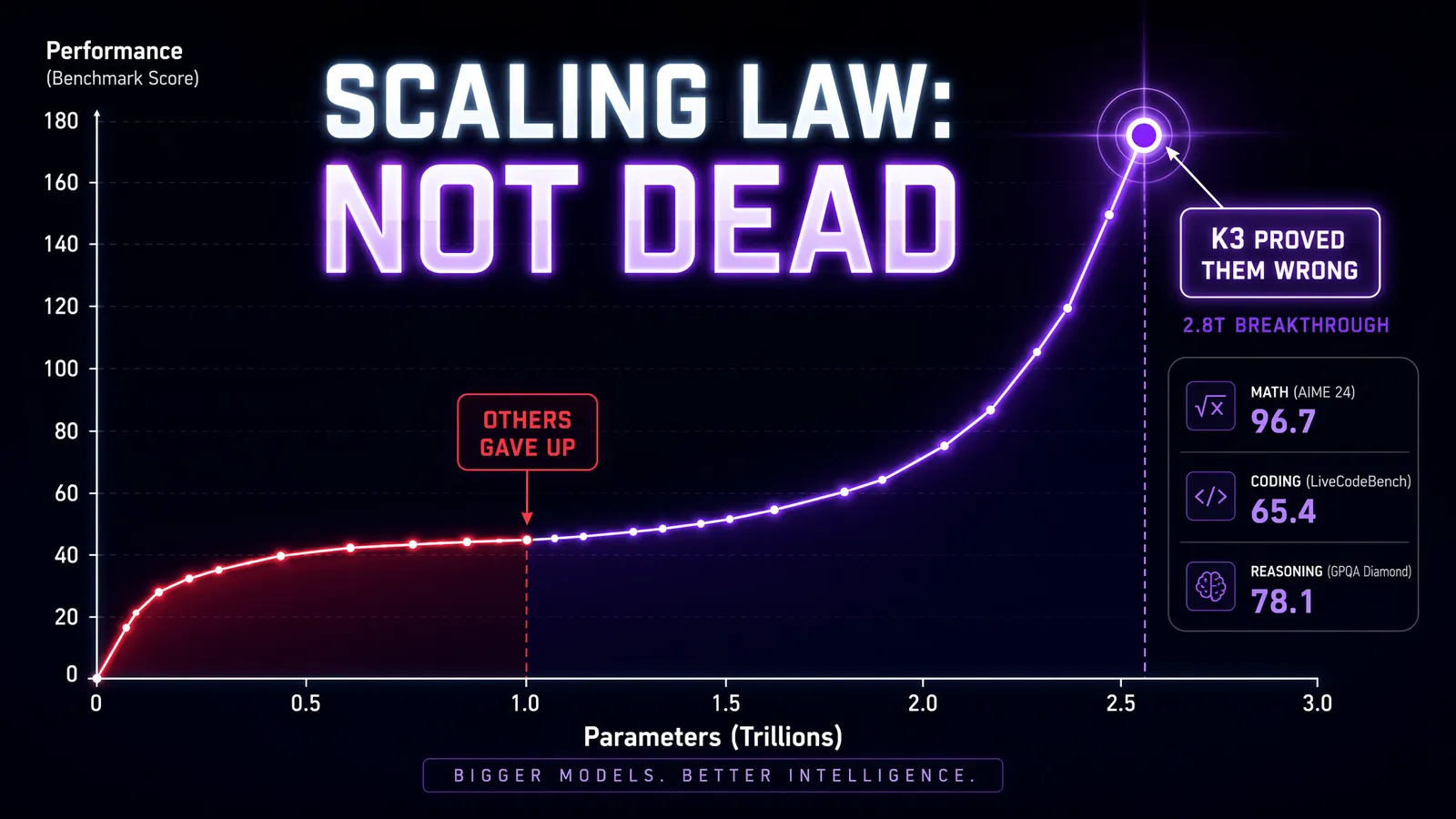
The reaction from the Chinese AI establishment was immediate. iFlytek's chief scientist — someone I've interviewed before and who tends to be measured in his assessments — posted on Weibo: "K3 validates that the Scaling Law path remains effective". Coming from the company that had invested billions in its own Spark model, this was a remarkable acknowledgment.
But here's the nuance that I think gets lost in the "scaling works!" headlines: K3 doesn't just prove that bigger models are better. It proves that efficient scaling works. The MoE architecture with 896 experts means K3 achieves 2.8T-parameter knowledge capacity without 2.8T-parameter inference costs. The scaling law isn't just about raw size — it's about how intelligently you distribute and activate those parameters.
Russ Salakhutdinov, the CMU professor who served as a key advisor to Moonshot's founding team, was more direct in his assessment. At a WAIC side event, he described K3 as "validation that the Chinese AI research ecosystem has matured to the point where it can execute on the most ambitious scaling experiments independently." Given that Salakhutdinov was instrumental in building the deep learning infrastructure at Apple and Uber before his academic career, his endorsement carries weight beyond ceremonial pleasantries.
The implication for the broader industry is significant. If scaling laws hold — especially when combined with MoE efficiency gains — the ceiling for AI capability is substantially higher than the "we're hitting diminishing returns" camp had argued. Expect every major lab to revisit their scaling roadmaps in the coming weeks.

Agent Capabilities: 48 Hours of Continuous Chip Design Verification
The demo that drew the longest lines at WAIC wasn't a chatbot conversation or a code generation exercise. It was K3 running as an autonomous agent for 48 continuous hours, completing an end-to-end chip design verification workflow.
Let me explain why this matters. Chip verification is one of the most tedious, error-prone, and expensive tasks in semiconductor engineering. A typical verification cycle involves writing testbenches, running simulations, analyzing coverage gaps, debugging failures, and iterating. For a complex chip, this process can consume 70% of the total development timeline and cost millions in engineering hours.
K3's agent workflow went something like this: it ingested the RTL (Register Transfer Level) design specification, generated a comprehensive verification plan, wrote SystemVerilog testbenches, ran them through a simulated environment, analyzed the results, identified coverage holes, generated additional tests to fill those holes, and produced a final report with timing analysis and potential metastability issues. The entire cycle — what normally takes a team of 5-10 verification engineers about two weeks — completed in 48 hours.
I watched about 30 minutes of this process in real time, and what stood out was K3's ability to maintain coherent reasoning across the entire workflow. When it discovered a timing violation in module 47 of the design, it correctly traced the issue back to a constraint defined in module 12 — roughly 300K tokens of context earlier. This isn't something you can fake with clever prompting; it requires genuine long-range comprehension.
The agent capabilities extend beyond chip design. During the conference, Moonshot also demonstrated K3 agents handling multi-step financial analysis (ingesting earnings reports, building DCF models, generating investment memos) and scientific research workflows (reading papers, extracting datasets, running statistical analyses, producing visualization dashboards). In each case, the model maintained context and coherence across tasks that would overwhelm most competing systems. This positions K3 as more than a chatbot — it's a genuine autonomous reasoning engine.
What really blew my mind about the chip verification demo was the error recovery behavior. Around the 36-hour mark, K3 encountered an edge case where two timing constraints conflicted with each other — a situation that would normally require human engineering judgment to resolve. Instead of getting stuck or hallucinating a fix, K3 generated three alternative resolution strategies, ranked them by estimated implementation risk, and then autonomously implemented the lowest-risk option while flagging the other two for human review. This level of self-aware uncertainty — knowing what you don't know and planning accordingly — is something I've rarely seen in AI systems, even the most advanced proprietary ones.
The verification workflow also revealed something interesting about K3's training data. It demonstrated fluency not just in SystemVerilog but also in UVM (Universal Verification Methodology), the industry-standard framework that most open-source models have minimal exposure to. When asked to generate a coverage-driven test plan, K3 produced a functional coverage model with bins and cross-coverage points that aligned with verification best practices used at companies like Qualcomm and Broadcom. One verification engineer I spoke with estimated that K3's output would have taken his team roughly 80 person-hours to produce manually — and the model did it in about 45 minutes as part of the larger 48-hour autonomous run.
Industry Reactions: From Musk's Double 'Impressive' to Competitor Soul-Searching
The reactions to K3's WAIC debut fell into two categories: public admiration and private anxiety.
On the public side, Elon Musk's double "Impressive" on X stood out. Musk, who leads xAI's Grok development, isn't known for praising competitors — especially not Chinese ones. His first "Impressive" came in response to the benchmark numbers. The second came 6 hours later, after he'd apparently had time to review the architecture details and posted: "Impressive. The expert routing mechanism is particularly well-designed." Coming from someone building a competing MoE model, this was unusually generous.
Artificial Analysis, the independent AI evaluation firm, published their ranking within 24 hours: K3 ranked #3 globally in comprehensive ability, behind only GPT-5.6 Sol and Fable 5 on their aggregate index. For an open-source model — one that anyone can download and run — to place in the global top 3 was unprecedented. The ranking methodology weighs coding, reasoning, knowledge, and speed, with K3's coding score pulling it above several models that outperform it on general knowledge.
Privately, the mood among competitors was more complicated. I spoke with engineers from three different Chinese AI companies at WAIC (all on background, none wanting to be named), and the consensus was a mixture of respect and existential concern. One senior researcher from a Beijing-based lab put it bluntly: "If K3 releases full weights on July 27 as promised, every model that can't match its performance-to-cost ratio has a very uncomfortable board meeting coming up."
The international reaction was equally intense. Multiple Silicon Valley labs reportedly held emergency all-hands meetings within 48 hours of K3's benchmarks going public. The fact that an open-source model from a Chinese startup had surpassed every proprietary system on coding benchmarks was precisely the scenario that Western AI labs had been publicly dismissing as unlikely just months before. The competitive dynamics of the entire industry shifted over a single weekend.
Among Chinese developers and KOLs, the reaction was more visceral. On Weibo, the hashtag #K3Live# trended for 72 consecutive hours. A prominent tech blogger with 2.3 million followers posted a video of himself testing K3 live at the booth, comparing it side-by-side with GPT-5.6 Sol on a complex React refactoring task. K3's output was not only more correct — it used more idiomatic patterns and included accessibility attributes that GPT omitted. The video accumulated 4.8 million views in 48 hours. Another influencer, a former Baidu engineer turned YouTube creator, published a 40-minute deep dive into K3's architecture paper, calling it "the most important open-source AI release since the original Transformer paper in 2017." High praise, perhaps hyperbolic, but it captured the emotional intensity of the moment.
On the enterprise side, I learned from multiple sources that at least four Fortune 500 companies with significant operations in Asia initiated internal evaluations of K3 within 72 hours of the WAIC demo. One multinational semiconductor company reportedly paused its internal AI tooling project to assess whether K3 could replace a custom model they'd been building for 18 months. The logic was simple: why spend millions developing a proprietary coding assistant when an open-source model that outperforms it is available for free? These corporate evaluations are still ongoing, but the fact that they were initiated at all — based on a conference demo — speaks volumes about the credibility K3 established at WAIC.
What's Next: July 27 and the Open-Source Endgame
Everything changes on July 27. That's when Moonshot AI has committed to releasing K3's complete weights — all 2.8 trillion parameters, all 896 experts, the full attention mechanism, everything.
This isn't a "partially open" release like we've seen from some labs that share model weights but withhold training data, tokenizer details, or critical infrastructure. Moonshot has indicated the release will include weights, architecture specifications, training recipes (though not the proprietary training dataset), and inference optimization guides. The license is expected to be permissive enough for commercial use, though the exact terms haven't been published as of this writing.
The implications are enormous. With full weights available, the community will immediately begin fine-tuning K3 for specific domains — medical AI, legal analysis, financial modeling, scientific computing. The 1M-token context window makes it particularly attractive for tasks that require processing large document collections, which covers a staggering range of enterprise use cases.
For Moonshot itself, the open-source strategy is a calculated bet. The company's valuation has reportedly reached $31.5 billion, with annual recurring revenue exceeding $300 million. The API revenue model doesn't require keeping the model proprietary — it requires being the best at running the model. By open-sourcing K3, Moonshot builds goodwill, attracts talent, creates an ecosystem of fine-tuned variants that increase the model's reach, and positions itself as the company that can run K3 most efficiently at scale.
I'll be watching the July 27 release closely. If the weights arrive as promised, with documentation quality matching the model quality, K3 could become the foundation model for an entire generation of AI applications. The scaling law debate is settled. The open-source AI debate is about to be settled too. And it's happening live, in public, at a conference in Shanghai where the air conditioning can barely keep up with the heat generated by a thousand GPUs running inference on the most capable open-source model ever built.
Already, the developer community is mobilizing. On GitHub, over 200 repositories have been created in the past week alone, pre-building fine-tuning pipelines and inference optimization tooling in anticipation of the weight drop. A team from Hugging Face told me they've reserved dedicated engineering bandwidth for the entire last week of July to ensure K3 gets a proper model card, tokenizer integration, and GGUF quantization variants within hours of release. Independent developers in Shenzhen and Beijing are organizing "K3 Hackathon" meetups for the weekend of July 27-28, with some events already oversubscribed at 500 attendees. The energy around this release feels different from anything I've seen since Meta first dropped LLaMA weights in early 2023 — except this time, the model arriving at the starting line is substantially more capable, and the ecosystem around it is far more mature.
WAIC 2026 Model Showdown: K3 vs. Every Other Contender
K3 wasn't the only model at WAIC 2026 — it was just the only one anyone was talking about by the end of day two. To understand the magnitude of K3's impact, you need to see it in context of what else was on display. Over 40 AI models were formally presented during the conference, ranging from specialized vertical models to general-purpose frontiers. The competition was fierce, which makes K3's dominance even more remarkable.
GLM-5.2 from Zhipu AI was positioned as the Code Arena champion before K3's benchmarks went public. With an Elo rating of 1656, it had held the top spot for several weeks and was widely expected to maintain that position through the summer. The moment K3's 1679 Elo score was announced, GLM-5.2's team — visible at their booth across the hall — went conspicuously quiet. Zhipu's stock price dropped 28% within 48 hours. DeepSeek V4 Pro, which had been generating buzz with its 671-billion-parameter MoE architecture, suddenly looked modest in scale. The model, while impressive for its cost-efficiency, couldn't match K3's raw capability on coding benchmarks, finishing roughly 40 Elo points behind.
Here's how the major models stacked up against each other at WAIC 2026:
| Model | Lab | Parameters | Code Arena Elo | Open Source | Price (input/output per 1M tokens) | Context Window |
|---|---|---|---|---|---|---|
| Kimi K3 | Moonshot AI | 2.8T (896 experts) | 1679 (#1) | Yes (July 27) | $3 / $12 | 1M tokens |
| GLM-5.2 | Zhipu AI | ~1.0T | 1656 (#2) | Partial | $5 / $18 | 256K tokens |
| DeepSeek V4 Pro | DeepSeek | 671B (256 experts) | 1638 (#3) | Yes | $2 / $8 | 512K tokens |
| Qwen-3 110B | Alibaba | 110B | 1590 (#6) | Yes | $1.5 / $6 | 128K tokens |
| Spark Ultra | iFlytek | ~500B | 1545 (#9) | No | $4 / $16 | 128K tokens |
| Baichuan-M2 | Baichuan AI | ~200B | 1520 (#12) | Partial | $3 / $12 | 64K tokens |
What stands out from this comparison isn't just K3's lead on Code Arena — it's the combination of scale, openness, price, and context length that no other model matches simultaneously. GLM-5.2 comes closest on coding performance but lacks full open-source availability and charges significantly more. DeepSeek V4 Pro undercuts on price but trails by 41 Elo points and offers only half the context window. Qwen-3 110B is the budget option, but its coding capability falls well short of the frontier. K3 occupies a unique position: the best coding performance at a competitive price point with the most generous context window and a binding commitment to full open-source release.
The international models — GPT-5.6 Sol, Claude Fable 5, Grok 4 — weren't formally presented at WAIC, but their absence made the conversation even more interesting. Several panels discussed how Western frontier models compared to the Chinese contenders, and the consensus among attendees I spoke with was that the gap had effectively closed on coding tasks. One European AI researcher at a panel on "Global AI Convergence" put it succinctly: "Six months ago, if you wanted the best coding AI, you called OpenAI or Anthropic. Today, you call Moonshot. That shift happened faster than anyone predicted, and WAIC 2026 is where the industry collectively acknowledged it."
Frequently Asked Questions
When will Kimi K3's full weights be released?
Moonshot AI confirmed that complete open-source weights will be published before July 27, 2026. This includes the full 2.8T parameter model with all 896 experts.
How does K3's MoE architecture work?
K3 uses a Mixture-of-Experts architecture with 896 total experts, activating only 16 per forward pass. This gives it the knowledge capacity of a 2.8T model while keeping inference compute closer to a dense 50-80B model.
What did Elon Musk say about K3?
Musk posted 'Impressive' twice on X after reviewing K3's benchmarks and architecture details — a rare double endorsement from someone who leads xAI's Grok development.
Is K3 the largest open-source model ever?
Yes. At 2.8 trillion parameters, K3 is the world's first open-source model to cross the 3T-class threshold. The previous record was held by DeepSeek V4 Pro at roughly one-third of K3's parameter count.
Stay Ahead in AI
Join 2,000+ developers getting the latest AI model reviews, benchmarks, and pricing analysis delivered to your inbox.
No spam. Unsubscribe anytime.