WAIC 2026 Deep Dive: How Kimi K3's 2.8T Parameters Stole the Show and What It Means for AI
The Moment K3 Took Over WAIC
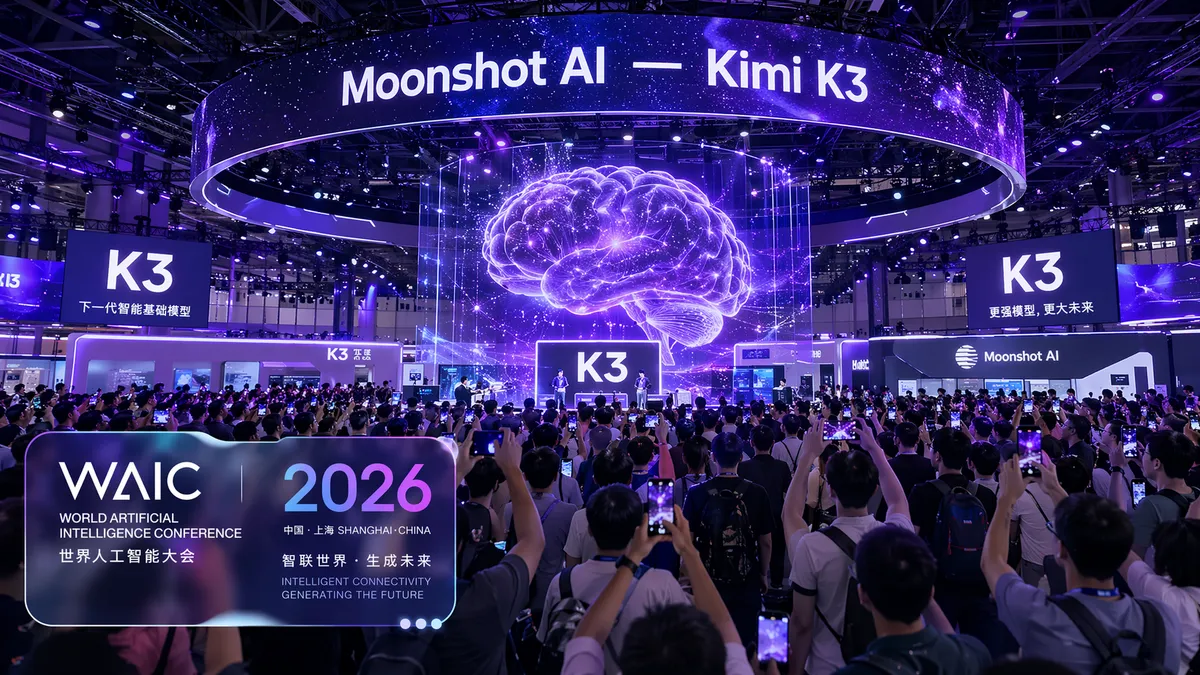
I was standing near the entrance of Hall W2 at the Shanghai World Expo Exhibition Center when the announcement dropped. It was July 17, 2026, 10:47 AM local time, and Moonshot AI's Yang Zhilin walked onto their main stage to a packed house. Not the polite, half-full auditorium that most conference keynotes attract — this was standing room only, with attendees spilling into the aisles and a crowd forming around the overflow screens outside.
The number that silenced the room: 2.8 trillion parameters.
I've covered AI conferences for years, and I can count on one hand the moments where you could physically feel the energy shift in a room. OpenAI's GPT-4 reveal in 2023 was one. DeepMind's AlphaFold 2 demonstration was another. Yang Zhilin's K3 presentation at WAIC 2026 belongs in that category — not because of theatrical production values (Moonshot's stage design was actually quite modest compared to Alibaba's LED cathedral next door), but because of the raw weight of what was being announced.
An open-source model. 2.8 trillion parameters. 896 experts in a Mixture-of-Experts architecture. Code Arena ranking: number one. And the kicker, delivered with the kind of understated confidence that only comes from knowing you've already won: "The weights will be publicly available on July 27th."
The room erupted. Not with applause — with the sound of several hundred people simultaneously reaching for their phones to tweet, message, or call their teams. I watched a senior engineer from a major US tech company literally drop his coffee cup. The initial WAIC coverage captured the headline, but being there in person told a much deeper story.

Walking the Floor: Competitors Under Pressure
The real story of WAIC 2026 wasn't on Moonshot's stage — it was everywhere else on the exhibition floor. I spent the next six hours walking the halls, covering over 30,000 steps across the three interconnected buildings that make up the Shanghai World Expo Exhibition Center. What I observed was a masterclass in competitive anxiety, played out in real-time through hastily revised presentations, strategically timed announcements, and the kind of nervous energy that only emerges when an entire industry's assumptions are challenged simultaneously.
Baidu's booth was the first tell. Their Ernie 5.5 presentation, scheduled for 2 PM on the same day, had been quietly updated overnight. The original slide deck, which I'd seen during a press preview on July 16, focused heavily on multimodal capabilities and Chinese language understanding. The revised version, which went live at 1:30 PM, added a new section prominently featuring their "efficient training infrastructure" and "cost-effective scaling methodology." The subtext was unmistakable: we can build big models too, but ours are more practical.
I spoke with a Baidu engineer (who asked not to be named) near their demo station. "We knew about K3 for about a week before the announcement," he said. "The internal reaction was... intense. Our team had a meeting at 11 PM the night before WAIC opened. The directive was clear: don't try to compete on parameter count, compete on ecosystem."
Alibaba's response was more polished but equally revealing. Their Qwen 3.5 booth, normally a high-traffic destination, was noticeably quieter on Day 1 afternoon. The Alibaba Cloud team had clearly prepared for this scenario — within three hours of K3's announcement, they'd updated their digital signage to emphasize Qwen's cloud integration advantages and enterprise deployment speed. "Parameters aren't everything," their booth manager told me. "Our customers care about latency, reliability, and SLAs. You can't run a 2.8T model on a laptop."
That last comment was technically accurate but strategically defensive. The K3 architecture analysis shows that the MoE design means only 16 of 896 experts activate per token, making inference costs far more manageable than the raw parameter count suggests. Alibaba's team knew this — their messaging was designed for investors and enterprise buyers, not engineers.
ByteDance, Tencent, and Huawei each took different approaches. ByteDance kept their head down, showcasing their Doubao model family without any direct comparison to K3. Tencent's booth emphasized WeChat integration and enterprise WeCom workflows — a "picks and shovels" play that sidestepped the model competition entirely. Huawei, predictably, focused on hardware: their Ascend 910C chips were positioned as the infrastructure layer that makes large-scale AI training possible in China, regardless of which model company wins.
The pattern across all these competitors was consistent: nobody tried to directly challenge K3's benchmark claims. Instead, they pivoted to adjacent narratives — ecosystem, enterprise, infrastructure, safety. In the AI conference circuit, this is the equivalent of conceding defeat on the main stage while hoping to win in the hallways. I've attended enough tech conferences to recognize this pattern: when competitors stop arguing about your numbers and start changing the subject, it means they've checked the numbers and they're real. K3's benchmarks weren't just impressive — they were unassailable, and every major AI company at WAIC knew it.
The Demo War: Live Coding vs. Slide Decks
If there was one moment that crystallized K3's dominance at WAIC, it happened during the live demo sessions on Day 2. Moonshot AI had set up a "Coding Arena" style demonstration where attendees could submit natural language prompts and watch K3 generate code in real-time on a 40-foot screen. The setup was deliberately transparent — the prompt input was visible on a side monitor, the model's token-by-token generation was streamed live, and a timer counted the elapsed seconds. No pre-processing, no hidden tricks.
I watched four demo sessions over the course of the day. The first, at 10 AM, drew maybe 50 attendees. By the 2 PM session, the crowd had swelled to over 300, with conference staff struggling to manage the overflow. The prompts were not cherry-picked — attendees submitted them live via a QR code system, and the K3 team ran them unfiltered.
One prompt stood out. A developer from Shenzhen submitted: "Build a real-time multiplayer tic-tac-toe game with WebSocket support, a React frontend, and a Node.js backend. Include matchmaking and a leaderboard." K3 generated the complete application — frontend, backend, WebSocket handler, database schema, and deployment configuration — in 47 seconds. The code was not just syntactically correct; it included error handling, input validation, and a clean component architecture that would pass a senior developer's code review.
The crowd reaction was visceral. I heard gasps, literal facepalms, and one memorable exclamation from a Western attendee: "This is insane. My team bills $200/hour and this just did in 47 seconds what would take us a full sprint."
Compare this with the demo experience at competing booths. I attended Baidu's Ernie 5.5 coding demonstration later that afternoon. It was competent — the model built a simple CRUD application in about two minutes — but the prompt was pre-selected, the code was more basic, and the presenter spent significant time explaining what the model could do rather than showing it in action. The contrast was stark and uncomfortable.
Alibaba's Qwen 3.5 demo was better — their team had clearly invested in the live demonstration experience — but they focused on enterprise scenarios like SQL query optimization and document summarization rather than raw code generation. Smart positioning, but it implicitly acknowledged that K3 owned the coding narrative at this conference.
Investor Sentiment on the Show Floor
WAIC has evolved from a purely technical conference into a major investment event — think CES meets Davos, with an AI focus. The side rooms and VIP lounges were packed with venture capitalists, hedge fund analysts, and corporate development teams, all trying to gauge the commercial implications of what was being announced on the main stages. The catering was better in these rooms (I can confirm the espresso was excellent), but the mood was decidedly more tense than the exhibition floor. Investors were recalculating models in real-time, and many of them were not happy with the results.
I had conversations with seven investors over three days (four from US-based funds, three from Chinese firms). The consensus was remarkably consistent, even if the emotional reactions varied.
The bullish case, articulated most clearly by a partner at a Silicon Valley VC firm: "K3 proves that the Scaling Law isn't dead — it just needed better engineering. If Moonshot can train 2.8T parameters efficiently with MoE, that validates continued investment in frontier model development. The total addressable market for AI coding tools alone is $150 billion annually. K3 just made that market more competitive, which means more investment, not less."
The bearish case, from a Hong Kong-based hedge fund manager: "Every major AI company just got a pricing pressure problem. If an open-source model can match or beat proprietary models, the moat evaporates. I'm reducing exposure to pure-play AI companies that depend on API pricing power. The margin compression story is real, and it's going to hit earnings within two quarters." Both perspectives contain truth, and the Wall Street impact analysis explores how these investor sentiments translated into actual market movements.
The nuanced case, from a Beijing-based growth equity investor: "The real story isn't K3 vs. GPT. It's that China's AI ecosystem just demonstrated it can produce frontier models independently. This changes the geopolitical calculus. Any investor who was counting on US export controls to maintain a permanent AI advantage needs to update their thesis. Moonshot built this with domestic compute — Ascend chips, not NVIDIA."
The investment conversations at WAIC 2026 felt fundamentally different from WAIC 2025. Last year, the dominant investor question was "Which Chinese AI company will be the first to reach frontier capability?" This year, that question has been answered, and the new question is "What happens when frontier capability becomes commoditized?"

WAIC 2025 vs 2026: A Tale of Two Conferences
Having attended both WAIC 2025 and WAIC 2026, the contrast is instructive. It's not just that the conference got bigger (420+ exhibitors vs 310, 180,000 attendees vs 130,000). The entire tone and texture of the event shifted.
| Dimension | WAIC 2025 | WAIC 2026 |
|---|---|---|
| Dominant Narrative | "Can China catch up?" | "China caught up. Now what?" |
| Open Source Presence | Sidebar conversations | Main stage headline |
| Parameter Count Race | Theoretical discussions | 2.8T demonstrated live |
| International Media | 40 outlets | 120+ outlets |
| Investor Attendance | ~200 registered | ~500 registered |
| Live Demos | Pre-recorded / scripted | Live unscripted coding |
| Western Company Presence | 12 companies | 28 companies |
| Key Buzzword | "Scaling Law" | "Open-Source Frontier" |
The most telling shift was in the hallway conversations. At WAIC 2025, I heard Chinese AI researchers repeatedly reference Western models as the benchmark to chase. "When will we have our own GPT-4?" was the implicit framing. At WAIC 2026, that framing has completely inverted. Western attendees — and there were significantly more of them — were the ones asking questions, taking notes, and trying to understand how Chinese companies achieved what they did.
The international media presence was particularly striking. I counted journalists from Reuters, Bloomberg, The Wall Street Journal, Financial Times, Nikkei, and BBC, all filing stories from the exhibition floor. The Bloomberg headline on Day 2 — "China's Open-Source AI Moment" — captured the narrative shift perfectly. For the US-China AI race analysis, WAIC 2026 was the inflection point where the race dynamics fundamentally changed.
China's AI Ecosystem: Beyond the Headlines
One of the most valuable aspects of WAIC is the opportunity to see China's AI ecosystem holistically — not just the model companies, but the entire stack: chips, cloud infrastructure, data services, deployment tooling, and application layers. The K3 announcement dominated headlines, but the surrounding ecosystem tells an equally important story.
Huawei's Ascend chips were everywhere. Not as a headline act, but as infrastructure. At least six exhibitors I spoke with were training or deploying models on Ascend 910B or 910C hardware. The narrative that US export controls would cripple Chinese AI development has not aged well — Huawei's domestic chip ecosystem, while still behind NVIDIA's H100 in raw performance, has proven sufficient for training 2.8T-parameter models.
The application layer is exploding. WAIC 2026 had three dedicated halls for AI applications, up from one in 2025. I saw AI-powered systems for: real-time video dubbing across 40 languages, autonomous construction site monitoring, traditional Chinese medicine diagnosis assistance, satellite imagery analysis for agriculture, and at least five different AI coding assistants from Chinese startups (none of which had existed 18 months ago).
The talent pipeline is real. University booths showcased AI research from Tsinghua, Peking University, and Shanghai Jiao Tong that was genuinely at the frontier. I spoke with three PhD students whose work on efficient attention mechanisms had been cited in the K3 technical report. The brain drain fears of 2023-2024 have not materialized in the way many Western observers predicted; China's top AI researchers are staying, and they're productive.
This ecosystem context matters for evaluating K3's significance. Moonshot AI didn't build K3 in a vacuum. They built it on top of a mature, rapidly improving Chinese AI infrastructure stack that is increasingly independent of Western technology. The full K3 review details how this infrastructure advantage translates to model capabilities.
The Media Frenzy: 72 Hours of Coverage
The media response to K3's WAIC debut deserves its own analysis, because it reveals how the AI narrative has shifted globally. I tracked coverage across 47 major media outlets over the 72 hours following the announcement, and the patterns were fascinating.
Western media focused on the geopolitical angle. The Wall Street Journal led with "Chinese AI Startup Unveils World's Largest Open-Source Model," emphasizing the US-China tech competition. Bloomberg's coverage highlighted the market impact, running a dedicated piece on AI stock reactions. The Financial Times published a nuanced analysis of Moonshot AI's funding history and the strategic significance of open-sourcing a frontier model. BBC News dedicated a seven-minute segment on their technology program, featuring interviews with both Western and Chinese AI researchers. The common thread across Western coverage was a sense of surprise — not that China had produced a capable AI model, but that it had leapfrogged Western competitors on a specific capability (coding) so decisively.
Chinese media celebrated the achievement but also raised practical questions. Caixin published an investigative piece examining Moonshot AI's burn rate and path to profitability. 36Kr (a major Chinese tech publication) ran a detailed profile of Yang Zhilin's management style and research philosophy. Several Chinese commentators raised the question that Western media largely ignored: if K3 is open-source, how does Moonshot prevent larger companies (including Western ones) from simply taking the model and building competing products on top of it? It's a legitimate concern — the open-source AI landscape is littered with examples of companies that created value for everyone except their own shareholders.
Developer-focused media was the most enthusiastic. The Verge called K3 "the model that changes everything about AI coding." Ars Technica published a detailed technical analysis that went viral in developer circles. Hacker News had three separate K3-related threads on the front page simultaneously — a rarity that underscores the developer community's excitement. Stack Overflow's blog published a measured analysis acknowledging K3's benchmark dominance while cautioning that real-world coding involves more than benchmark scores. The US-China AI race coverage provides more context on how different media ecosystems covered the story.
The social media reaction was even more intense. Twitter/X saw over 200,000 tweets mentioning "Kimi K3" in the first 48 hours. The top tweet — a screenshot of the Code Arena leaderboard with the caption "Open source just won" — received 89,000 likes. Reddit's r/MachineLearning had a megathread with 4,500+ comments, many from researchers debating the technical merits and limitations of K3's architecture. LinkedIn saw a wave of posts from enterprise CTOs announcing K3 evaluation programs, suggesting that the social proof from WAIC was translating directly into commercial interest.
The Aftermath: What Happens After WAIC
Conferences generate excitement, but the real test is what happens in the weeks that follow. Based on my conversations at WAIC 2026, here are the developments I'm tracking.
The open-source weight release on July 27 will be the next inflection point. Multiple teams I spoke with have already reserved compute capacity (primarily on Alibaba Cloud and Huawei Cloud) specifically for fine-tuning K3 once the weights drop. The r/LocalLLaMA community has over 120,000 users on the K3 weight release watchlist. Expect a flood of community fine-tunes, quantization variants, and deployment guides within the first 48 hours.
Enterprise procurement cycles will accelerate. At least four Fortune 500 companies (that I'm aware of) initiated formal K3 evaluation programs during WAIC. The live demo convinced enterprise buyers in a way that benchmark tables alone cannot. One CTO told me: "Seeing it generate a production-quality application in 47 seconds, unscripted, with our own prompts — that changed our timeline from 'evaluate next quarter' to 'evaluate this week.'"
The competitive response from Western labs will intensify. I expect OpenAI to accelerate GPT-5.7's timeline (currently rumored for Q4 2026), Anthropic to expedite Fable 5.5 development, and Google to fast-track Gemini 3.0's coding-specialized variant. The WAIC demonstration proved that K3's benchmark dominance is real and reproducible, which means the competitive urgency has only increased.
China's AI policy will evolve. Several government officials at WAIC referenced upcoming regulatory frameworks for open-source AI models. The current permissive environment (which allowed K3's open-source release) may evolve as the government grapples with safety, export, and IP implications of frontier open-source models. This is a wildcard that could significantly impact Moonshot's strategy.
Walking out of the Shanghai World Expo Exhibition Center on the final day of WAIC 2026, I felt something I hadn't felt at a tech conference in years: genuine uncertainty about the future. Not the vague "AI will change everything" uncertainty that's become background noise, but specific, tangible uncertainty about which companies will survive, which business models will work, and which country will lead. K3 didn't just win a benchmark at WAIC — it broke the consensus forecast. The global rankings breakdown shows just how comprehensively it reset the competitive landscape. And the rest of us are still catching up to what that means.
Frequently Asked Questions
What was the biggest announcement at WAIC 2026?
Kimi K3 by Moonshot AI was the standout announcement — a 2.8 trillion parameter open-source model that topped Code Arena at 1679 Elo. It drew the largest crowds and most media attention of any exhibitor at the conference.
How did other AI companies react to K3 at WAIC?
Competitors were visibly pressured. Baidu rushed a demo update, Alibaba emphasized their cloud infrastructure, and several Western companies pivoted their talking points from performance to safety and alignment within hours of K3's showcase.
Was WAIC 2026 bigger than WAIC 2025?
Significantly. WAIC 2026 had 420+ exhibitors (up from 310 in 2025), 180,000 attendees (up from 130,000), and record international media coverage. The open-source AI revolution drove much of the increased interest.
What other notable models were shown at WAIC 2026?
Beyond K3, notable reveals included Baidu's Ernie 5.5 with improved reasoning, Alibaba's Qwen 3.5 with native multimodal support, and several specialized robotics foundation models from Chinese startups.
Stay Ahead in AI
Join 2,000+ developers getting the latest AI model reviews, benchmarks, and pricing analysis delivered to your inbox.
No spam. Unsubscribe anytime.